
The story of this place
An urban fringe becomes an art landscape
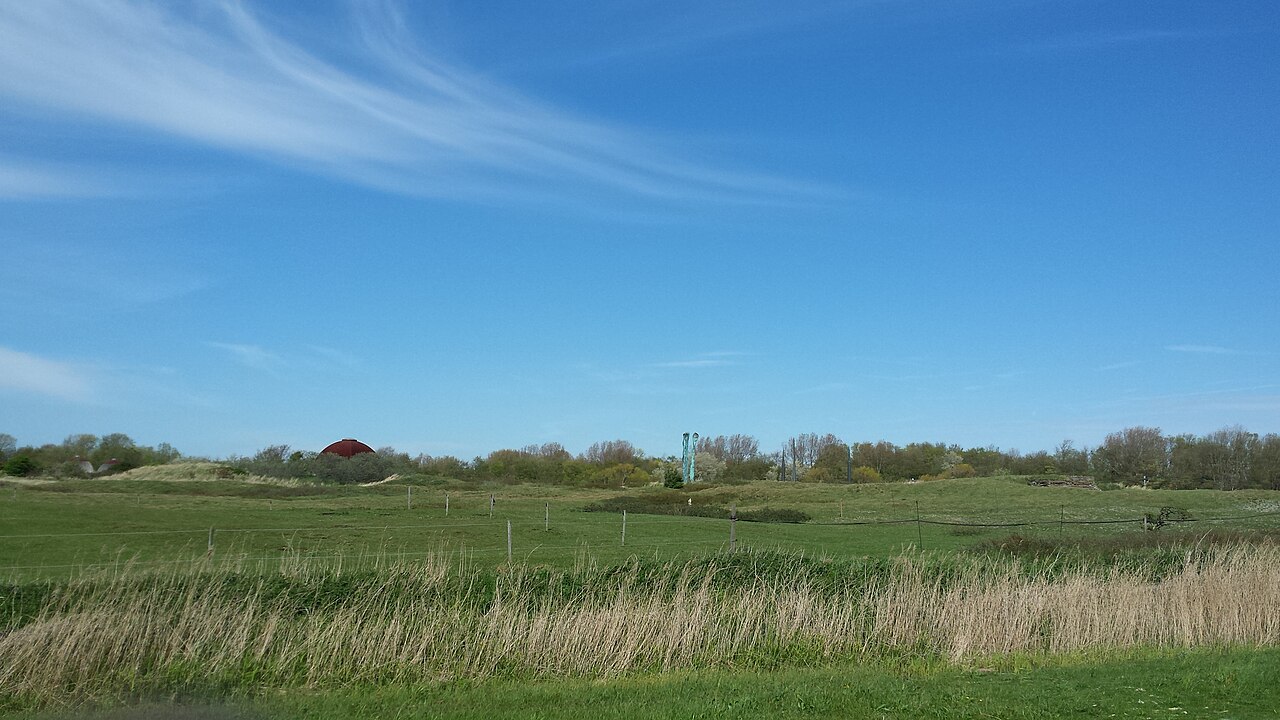
De Nollen lies on the edge of Den Helder, where railway, roads, housing and inland dunes meet. For a long time, the site had an undefined character. There were low dunes, water, rough vegetation, bunkers and storage spaces, but little suggested a coherent whole. It was neither a classic nature reserve, nor a recognisable monument, nor a designed park.
From 1980 onwards, artist R.W. van de Wint began working here. He did not simply place sculptures in the landscape, but made the landscape itself part of his art. Ground, water, bunkers, paths, differences in height and light were drawn into one slowly growing whole.
De Nollen therefore cannot be understood at a glance. Low dunes and grass form the first layer. Then rust-brown steel forms, painted spaces and bunkers half buried in the earth appear. The place does not work like a museum room filled with separate objects, but like a landscape in which every bend and change of viewpoint reveals something new.
Bunkers without a sealed-off past
The military remains are an important part of that landscape. The bunkers from the Second World War were neither removed nor presented separately as war monuments. Van de Wint incorporated them into his work. In some places they remain clearly recognisable as concrete defensive structures; elsewhere they become dark rooms, carriers of colour or heavy forms in the dunes.
Their meaning changes without erasing their past. The bunkers remain remnants of war, yet at the same time become part of a new art landscape. Concrete, sand, steel, paint, grass and water do not lie beside one another as separate layers, but interlock.
The inland dune landscape also shapes the way De Nollen is experienced. A nol is a low dune or sandy rise. Such small undulations guide sightlines and make artworks appear and disappear. The site is not a flat surface on which art has been placed. Moving through the landscape is part of the work.
Steel, colour and movement
Many forms are made from weathering steel. Under the influence of rain, wind, salt and time, the steel develops a reddish-brown skin. That colour fits sand, marram grass and weathered concrete. In bright sunlight the material can stand sharply against the sky, while on a grey day it almost seems to sink back into the ground.
Colour plays an equally important role. Van de Wint worked as a painter, sculptor and builder. Some interiors resemble paintings you can enter. Other works behave like walls, tunnels or signs in the landscape. The boundary between painting, sculpture and architecture dissolves.
De Nollen became Van de Wint’s life’s work. For years he continued building, painting and changing the site. It therefore never acquired a fixed or finished form. It still seems to move, as if wind, rust, vegetation and light continue the work.
A life’s work that kept growing
After his death in 2006, the site remained intact as a whole. Stichting De Nollen manages the area and makes guided visits possible. That way of visiting suits the nature of the place. Its meaning lies not only in separate works, but in the coherence of routes, spaces, sightlines and landscape.
The rough character of the old urban fringe has not disappeared completely. Vegetation remains unruly, paths run irregularly and concrete masses sometimes project unexpectedly from the sand. The place has been carefully shaped, but not smoothed out. That is precisely why the history of the terrain remains tangible.
A second life for a difficult place
The history of Den Helder also resonates in De Nollen. The city was shaped by sea, navy, war, railway lines, canals and reconstruction. In De Nollen, those elements return as wind, sand, concrete, steel and open space. The military past is not fixed here in a traditional monument, but transformed into a landscape.
Several phases in the life of the site therefore come together in De Nollen. It was dune ground, military terrain, neglected urban fringe, storage site, studio and workplace. It now forms an art landscape in which those older layers remain present.
The large steel works attract attention, but are no more important than the bunkers, water, low dunes and rough vegetation. Only in their mutual relationship does it become clear what Van de Wint created here: not a collection of sculptures, but a landscape in which war remains and art continue to influence one another.
De Nollen shows that a difficult place does not need to be tidied away in order to gain new meaning. The bunkers were not erased and the dune ground was not turned into a neat park. Its roughness remained and became part of the work.
That is why De Nollen is more than an art location. It is an old fringe landscape that gained a second life without losing its past. In rusting steel, grass against concrete, low dunes and open sky, war, neglect, art and recovery come together.