
Stil eropuit
The Netherlands Beneath Your Feet
Back to map

Vanished places

Castellum Flevum, the Lost Roman Fort near Velsen

At the beginning of the first century, a Roman harbour fort with ramparts, ditches, barracks, workshops, jetties and other harbour structures stood near Velsen. This fort, now known as Velsen 1, was built beside the Oer-IJ around AD 14–16 and is generally identified with the Castellum Flevum mentioned by Tacitus. It came under heavy attack during the Frisian revolt of AD 28 and was abandoned shortly afterwards. Around AD 39, the Romans constructed a much larger military camp nearby, known as Velsen 2. Roads, tunnels, industry and other modern interventions have completely transformed the ancient landscape. Both complexes survive only as archaeological remains below ground.

Vanished placesRomans & early frontiersRoman fortArchaeological landscape
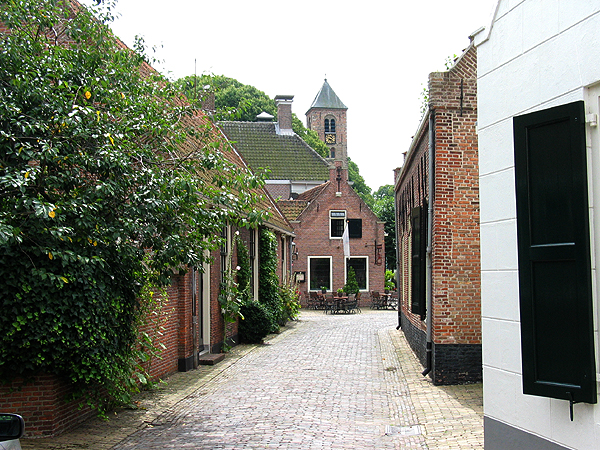
Village view in Velsen-Zuid, in the vicinity of the Roman archaeological sites
A village view in Velsen-Zuid, photographed in 2003. The underground remains of Velsen 1 and Velsen 2 lie in the wider surroundings. The photograph does not show the fort sites or a visible archaeological remain.Photo: Gerard Hogervorst, username Gmhogervorst on Dutch Wikipedia, via Wikimedia Commons, CC BY 1.0 NLChanges: No changes.

Why go here?

Two Roman military bases once stood at Velsen in a place that now gives almost no indication of antiquity. Velsen 1 contained not only defences and barracks, but also an unusually extensive harbour complex with jetties, revetments and probable shipsheds. Nearby, Velsen 2 later formed a military camp of at least eleven hectares capable of accommodating thousands of soldiers. The finds reveal soldiers, shipping, supply networks, contacts with the Frisians and a violent attack. Almost nothing can be recognised above ground. The contrast between the modern transport landscape and the extensive Roman remains beneath it makes the site remarkable.

What do you see?

Grassland, roads, recreational areas, waterways and the infrastructure of the Velser and Wijker tunnels now surround the former fort sites. Nothing from the ramparts, barracks, harbours or jetties is clearly visible at the surface. An information panel near the site of Velsen 1 explains the Roman presence. Part of the archaeological site is protected below ground. The remains lie across a landscape transformed since Roman times by the silting of the Oer-IJ, construction of the North Sea Canal, industry, roads and tunnel works.

Why it matters

The forts at Velsen show that the Roman presence in North Holland was larger and more ambitious than the image of an isolated frontier post suggests. The bases stood far north of the later permanent Rhine frontier and formed part of Roman attempts to control the coastal region and routes towards the north. The harbour at Velsen 1 ranks among the most exceptional early Roman harbour complexes in northwestern Europe. Velsen 2, covering at least eleven hectares, points to a military operation on a much larger scale. The attack of AD 28 also shows that the Frisian population was not a passive observer, but could resist Roman coercion by force.

The deeper story

At the beginning of the first century, the surroundings of Velsen looked entirely different. The North Sea Canal did not yet exist and neither did the present coastline, polders, roads and tunnels. The Oer-IJ flowed through Kennemerland as a broad waterway connecting the interior, Lake Flevo and the North Sea. Frisian communities lived on its fertile banks, keeping livestock and cultivating fields.

This waterway was strategically important to the Roman army. Ships could travel from the Rhine and Vecht river systems towards the Oer-IJ. Soldiers, supplies and equipment could be moved from this northern base to the coast and farther north. Around AD 14–16, the Romans therefore constructed a fortified harbour base on the southern bank.

This earliest complex is now known as Velsen 1. It was not a simple rectangular fort following a single standard plan. Its form was adapted to the shoreline and harbour. Defensive ramparts, ditches, timber gates, barracks, workshops and stores stood beside jetties, revetments and other facilities for ships. Water was not merely the boundary of the camp, but an essential part of its function.

The base was enlarged in several phases. The first enclosure covered about one hectare, after which the complex expanded to approximately two hectares. The harbour contained several jetties and probable shipsheds. Timber structures survived exceptionally well in the wet soil. Archaeologists could therefore study not only building plans, but also large numbers of wooden objects and structural elements.

Weapons, shoes, locks, keys, furniture components, tent pegs, tools and waste were recovered from the soil. Amphorae and other pottery indicate the import of wine, olive oil and fish sauce from distant parts of the Roman Empire. The military community at the Oer-IJ lived at the edge of Roman influence, but military supply networks connected it with Gaul, Italy, Spain and the eastern Mediterranean.

The name Castellum Flevum comes from an account by the Roman historian Tacitus. During the Frisian revolt, he described a fort called Flevum. Its location, date, harbour function and traces of violence make Velsen 1 the most likely candidate. No inscription recording the Roman name of the site has ever been found, however. The identification is therefore widely accepted but not directly proven.

Relations between Romans and Frisians were not initially marked by constant hostility. The Frisians paid tribute in cattle hides and trade, diplomatic contacts and military cooperation existed. According to Tacitus, the demands made by the Roman official Olennius became increasingly severe. When exceptionally large hides were demanded and livestock, land and eventually people were seized as security, revolt broke out in AD 28.

The harbour fort at Velsen came under heavy pressure. Archaeologists found hundreds of lead sling bullets, weapons and other traces of fighting. The distribution of the projectiles points to attacks from several directions. Frisian fighters reached parts of the defences and violent confrontations took place inside the camp.

One of the most striking discoveries is a human skeleton found in a well. A plaited cord lay around the neck. The individual is often interpreted as a Roman soldier, but his exact identity and cause of death have not been established with certainty. The body may have been thrown into the well during or after the attack. The suggestion that this was intended to contaminate the drinking water is plausible, but remains unproven.

Tacitus described how the garrison held out until the Frisians abandoned the assault. Archaeology confirms severe violence but cannot verify every element of his account. Velsen 1 was in any case abandoned shortly after the events. Buildings were dismantled or decayed and harbour structures slowly disappeared into the wet soil.

Roman military activity at the Oer-IJ was not yet over. Around AD 39, the army built a new base nearby. This site is known as Velsen 2. For a long time, it too was considered a relatively small castellum. New analysis of its ditches and defences showed, however, that it covered at least eleven hectares.

Velsen 2 was therefore not a fort for only several hundred auxiliary soldiers, but a castrum capable of housing parts of a legion and possibly other units. Its eastern side bordered the Oer-IJ and the full extent has not been established everywhere. The camp may consequently have been larger than the eleven hectares demonstrated so far.

Its construction is often associated with major Roman campaigns under Emperor Caligula and preparations for the invasion of Britain under Emperor Claudius in AD 43. Velsen may have functioned as an assembly point, harbour, transit site or supply base. Its scale clearly points to a major military operation, although the camp’s precise role remains under investigation.

Around AD 47, the Roman commander Corbulo was ordered to withdraw his forces behind the Rhine. The river increasingly became the northern frontier of the Roman Empire. Velsen 2 was abandoned. Timber buildings decayed, ditches filled and the Oer-IJ gradually silted up during the centuries that followed.

The military landscape disappeared beneath deposits and later human interventions. Waterways changed, peat and clay accumulated and the area acquired new forms of occupation and use. From the nineteenth century onward, the North Sea Canal, industry, railways, roads and tunnels transformed the surroundings once again.

The Roman remains reappeared step by step during the twentieth century. Roman pottery was found in a German anti-tank ditch during or shortly after the Second World War. Later work on tunnels, pipelines, roads and other infrastructure exposed more traces. Velsen 1 was excavated extensively from the 1970s onward. Velsen 2 was investigated in several campaigns.

Modern development formed both a threat and an opportunity. Parts of the sites disappeared during construction, but those same projects enabled large-scale archaeological research. Timber harbour structures, ditches, buildings and thousands of objects could be recorded before infrastructure transformed the ground further. Part of Velsen 1 remained protected below ground as an archaeological monument.

Almost nothing from either military complex can be recognised above the surface. The Oer-IJ no longer flows as a broad river past the former camps. Grassland, roads, water, recreational areas, buildings and tunnel infrastructure now shape the view. An information panel recalls the Roman presence, but the scale of the forts is difficult to imagine in the present landscape.

Beneath these modern surroundings lie traces of two different Roman ambitions. Velsen 1 was a fortified harbour complex supporting operations in the north. Velsen 2 was a much larger military camp connected with a major campaign. Both disappeared within several decades. What remains are ditches, timber, objects, soil traces and the quiet ground of a place where Romans and Frisians met, exchanged goods and fought.

Further reading