
The story of this place
From Oostenburg to the northern bank of the IJ
At the beginning of the twentieth century, Amsterdam’s shipbuilding industry moved towards the northern bank of the IJ. The older yards on the eastern side of the city no longer offered enough space for increasingly large steel ships. Amsterdam North provided wide sites, deep water and a direct connection to the North Sea Canal. This made it suitable for modern shipbuilding on a large scale.
The Nederlandsche Scheepsbouw Maatschappij had been founded at Oostenburg in 1894. The company expanded rapidly and became confined at that location. A new site was found across the IJ in 1915. From 1919 onward, an enormous shipbuilding hall, workshops, slipways and other facilities were constructed there.
Nearby, the Nederlandsche Dok Maatschappij concentrated on repair and maintenance. The two companies served different parts of the same maritime economy. One built new vessels, while the other dry-docked existing ships for repair or modification.
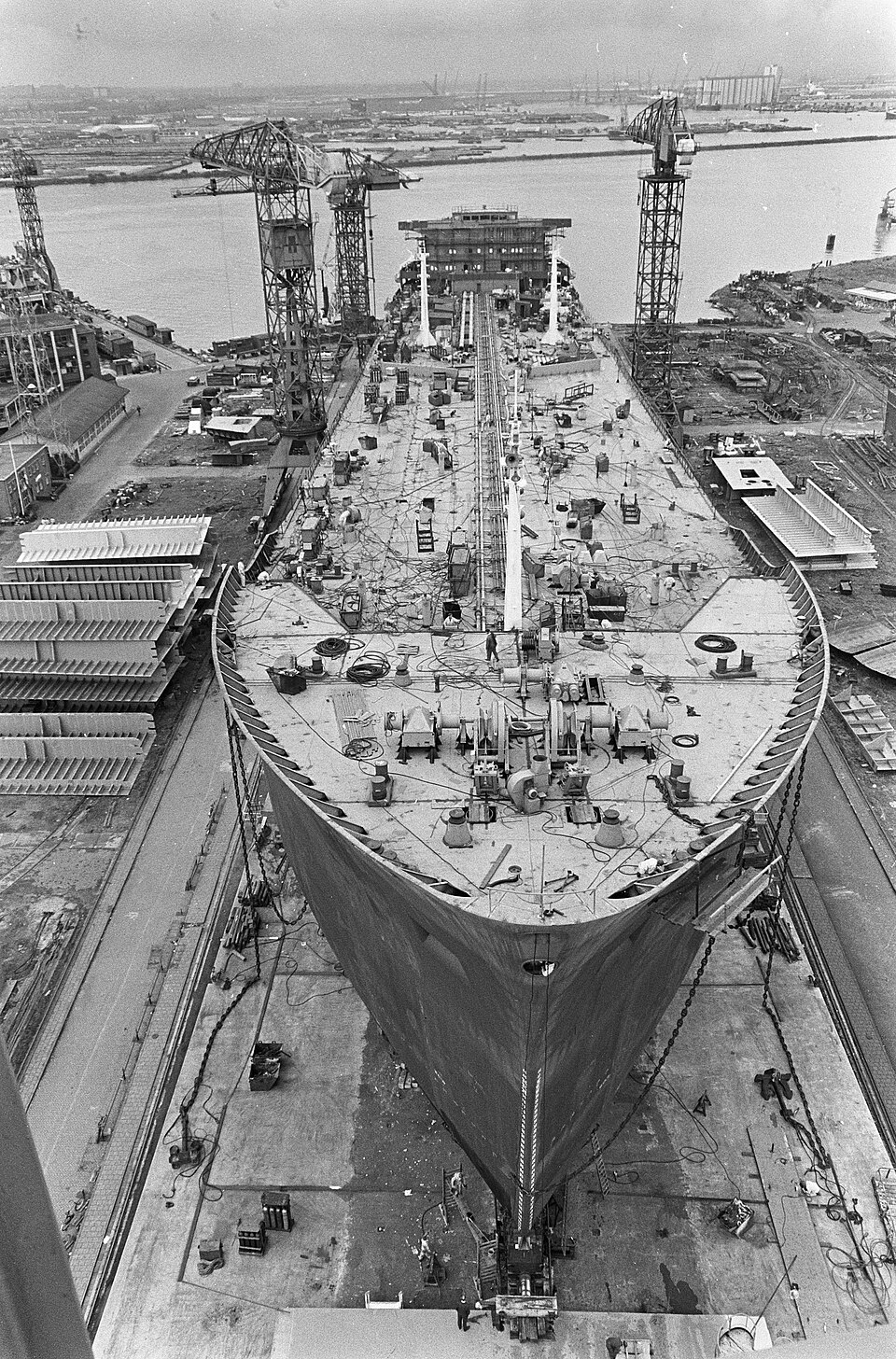
The new yard developed into an extensive industrial landscape. Steel plates arrived by ship or rail and were stored on open ground. Inside the halls they were measured, cut, heated, bent and then riveted or welded. Large sections were moved to the slipway, where a complete hull slowly took shape.
Craftsmanship, reconstruction and growth
Shipbuilding depended on collective labour. Draughtsmen produced designs, plate workers shaped the hull and welders joined the sections. Pipefitters installed the piping, while electricians, carpenters, painters and engineers completed the vessel. No single worker controlled the entire process, but the final result depended on cooperation between all trades.
The scale of the work determined the architecture. The shipbuilding hall had an almost undivided interior with heavy steel frames and crane tracks. High doors allowed large components to be moved. Entire hulls could be assembled on the slipways before entering the IJ.
During the German occupation, the yard was used for war production. Buildings and equipment were damaged and some installations were destroyed or removed near the end of the war. After 1945 there was a great demand for new ships. Wartime losses, ageing fleets and the recovery of international trade created a large flow of orders.
In 1946 the Nederlandsche Scheepsbouw Maatschappij and the Nederlandsche Dok Maatschappij merged to form the Nederlandsche Dok en Scheepsbouw Maatschappij. The abbreviation NDSM became the name by which the yard was known in Amsterdam and far beyond. New construction and repair were combined within one large company.
The 1950s and 1960s were the peak years. The yard built passenger ships, freighters, tankers, ferries and naval vessels. Dutch shipping companies, Shell, the Royal Netherlands Navy and foreign clients all placed orders there.
A ship under construction dominated the yard for weeks. The metal skeleton appeared first. Hull plates, decks, superstructures and equipment followed. Launching was the major public moment. Workers, managers, guests and relatives watched as the hull came free and slid into the IJ.
Hard work and a complete shipyard community
The work was heavy and dangerous. Steel plate was sharp and immensely heavy. Sparks, smoke, paint, oil and noise were part of the daily environment. Workers laboured on scaffolding, inside narrow tanks and beneath moving loads. Precision mattered, but so did trust between colleagues.
At its height, around six thousand people worked directly for NDSM. Subcontractors and temporary workers added many more. At every shift change large groups crossed the ferries, roads and gates. The yard shaped the rhythm of Amsterdam North and provided generations of families with an income.
NDSM was also a social world. The company had a medical service, staff associations, sports clubs, training and housing support. Employees met not only in the halls, but also in canteens, club buildings and residential neighbourhoods.
The yard attracted workers from Amsterdam, other parts of the Netherlands and later from abroad. When labour shortages developed in the 1960s, workers were recruited from countries including Turkey. Some lived temporarily at the Atatürk residential camp. The history of the yard therefore also became part of the migration history of Amsterdam North.
Competition, crisis and the end of the shipyard
International shipbuilding changed rapidly. Ships became larger and production methods more efficient. Yards in Japan and later other Asian countries could build at lower cost. Dutch companies struggled to secure enough orders, while large tankers required enormous investment.
The 1973 oil crisis intensified the difficulties. Demand for tankers fell and orders were postponed or cancelled. Mergers and government support could not solve the structural disadvantage. The site that had once been filled with steel, ships and workers became steadily quieter.
Large-scale shipbuilding ended in 1978. Repair work and parts of the company continued for a time under new arrangements, but the former shipyard community did not return. The remaining operations ended in 1984.
The closure affected more than individual workers. Skilled teams broke apart and knowledge built up through years of cooperation disappeared. Canteens, associations and medical services lost their purpose. Amsterdam North lost one of its most important economic and social centres.
An industrial skeleton with a new life
After the closure, enormous halls and empty grounds remained. The buildings were too large for ordinary companies and expensive to maintain. Weeds grew between rails and concrete. Roofs leaked and equipment disappeared. For a time, the former yard looked like an abandoned industrial area without a clear future.
From the 1990s onward, artists, builders and squatters moved into the site. The large spaces offered possibilities unavailable elsewhere in Amsterdam. They created studios, workshops, stages and temporary structures. The yard was not restored to its former purpose, but gradually adapted to new uses.
In 2007 parts of the historical buildings and infrastructure were designated as national monuments. These included the shipbuilding hall, workshops, slipways and crane. The protection recognised not only their architecture, but also NDSM’s importance as one of the leading shipyards in the Netherlands.
Today the site is surrounded by offices, cultural venues, restaurants, festivals and housing. The name NDSM is better known than in the years after closure, but for many people it now refers mainly to a creative urban district. The history of the thousands of workers therefore risks fading into the background.
The former purpose remains visible. Notice the height and width of the shipbuilding hall, the heavy steel structures, crane tracks and open slipways towards the IJ. None of these features was decorative. Every dimension followed from the need to build and move ship sections weighing dozens or hundreds of tonnes.
No ship hulls now stand on the slipways and the halls no longer echo with hammers, grinders and welding. Workers no longer stream through the gates at shift changes. What remains is an industrial skeleton in which new activities have grown. Among art, restaurants and new buildings, the old yard can still be read as the place where Amsterdam once built ocean-going ships on an enormous scale.