
The story of this place
Something moves in the Purmermeer
After the storm something lay in the water near Edam.
At first no one thought of a woman. After bad weather the Purmermeer could return all sorts of things. Weed. Branches. Dead fish. Wreckage. A piece of roof. A barrel knocked from a ship. The water was always carrying debris. But this moved differently.
The girls in the boat saw it among the reeds. Something green. Something pale. Hair that did not float like hair but like water plants. A shoulder. A face. Eyes that did not blink as human eyes blink. Beneath the body no skirt and no legs. A shining tail cut through the dark water.
They could have rowed away.
Perhaps they should have.
But whoever sees something that cannot exist keeps looking. First from fear. Then from curiosity. Then because it is too late to pretend nothing has been seen. The boat came closer. The creature did not withdraw far enough. The water around her was shallow and treacherously still. Behind the dyke the way back to the Zuiderzee was closed.
That is how the woman from the water came into human hands.
The woman from the water
In Edam the news must have travelled faster than a bell stroke. A sea woman had been found. Not a drowned woman. Not a fish. Not a devil showing its teeth at once. Something in between. The whole town came out to see. Children were lifted up. Women whispered behind their hands. Men stared too long and pretended they were not afraid.
She smelled of weed, salt and deep water.
They washed her. They washed the green from her skin. They gave her clothes. They brought food. It sounds gentle. Yet there was something hard beneath it. With every cloth and every hand she was pulled farther from the water. Not only her body lay on dry land. Her silence too was placed between walls.
The mermaid did not speak as people spoke. Perhaps she made sounds no one understood. Perhaps she only kept silent. Perhaps she looked at doors, windows, buckets and canals as if all that water was too small. A canal is not a sea. A tub is not a lake. A town is no world for something that comes from the depths.
Edam knew storms. Edam knew dykes that groaned. Lakes that rose. Land that grew wet where it should have stayed dry. But a woman from the water was different. She brought the sea with her without a wave running through the street. She brought the thought that the water was not empty. Beneath the surface lay not only mud, fish and cold. There could also be eyes looking back.
Then the men of Haarlem came.
Haarlem was larger. More certain of itself. A city accustomed to drawing things towards it. Trade. Power. Stories. Wonders. The mermaid did not remain in Edam. She was taken away. Perhaps the people of Edam watched from the quay. Perhaps it felt as if the water lost her for a second time. First to the dyke. Then to the city.
From Edam to Haarlem
In Haarlem she was taken farther from her origin. They taught her to spin. They taught her gestures that belonged to people. They drew a cross over her strange body. The wild smell of water had to disappear. Hands that once moved through weed and cold had to learn to hold thread. The creature from the lake had to fit inside a room.
But not everything can be tamed.
Even dressed, she still seemed to belong to the water. Even in silence, she still seemed to say something. Whoever saw her must have felt that a boundary had been crossed. Not the boundary between Edam and Haarlem. An older boundary. The one between what people can take and what they should have left alone.
In some tellings she dies as a human being. Not with one last leap towards the water. Not with a tail stroke in foam. But indoors. Far from the lake. That may be the darkest ending. Not that she was a monster. Not that she dragged anyone down. But that she was slowly made human enough to disappear.
The mermaid remains in stone
Yet in Edam she remained.
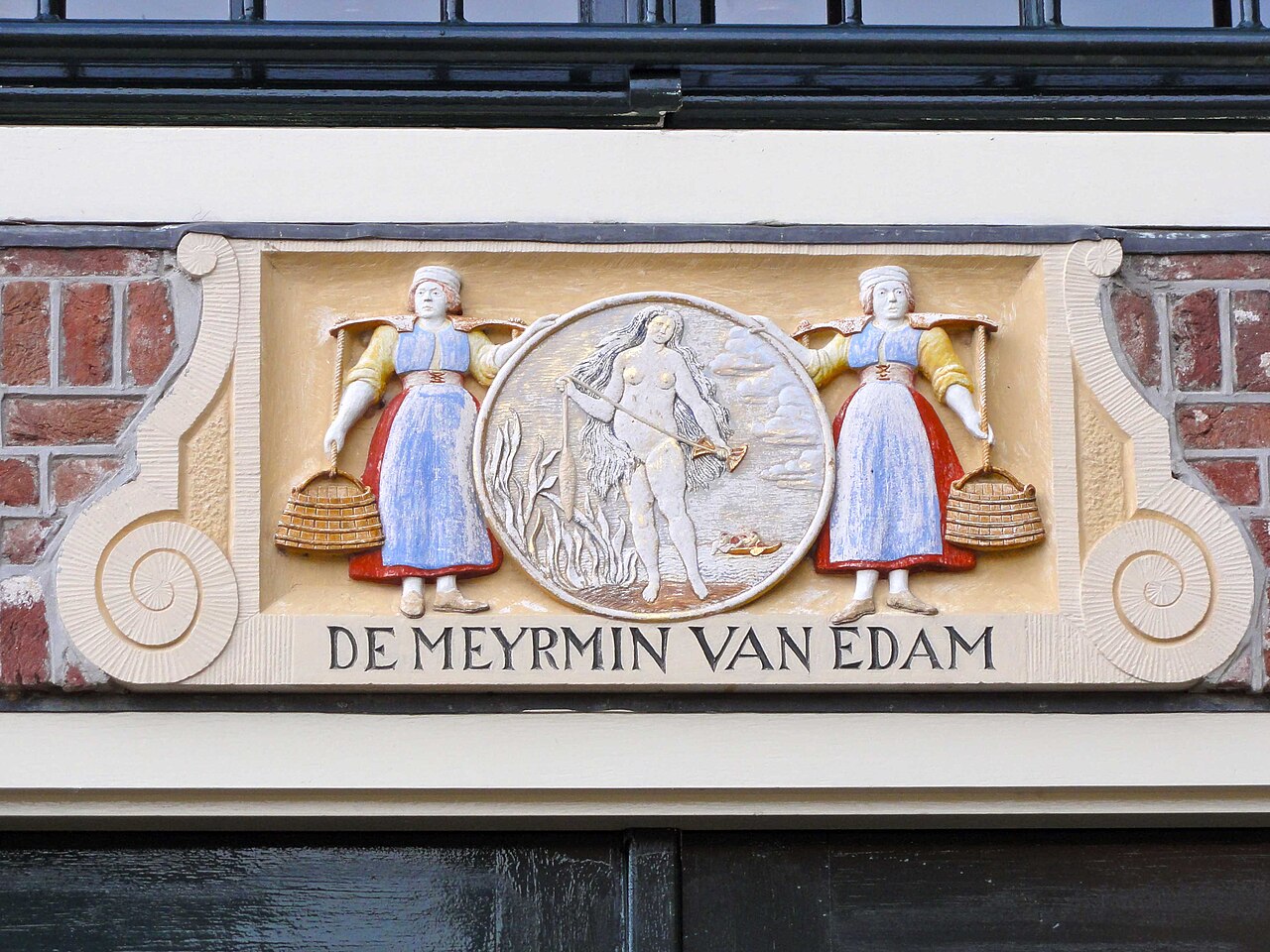
Not in flesh. Not in breath. In stone. On Jan Nieuwenhuizenplein her name still stands on a gable stone: De Meyrmin van Edam. There she is not wet and not wild. She is fixed in an image. Watched by passers-by. Absorbed into the town that once found her and lost her.
But stone remembers differently from people. A gable stone does not say everything aloud. It holds something. A name. A shape. An uneasy suspicion. Whoever looks at it sees no proof that a woman with a tail was truly carried through Edam. But proof is not what this story asks for. It asks whether still water can be trusted.
The vanished Purmerpoort once carried her image too. In old coats of arms and memories she returns. Sometimes spinning. Sometimes held by milkmaids. Sometimes tamed by hands that did not understand her. Again and again the same strange movement. The water gives her. People take her. Images hold her fast.
Beneath all those layers the first moment remains.
A boat on dark water. Girls ceasing to row. Reeds tapping against the bow. Something pale rising halfway above the surface. No song. No call. Only looking. As if the creature herself does not understand why the water does not take her back.
The Purmermeer has vanished from the landscape as it once was. Drained. Divided. Renamed. Fixed on maps. The old unease of that water now lies beneath roads, houses and land. Edam stands more firmly than before. The dykes follow different lines now. The sea is farther away.
Still the story cannot be drained.
When evening settles over the canals, Edam sounds like any other town. Voices. Footsteps. A bicycle. A door somewhere. By the gable stone, the mermaid remains motionless. But beneath that ordinary sound lies something else. An old lapping. A wet silence.
For a moment she still seems to be looking.
Not angry. Not pleading. Only strangely silent. A woman from the water. Washed. Clothed. Taken away. Remembered. But never entirely returned.