
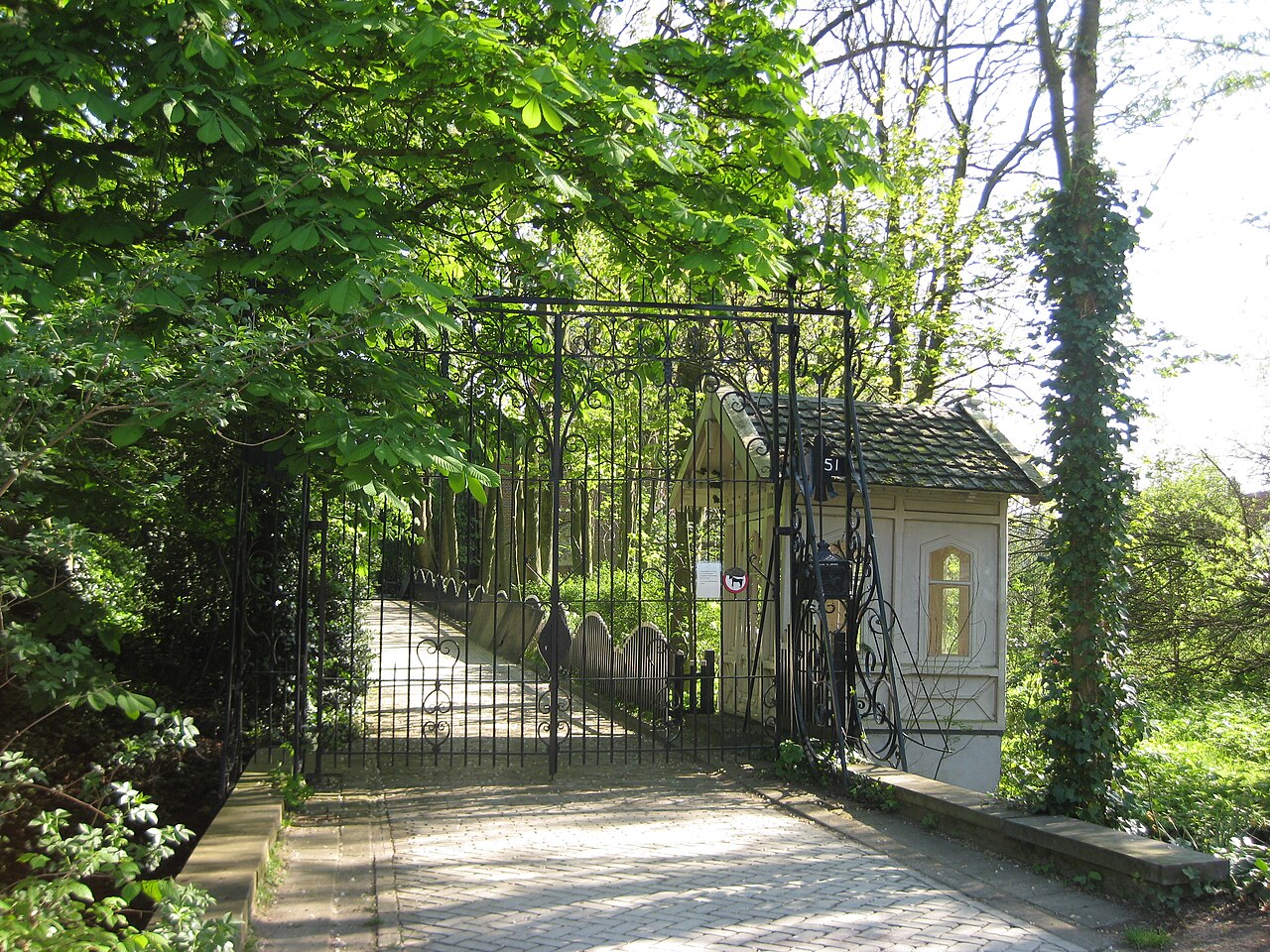
The story of this place
A name along the old Schinkel route
Huis te Vraag lies on the Rijnsburgstraat in Amsterdam-Zuid, close to the Schinkel. Behind its gate is an enclosed world of gravestones, narrow paths, hedges, ivy and tall trees. The history of the site, however, began long before a cemetery was established here. Its name leads back to an old route between Haarlem and Amsterdam and to a time when the landscape around the Schinkel was still wet, open and rural.
A road between Haarlem and Amsterdam existed before 1400. It was not a straight traffic route, but a track through peatland with ditches, side paths, farms and small settlements. At the Schinkel, travellers had to cross the water. A ferry house or inn could provide transport, food, shelter and directions for the rest of their journey.
According to tradition, a sign bearing the words ‘te vraghe’ hung at the house, indicating that information was available there. The name may therefore have originated from a simple practical function. Travellers could ask for directions before continuing towards Amsterdam or Haarlem. The story later became associated with Maximilian of Austria, who was said to have asked for the correct route here during a journey in 1486. There is no conclusive evidence for this event, but it became an important part of the tradition surrounding the name.
From inn to country house
Around 1618, an Amsterdam cloth manufacturer had a substantial country house built on the site. He named it ’t Huys te Vraag. The old name thus moved from an inn or ferry house to a country estate. By then, the Schinkel had become a busy waterway and a small group of farms, a mill and a shipyard developed around the house. Huis te Vraag became a familiar landmark and was used in property deeds to describe the location of land and buildings.
Its owners were often connected with the cloth trade and cotton dyeing. The house was therefore part not only of a landscape of country retreats, but also of an environment where transport, craft and commerce came together. Goods and passengers travelled along the Schinkel between Amsterdam, the Nieuwe Meer and the surrounding countryside.
During the nineteenth century, this world lost its economic foundation. The textile industry changed and maintaining the country house became too expensive. Its final owner, Mr Poort, had Huis te Vraag demolished in 1890. The building disappeared, but the name remained attached to the plot.
A cemetery above a vanished house
A year later, Pieter Oosterhuis received permission from the municipality of Sloten to establish a private Protestant cemetery on the grounds. He did not envisage a simple field of graves, but a designed burial ground with a chapel, reception room, caretaker’s house and carefully planned planting of trees and shrubs.
The ground required substantial alteration. Much of the surrounding land consisted of low peat and was unsuitable for burial. The Huis te Vraag plot was slightly higher. Rubble from the demolished country house was spread across the surface to provide an initial foundation. Around 50,000 cubic metres of sand were then transported by ship from Muiderberg. The vanished house thus came to lie literally beneath the new cemetery.
The cemetery opened in 1891. Burials continued well into the twentieth century, with the last taking place in 1962. The grounds then lost their active function. Gravestones subsided, vegetation spread and the original design became less clearly defined.
A garden that slowly grew wild
From 1987 onward, visual artist and gardener Leon van der Heijden cared for the grounds. Paths were made accessible again and hedges were maintained without entirely removing the overgrown atmosphere. This created the present character: neither a tightly restored cemetery nor a completely overgrown ruin. Gravestones, trees, ivy and old buildings continue to exist side by side.
Several former worlds meet on the same ground. The ferry house and inn disappeared, as did the country house, the surrounding activity and part of the old landscape beside the Schinkel. The cemetery survived, but closed to new burials. What remains is a green enclave in which changes to the surrounding city have not erased everything.
What survived here
The name Huis te Vraag links all these periods. What may have begun as a place where travellers asked for directions became first the name of a country house and later that of a cemetery. Behind the gate on the Rijnsburgstraat, gravestones and a living garden now lie above the remains of a vanished house. The site is therefore not a single remnant, but a layering of old route, name, country estate, demolition rubble, cemetery and urban nature.