
The story of this place
A farming village and vulnerable property
Sint-Cunerakerk stands on Dorpsstraat in Nibbixwoud. The present building dates from the nineteenth century, but Cunera’s name refers to a much older village devotion centred on livestock, disease and protection. Nibbixwoud lies in the agricultural landscape of West Friesland, within the municipality of Medemblik in North Holland. For centuries, cows and horses formed an important part of daily life. They provided food, manure, pulling power and income. Disease in the stable could therefore affect an entire household or farm.
In this world, Cunera gained meaning. From the thirteenth or fourteenth century onwards, she was venerated in Nibbixwoud as a patron saint of livestock. The church bore her name and her feast day on 12 June became the centre of a local devotion. The veneration made an abstract faith practical. Those who prayed for the protection of their animals were also praying for food, income, work and the future of their household.
A cow was not simply an animal in a field. It represented milk, butter, cheese and an important share of household income. Horses provided power for transport and farm work. Disease, a difficult birth or sudden loss could destroy months of labour at once. Cunera’s protection therefore touched the village’s most immediate concerns.
The livestock blessing of 12 June
Historical accounts state that livestock was gathered by the church around her feast day. Priests blessed the animals and offered prayers for health and protection. Cows and horses were brought together and blessed by the church. The farm itself thus became part of the celebration.
According to local tradition, the feast day also included a procession in which an image of Cunera was carried through the village. Her protection did not remain within the church walls, but moved symbolically past houses, farmyards and fields. The precise route is no longer known.
On 12 June, faith and farming life therefore came together quite literally around the church. The presence of livestock made visible how closely religion, labour and landscape were connected.
According to legend, Cunera belonged to the company of Ursula and her virgins. She escaped the violence and reached Rhenen, where she was later said to have been strangled out of jealousy. She was therefore invoked against diseases of the throat. She also became associated with the protection of animals, especially horses and other livestock. That role suited an agricultural village such as Nibbixwoud particularly well.
Exactly how her veneration reached Nibbixwoud is not known with certainty. Cunera nevertheless acquired a permanent place in local religious life. The pilgrimage and veneration continued at least until about the middle of the seventeenth century.
From Reformation to a new church
The Reformation made public Catholic rituals more difficult. Processions disappeared from the streets, but Cunera’s memory did not vanish immediately. The veneration of relics and the blessing of livestock continued locally into the nineteenth and twentieth centuries. The medieval cult therefore did not disappear in a single moment, but left a long local memory that repeatedly took a different form.
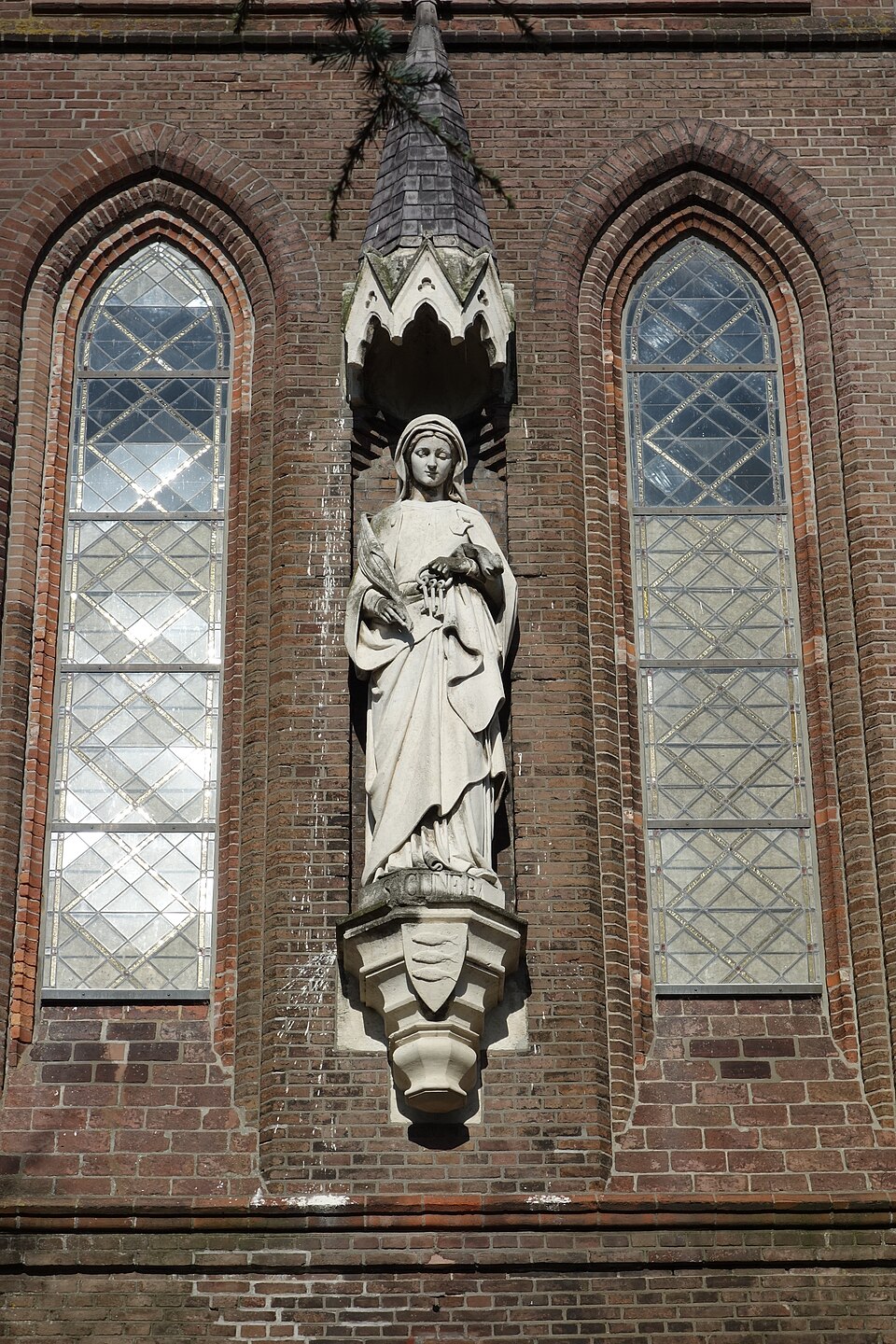
The present Sint-Cunerakerk was built under the direction of architect A.C. Bleijs and completed in 1877. It belongs to the period in which Catholics were once again permitted to build recognisable churches. The building is not a medieval remnant, but it carries the old name forward. A statue of Cunera recalls a time when she was not merely depicted, but actively invoked to protect animals and farms.
In 2002, a fire destroyed large parts of the roof and vaults. The village then committed itself to the restoration. This once again showed that the church is not only a monument, but also a place sustained by its community.
A vanished ritual in the landscape
The heart of the story remains the vanished livestock blessing. Animals were gathered around the church and prayers were offered for health and protection. Religion was directly connected with farming life. When visiting Sint-Cunerakerk, look beyond what you see in the street today. Think of June, of livestock around the church grounds and of farmers hoping to keep their animals healthy.
The procession has disappeared and the old route is not marked. Cunera’s name nevertheless still preserves the memory of a village that placed its most vulnerable possession under the protection of a saint.