
The story of this place
An old peat island between deep polders
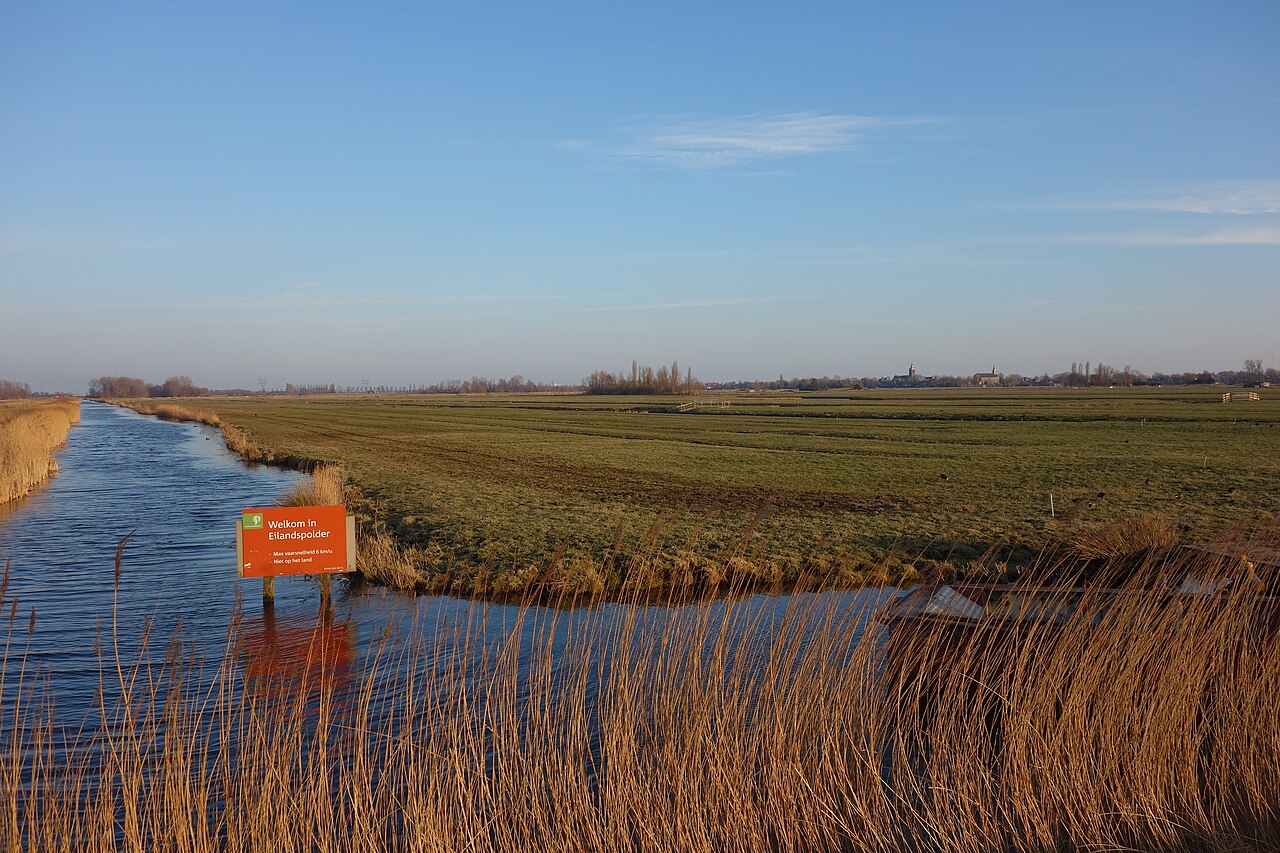
The Eilandspolder lies between the deep reclaimed polders of the Schermer and Beemster. From the low dykes, the area appears almost level, but the old peat island stands higher than the polders surrounding it. Narrow grasslands, ditches, reed fringes and small pools continue towards the horizon. Its name recalls the period when the Schermereiland lay between large lakes and open water.
Peat forms the foundation of the landscape. For centuries, plants grew under waterlogged conditions and their dead remains accumulated into increasingly thick layers. From the Middle Ages onwards, inhabitants dug ditches to remove water. This created long narrow fields used for grazing and haymaking. The pattern of this reclamation remains clearly visible.
Drainage made farming possible but also caused subsidence. When peat dries, it compacts and decomposes through contact with air. The land therefore sank lower and required continuous pumping. Windmills, sluices and later pumping stations kept water levels manageable. The Eilandspolder did not become dry land, but an artificially maintained balance between conditions that were too wet and too dry.
Meadow birds and winter visitors
This wet character is important for meadow birds. Black-tailed godwits, lapwings and oystercatchers return to the open grasslands in spring. They need damp, herb-rich fields where worms and insects remain accessible. Tranquillity, late mowing and sufficiently high water levels are especially important for their chicks.
The birdlife changes after summer. European golden plovers and other migrants use the grasslands as resting places. In winter, thousands of wigeons may gather on pools, broad ditches and wet meadows. Teals, coots and geese join them. The open landscape is anything but quiet, filled with calling birds and flocks taking flight.
Where water slowly becomes peat again
Pools, broad waterways and old peat cuttings lie between the grasslands. Along sheltered banks, open water slowly begins to fill with vegetation. Floating root mats and aquatic plants appear first, followed by reeds, sedges, ferns and peat mosses. Infilling vegetation develops in this way: new ground that may still be soft, floating and mobile.
Sphagnum reedbed is one of the most vulnerable stages of this development. Peat moss retains rainwater and creates acidic, nutrient-poor conditions. Ferns, orchids, sedges and unusual mosses can grow here, although they have little chance in ordinary grassland. Without management, the open reed bed gradually develops into scrub and woodland.
Reeds and rough vegetation are therefore cut and removed, while young trees and shrubs are cleared. Nutrient-rich soil is removed in selected places. This is necessary because nitrogen and nutrient-rich water favour fast-growing plants. When brambles, shrubs and tall reeds begin to dominate, the low and slow-growing species of quaking bog and sphagnum reedbed disappear.
The ditches themselves form an extensive habitat. European bitterlings and weatherfish live in quiet, plant-rich waterways. Bitterlings depend on large freshwater mussels in which their eggs are laid. Clear water, sufficient aquatic vegetation and careful ditch maintenance are therefore as important as grassland management.
The root vole also benefits from the wet island landscape. It lives hidden in reed beds, rough banks and damp grasslands. Water often excludes competing vole species more effectively. When reed strips dry out or islands become connected to dry land, the root vole loses this advantage.
A landscape that must live with water
Farming and nature management are closely connected in the Eilandspolder. Mowing and grazing keep the landscape open, while meadow birds also require tranquillity and delayed mowing. Some soft fields can be reached only by boat and heavy machinery can barely be used. Traditional land use therefore still matches ecological needs in parts of the area.
The old field pattern can be seen from roads and dykes around Noordeinde, Grootschermer, Schermerhorn and De Rijp. Its structure becomes fully apparent from the water. A canoe or small boat moves between reed fringes, low bridges and elongated fields. Farms and church towers remain visible above the flat land.
The future of the area revolves around water. Higher levels slow peat decomposition and subsidence but may make farming more difficult. Lower levels make the land easier to work but accelerate drying and oxidation. Nutrient-rich water and nitrogen also place vulnerable vegetation under pressure. Management therefore requires a continuous search for a workable balance.
The Eilandspolder is neither untouched nature nor an ordinary agricultural polder. Its ditches were dug, its fields shaped and its water levels artificially controlled. Yet centuries of living with water created a landscape in which meadow birds, waterbirds, fish, peat mosses and small mammals can coexist.
Every ditch, reed edge and narrow strip of grass forms part of the same system. A black-tailed godwit calls above the fields, a sedge warbler sings from the reeds and a weatherfish moves beneath the water. The old peat island remains alive because land and water are never completely separated.
What can you see when?
The months below show when a sighting is most likely. Wildlife remains unpredictable.
Black-tailed godwit
Black-tailed godwits return to the wet grasslands from March. Their calls, display flights and alarmed parents are most noticeable above the fields in April and May.
Northern lapwing
In spring, lapwings perform tumbling display flights above the open grasslands. Later in the year, larger flocks may gather on short grass.
Eurasian wigeon
Large flocks of Eurasian wigeons rest on pools and broad ditches in winter. Towards evening, they whistle as they move onto wet grasslands to graze.
Eurasian teal
Eurasian teals favour sheltered shallow pools and quiet ditch margins. When disturbed, the small ducks often rise as a compact flock.
Eurasian spoonbill
Spoonbills sweep their bills from side to side through shallow ditches and pools in search of small fish, insects and other aquatic animals.
Sedge warbler
Along reed fringes and wet rough vegetation, the busy song of the sedge warbler is often heard before the bird is seen in spring and early summer.
Eurasian bittern
The Eurasian bittern usually remains hidden in broad reed beds. In spring, its low booming display call may carry across the landscape.
Root vole
All yearThe root vole lives hidden in wet reed beds, rough banks and damp grasslands. Direct sightings are rare, but the water-rich island landscape provides important habitat.
Sphagnum reedbed
In old succession zones, reeds and peat moss grow together on floating vegetation mats. The differences between reeds, sedges, ferns and low marsh plants are most visible in spring and summer.

Marsh ferns and orchids
Ferns and orchids may grow among sedges and mosses in nutrient-poor quaking bogs and sphagnum reedbeds. They are vulnerable and generally visible only from paths or during excursions.