
The story of this place
Beneath the Seven Pancakes
On the Hoge Berg of Texel lies a small wood that looks almost friendly by day.
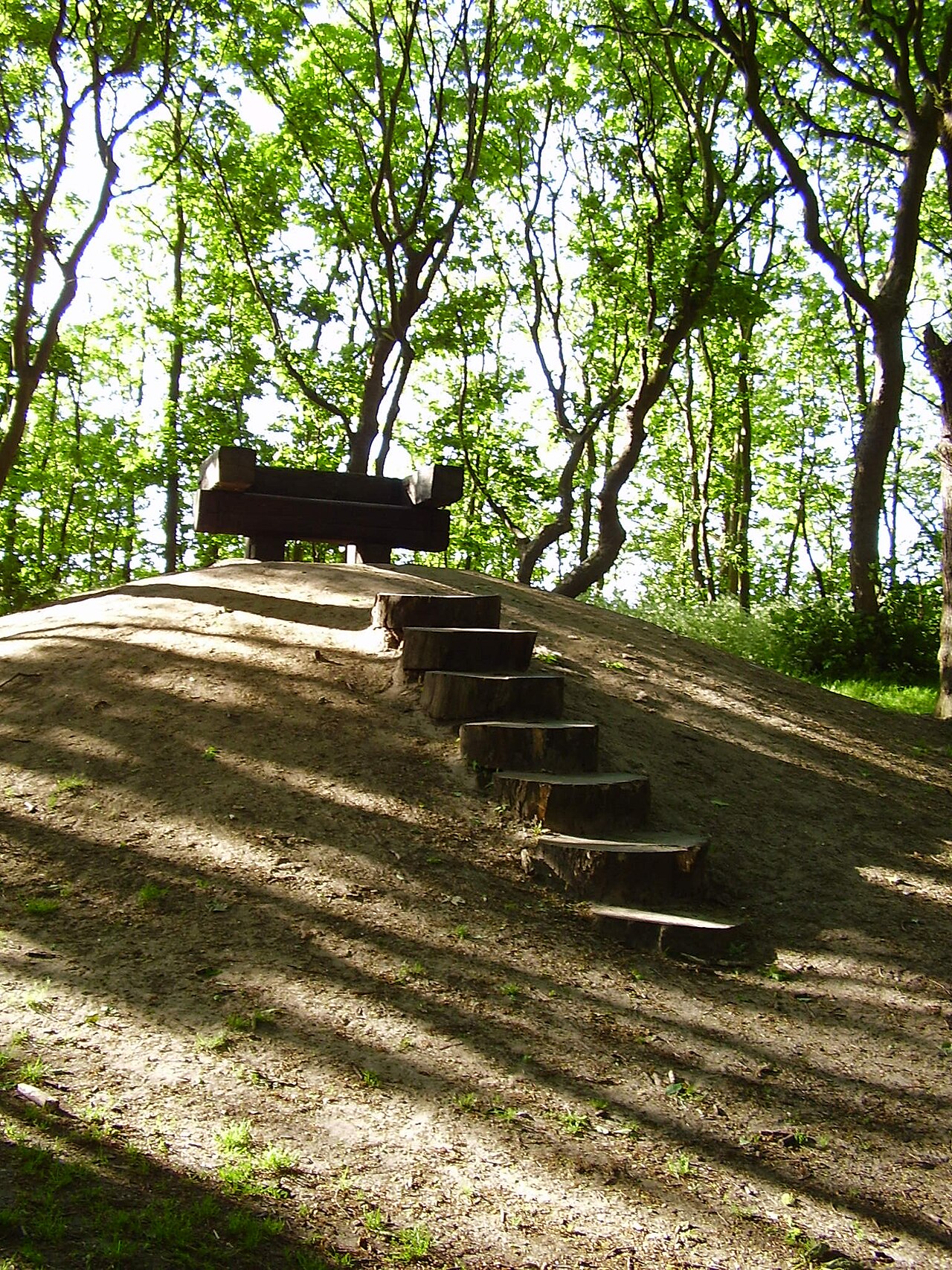
Trees. Shade. Steps. A bench. The open island landscape around it. Wind over the height. Birds in the branches. Nothing seems threatening. But the names make the place less peaceful. Doolhof. Seven Pancakes. Engelsteen. English Stone. And when the story grows darker: Devil’s Stone.
Those names do not lie neatly beside one another. They slide over each other. As if no one was ever entirely sure what lay beneath the ground here. An innocent name over a strange one. A playful name over an older fear. Seven Pancakes sounds almost cheerful. Yet beneath that mound something was said to lie that was not cheerful at all.
Standing there today you see no colossal boulder jutting from the earth. No black rock. No altar. No stone marked by claws or fire. That is exactly what makes the place uneasy. The stone does not show itself. It lies beneath your feet. Beneath the steps. Beneath the green. Beneath the quiet walking place.
A stone without end
Down there according to the tale lay a boulder without end.
What once rose above the ground was only the head. The rest went downward. Farther than anyone could dig. Deeper than an ordinary stone should go. Beneath Texel. Beneath the sea. All the way to England. A body of stone that ignored water, distance and maps. As if the island was still fixed deep in the earth to another land.
People wanted to know how deep it went.
They dug. Around the stone. Along the stone. Farther and farther down. Surely there had to be an end. Everything has a limit. A tree has roots. A house has foundations. A stone has a base. But as long as that base was not found the boulder grew larger. Perhaps not in the earth. But in the mind of everyone who heard the tale.
From Engelsteen to Devil’s Stone
A stone without end does not remain just a stone.
It gains something stubborn. Something contrary. Something that refuses to be understood. First it is called Engelsteen. As if something light still clings to it. Then English Stone. Because imagination lets it run beneath the sea to England. But with such depth shadow comes naturally. A stone that does not yield, does not seem movable and still returns in names draws darker words towards it.
Devil’s Stone.
Not because the devil was neatly caught there. Not because one single tale tells how he stood with hooves on the Hoge Berg and drove the boulder into the ground. But because people seek a name for such stones that fits their unease. A stone that goes too deep, feels too old and refuses to end does not quite belong to people.
Around the Seven Pancakes the hidden stone grew stranger still. The mound gained layers, steps and a form one could climb. As if the place had been smoothed over. Covered. Made suitable for walkers. But covering is not the same as making something disappear. Sometimes a layer of earth only strengthens a story. What is visible can be pointed at. What is hidden keeps growing.
Later, the stone was also presented as a sacrificial stone.
A pagan stone on a high place. A hard place in an old island landscape. Views over land and sea. Wind that nothing stops. You do not need to know it for certain to understand why such a thought remains. Great stones attract old words. Sacrifice. Angel. Devil. England. Depth. Each word tries to make the boulder smaller. No word ever fully holds it.
The Hoge Berg adds to the effect.
This is no ordinary piece of Texel. The height feels older than the roads, older than the farms and older than the neat paths. Turf walls draw lines through the land. Sheep barns stand low and dark in the fields. Drinking ponds lie like eyes in the grass. Beneath everything sits an Ice Age landscape. Heavy ground shaped by ice rather than people. Walking there makes it easier to feel that the earth is keeping something.
What rests down there?
In the eighteenth century the place around the summit was made neater. A pleasure ground. Walking paths. Sightlines. A small maze. People made it into a place for strolling, looking and sitting. The wild boulder received a civilised setting. But some stories care little for hedges and benches. Beneath the arranged greenery the same question remained.
What rests down there?
Perhaps it was simply a large erratic boulder. Left behind by ice and time. Finite, heavy and old. Not bottomless. Perhaps later investigations removed the connection with England from the tale. Yet that does not empty the place. The real stone could end. The stone of the story could not.
That stone of the story still lies there.
Not visible. Not measurable from the path. Yet present as soon as you look at the ground and imagine that beneath the mound something begins that does not stop. The earth becomes thinner then. The wood quieter. The name Seven Pancakes less cheerful. The Doolhof less innocent.
For a maze need not always be made of hedges. Sometimes it is a tangle of names. Engelsteen. English Stone. Devil’s Stone. Each name points in another direction. All return to the same place. A hidden boulder beneath the Hoge Berg. Too large for what people wanted to know.
By day you hear birds. Wind in the leaves. Perhaps voices of walkers. Someone sits on the bench. A child runs up the steps. Texel lies open and bright around you. But stand still at the Seven Pancakes for a moment. Do not look at the view. Look down.
That is where the story begins.
Beneath earth, roots and silence. Beneath a mound that seems smaller than what it hides. There lies not only a stone. There lies the idea of a stone without end. Half angel. Half devil. Fixed in the old soil of Texel. As if it still refuses to say how deep it truly goes.