
The story of this place
Nature on reclaimed ground
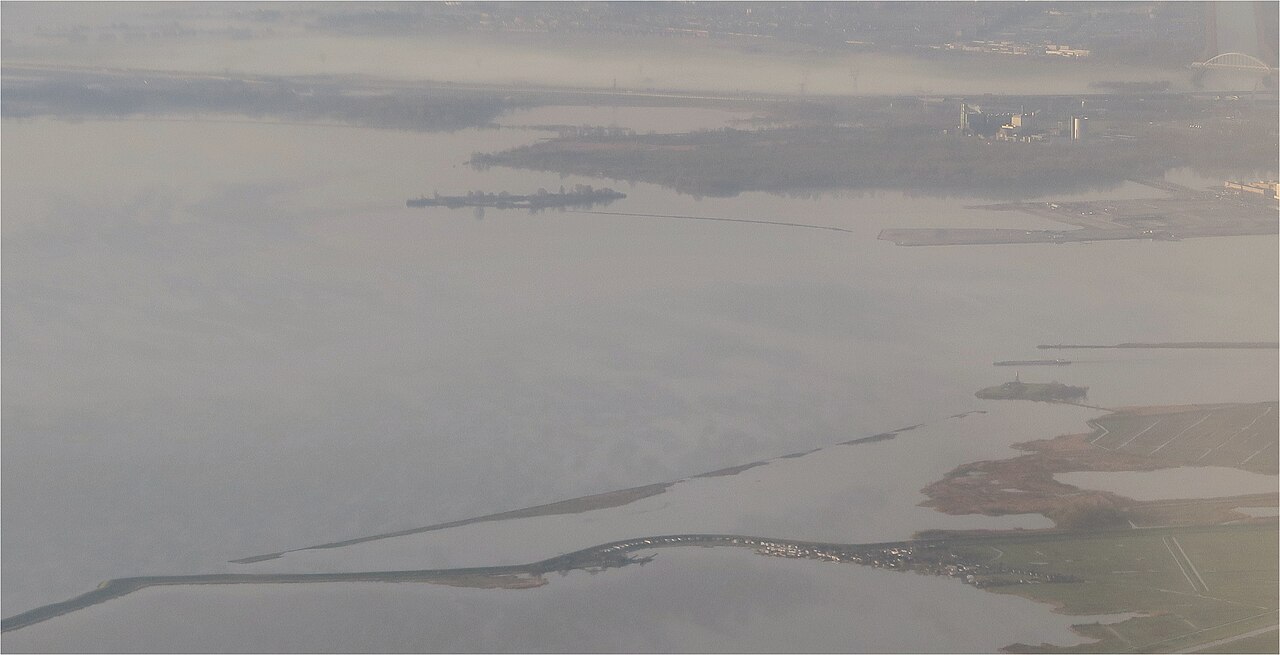
De Vijfhoek lies on the north-eastern side of Diemen, between the Diemerzeedijk, the IJmeer and the Over-Diemen power station. The area is also known as the Diemer Vijfhoek and PEN-eiland. Walking among reeds and willows, it is difficult to see that almost all the ground was deposited only around 1970. The dense woodland and wet soil suggest an older marsh, but beneath the roots lies dredged material from major engineering works.
The construction of the power station and the widening of the Amsterdam–Rhine Canal produced large quantities of soil and dredged silt. The material was deposited outside the dyke in the IJmeer and formed a peninsula of roughly eighty hectares. Embankments were added to prevent the new land from washing away. Its five-sided shape gave the area its name.
At first, the surface was bare, wet and uneven. Seeds arrived by wind, water and birds. Willows quickly established themselves on the damp soil, while reeds grew along shallow margins. Pools remained in depressions and higher reclaimed sections became drier. Within a few decades, a mosaic of young swamp woodland, reed beds, wet tall-herb vegetation, open water and muddy banks had developed.
Development did not proceed in the same way everywhere. The western section is accessible by walking paths. The eastern section remains closed and provides quiet for breeding birds and other animals. The combination of a visited margin and an inaccessible core is important. Animals can retreat into dense reeds, wet woodland and remote banks, while the western side still allows people to experience the landscape.
From willow woodland to open water
The willow woodland has no regular structure. Trees stand close together, branches break and fallen trunks remain. Dead wood attracts beetles, fungi and other organisms and provides food and nesting opportunities for woodpeckers. Nettles, brambles, elder and tall herbs fill the gaps. In the wettest places, leaves and timber slowly sink into dark soft soil.
In spring, the area is primarily experienced through sound. Bluethroats sing at the transition between reeds, young willows and open mud. Sedge warblers and Savi’s warblers remain largely hidden among the stems. Cetti’s warbler reveals itself with a sudden powerful outburst from dense cover. Woodpeckers call in the woodland, and the fluting song of a golden oriole may occasionally come from the canopy. Which species stand out differs from year to year and changes as the woodland matures.
Small pools and quiet waterways add another layer. Little grebes easily disappear behind overhanging vegetation, and kingfishers fly low across the water. Grass snakes use pools, banks and warm embankments. They swim extremely well and hunt amphibians and small fish. Encounters are usually brief, as the animals quickly vanish into water or vegetation when disturbed.
Along its northern and eastern sides, the area meets the IJmeer. Cormorants, grebes, ducks and great egrets appear there. During migration, birds follow the shores of the IJmeer and Markermeer or cross the open water. Hobbies and other birds of prey may hunt above the peninsula. The location makes unexpected sightings possible, although occasional rarities do not define the everyday character of the area.
A link in a wider green network
De Vijfhoek forms part of a wider green network. Shores, dykes and nature strips connect it with Diemerpark, the Diemerscheg and areas towards Muiden and Waterland. Birds, grass snakes and other mobile animals do not experience these places as isolated reserves. They use different sites for breeding, feeding, resting and wintering.
Its human origin remains visible. Power lines, bridges, dykes and the power station stand nearby. IJburg appears on the horizon from open places, and traffic noise may enter the area. After a few bends, however, the willow woodland closes the view. Wet soil, rustling reeds and birdsong then dominate.
The landscape continues to change. Reeds spread through shallow water, open tall vegetation develops into willow woodland and old trees collapse. Without management, some pools, reed zones and open places would gradually disappear. The aim is therefore not to make the nature tidy, but to preserve enough variation and wet conditions. Water levels, tranquillity and the connection with the IJmeer matter more than a carefully maintained appearance.
A young landscape still changing
Walking is free and requires no guide. Paths in the western section may become extremely muddy and slippery after rain. The closed eastern section must not be entered. Bicycles and free-running dogs are not permitted; signs at the entrances provide the applicable dog rules. A bird screen and open banks offer views across the water without entering the quiet core.
Each season creates a different impression. In early spring, light still reaches the wet woodland floor. The canopy then closes and the area becomes green and enclosed. Birdsong, reeds and insects dominate spring and summer. Autumn brings migrating birds along the IJmeer. In winter, water, bare willows and dead wood become clearly visible again.
De Vijfhoek does not prove that new nature can replace ancient habitats. Old woodland, historic marshes and original coastal landscapes remain irreplaceable. It does show how quickly a complex ecosystem can develop when a bare technical leftover site is given time and space. Nature was not designed here in detail. Water, seeds, roots, decay and successive generations of plants and animals performed most of the work.
The artificial ground remains beneath the reeds and willow woodland. The power station continues to operate nearby and traffic crosses the surrounding bridges. Yet kingfishers, woodpeckers, marsh birds and grass snakes live here. That is the significance of De Vijfhoek: a young landscape in which infrastructure never disappears, but where an unexpected abundance of wild life has emerged among its hard lines.
What can you see when?
The months below show when a sighting is most likely. Wildlife remains unpredictable.
Bluethroat
From April, males sing from reeds, young willows and wet rough vegetation. A bird may briefly appear on top of a stem before vanishing completely into cover.
Cetti’s warbler
All yearIts powerful, explosive song often bursts unexpectedly from dense reed or willow margins. The bird itself usually remains low and hidden.
Common kingfisher
All yearAlong quiet waterways, watch for a fast blue flash just above the surface. The species may become temporarily scarcer during severe winters.
Little grebe
All yearLittle grebes use small sheltered pools and quiet waterways. Their trilling call is often heard before the tiny, low-sitting bird is seen.
Savi’s warbler
In spring and early summer, a long reeling song may come from extensive reed beds. The bird usually remains deep within the vegetation.

Eurasian golden oriole
In late spring and summer, its fluting song may carry from the dense canopy. Even the brightly coloured males can be surprisingly difficult to spot among the leaves.
Lesser spotted woodpecker
In early spring, drumming and soft calls are the best clues. This small woodpecker searches thin branches and dead willow wood for insects.

Grass snake
On warm days, grass snakes may bask beside pools, on embankments and along sunny banks. They swim very well and usually disappear quickly into water or vegetation.
Great egret
From late summer into winter, great egrets may appear along shallow shores or over the IJmeer.
IJmeer waterbirds
In autumn and winter, grebes, tufted ducks, gadwalls, cormorants and other waterbirds rest on the open water and along sheltered margins.