
The story of this place
From tidal flat to freshwater dune valley
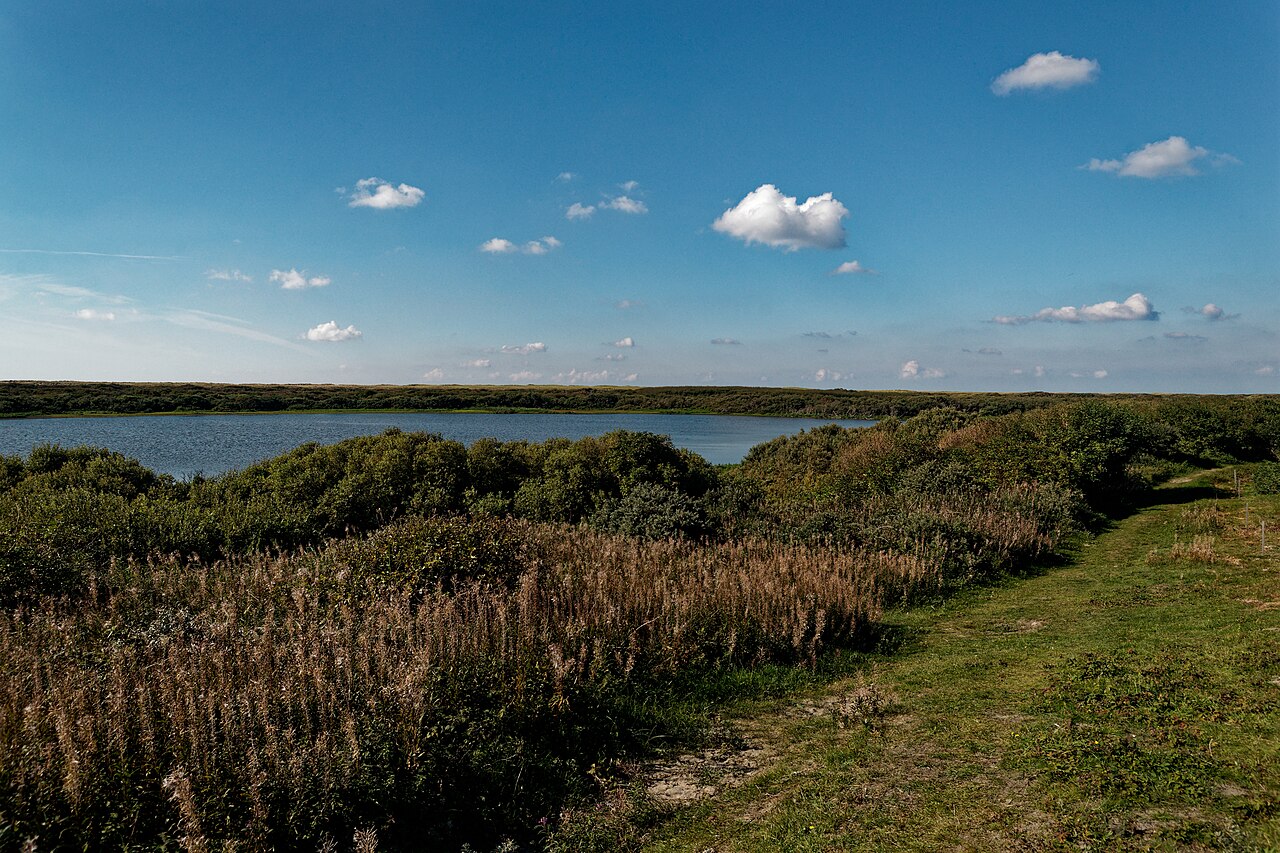
De Muy lies between De Koog and De Slufter in the western dunes of Texel. High dune ridges enclose an elongated low valley containing grasslands, reeds, scrub, the Muy lake and the small pine copse known as Oorlogsschip. What now appears to be one natural landscape developed through coastal formation, dyke construction and later ecological restoration.
The valley originally formed part of a beach plain influenced by seawater through low openings. Unlike De Slufter, this connection was eventually closed. A small dyke kept out the salt water and fundamentally changed the area’s development. Rainwater and groundwater became dominant.
New sand dykes were later constructed on the seaward side. Rainwater then drained less easily and groundwater levels rose. The Muy lake formed in the lowest part. Reeds, wet grasslands, marsh vegetation and wet dune valleys developed around the water.
The contrast with De Slufter is therefore strong. Salt, tides and flooding shape that area, while rainfall, groundwater and seasonal fluctuations determine De Muy. Two very different forms of coastal nature lie within a short distance.
From high dunes to wet valleys
The dunes surrounding the valley are remarkably steep in places. Wind piled sand into high ridges and sharp slopes. Marram grass and dry-dune plants grow on open parts, while grassland, scrub and wet vegetation occur lower down. From the higher dunes, the narrow valley can be seen enclosed between sandy ridges.
Bertusnol is the best-known viewpoint. A long staircase leads to one of Texel’s higher dunes. From the top, De Muy, De Nederlanden and the more northerly Slufter spread across the landscape. The Muy lake is visible among reeds and grassland, while the North Sea and coastal dunes can be seen in clear weather.
The pine copse Oorlogsschip stands in the centre of the valley. Its dark trees contrast strongly with the open grassland and form a distinctive landmark. It is not ancient natural dune woodland, but it provides shelter for birds, insects and bats.
The wet dune valleys are among the most vulnerable parts. They are supplied by clean groundwater and are naturally nutrient-poor. Low plants that disappear from fertilised or dried grasslands can therefore survive. Green-winged orchid flowers early in spring and may colour parts of the grassland pink and purple.
Other orchids, grass-of-Parnassus and chaffweed follow later. Grass-of-Parnassus grows in damp open places and has white flowers with green veins. Chaffweed is much smaller and remains low among grass and moss. Such species reveal how wet and nutrient-poor the soil remains.
Without management, the valleys would become overgrown by tall grasses, reeds and shrubs. Parts are therefore mown, grazed and stripped of their top layer. Galloway cattle keep vegetation short and create small bare patches where pioneer plants can germinate.
Spoonbills, songbirds and open dunes
De Muy is also known for its spoonbills. The colony is among the oldest breeding sites on Texel and in the Wadden region. The birds nest in a quiet protected section and feed in shallow water on small fish and shrimps. They are regularly seen flying above the area with outstretched necks and slow wingbeats.
Cormorants and grey herons also use the lake and surrounding trees. Nesting sites may shift over time. Droppings strongly enrich the soil around colonies, changing vegetation and sometimes killing trees. This is part of the dynamics of a large bird colony.
Bluethroats, sedge warblers and marsh warblers inhabit reeds, scrub and wet tall vegetation. Bluethroats sing from low shrubs and reed stems in spring. Nightingales usually remain hidden in dense sea-buckthorn and hawthorn scrub, but their song carries across the valley in April, May and June.
Open dunes and grasslands also attract birds of prey and owls. Hen harriers may hunt low above the vegetation in autumn and winter. Short-eared owls appear irregularly when voles are abundant. Neither species should be expected on every visit.
A landscape that must stay open and wet
An old drainage ditch once removed large amounts of rainwater from the valley and contributed to drying. It has been filled. A dune stream was restored through the lowest part so that water moves more slowly and naturally and more rainwater can replenish groundwater.
Management constantly seeks a balance. More water benefits wet dune valleys, but very high levels may affect paths and vegetation. Without mowing and grazing, the area becomes overgrown, while overly intensive management may damage vulnerable plants and breeding sites.
Walking routes mainly follow the margins and less vulnerable sections. Some paths are open throughout the year, while others are available only outside the breeding season. Temporary closures protect colonies, ground-nesting birds and other animals during their most sensitive period.
To the south, De Muy merges into De Nederlanden. Grasslands, dunes and a characteristic sheep barn recall the long coexistence of nature and agriculture. Parts of the area were historically used for grazing and haymaking.
Each season alters the appearance. Spring brings birdsong, fresh green valleys and flowering green-winged orchids. Spoonbills regularly fly overhead in May and June as scrub becomes denser. Grass-of-Parnassus and other wet-valley plants flower in July and August. In autumn and winter, the dark Oorlogsschip and the bare shape of the dunes stand out more strongly.
The strength of De Muy lies in nearby contrasts. High dry dunes directly border lake and marsh. A dark pine copse stands within open grassland. And beside the saline tidal Slufter lies a freshwater dune system governed entirely by rainwater and groundwater.
De Muy is therefore not a smaller version of De Slufter. It shows what happens when a beach plain is separated from the sea and freshwater is retained. Orchids, spoonbills, wet valleys and the Muy lake all result from this transition from salt to fresh water.
What can you see when?
The months below show when a sighting is most likely. Wildlife remains unpredictable.
Green-winged orchid
This early-flowering orchid can turn damp grassland pink and purple. Flowering depends on sufficient groundwater, low vegetation and careful management.

Grass-of-Parnassus
The white, green-veined flowers appear in summer on damp, nutrient-poor ground in the dune slacks.
Chaffweed
The tiny pink flowers grow low on wet, open, nutrient-poor ground and are easily overlooked among grass and moss.
Eurasian spoonbill
Spoonbills breed in a quiet protected part of De Muy. They are most easily seen flying over the area or feeding in nearby shallow waters.
Bluethroat
From April, male bluethroats sing from reeds, low shrubs and wet rough vegetation. Occasionally they briefly display their blue breast from a tall stem.
Common nightingale
The powerful song carries from dense sea-buckthorn and hawthorn scrub. The bird itself usually remains completely hidden.
Great cormorant
All yearCormorants use the pool, nesting trees and surrounding waters. Birds regularly fly between De Muy and feeding areas around Texel.
Galloway cattle
All yearThe black cattle graze parts of the area throughout the year and help keep grasslands and valleys open. Always keep well back and never walk between a cow and her calf.

Hen harrier
In autumn and winter, a hen harrier may hunt low over grasslands and wet valleys. It appears irregularly and is always a notable sighting.

Short-eared owl
When vole numbers are high, short-eared owls may hunt over the open valley. The species does not appear every year, so any sighting depends on a degree of luck.