
The story of this place
On the boundary between river and sea
At Muiden’s waterfront, the sea could once seem darker than elsewhere.
The Vecht flowed slowly in from the interior. Past quays, ships, warehouses and the castle. Then it lost itself in the wide water of the Zuiderzee. In calm weather the water lay open and silver. But when the wind came from the north, the water darkened. Something large seemed to press in through the river mouth.
Fishermen knew that boundary.
They sailed out between river and sea. Between fresh and salt. Between town and emptiness. In the mist a buoy could look like a head. A clump of weed could move like hair. A wave could become an arm if the light fell wrongly upon it. Whoever stared too long at the water sometimes saw more than he dared tell at home.
A strange catch
One day fishermen drew something from the water that was no fish.
At first they thought of driftwood or weed. Something the sea had torn loose and pushed against their net. Then they saw skin. Hair. Eyes. An upper body like that of a young woman. But below it no legs. Only the gleam of scales and a tail still striking towards the water.
The men hauled her in.
Perhaps from fear. Perhaps from greed. Perhaps because no one throws a wonder back before knowing what it is worth. The mermaid did not fight like a trapped animal. She looked. That made it worse. A fish thrashes. A seal snaps. But something half human that looks at you in silence is not easily released.
In Muiden the news must have travelled faster than the wind.
A mermaid. Captured by the town. Taken from the Zuiderzee. People came to look. One crossed himself. Another laughed too loudly. Children were pushed forward and pulled back again at once. Someone said she was a devilish thing. Someone else whispered that such beings should never be taken from the sea.
The sea wants her back
Outside the water grew restless.
First people noticed it in the harbour. Ropes began to strain. Ships scraped against their posts. Gulls vanished inland. The sky hung low above Muiderslot. Then came the wind. Not ordinary wind but something that knew where it had to be. It struck through the streets, drove against doors, bit into thatched roofs and pushed the water against the quay.
The sea wanted her back.
As if the Zuiderzee itself had turned against Muiden. As if something beneath the water knew what the town had taken and wanted it back. The storm continued as long as the mermaid was not returned.
The people understood only when the storm continued.
It was not merely bad weather. The wind had a reason. The water was searching for someone. The woman from the sea was no longer a prize, but a burden of guilt. As long as she did not return, Muiden would have no peace. No wall, no gate, no castle stone could help against a sea that came to claim something back.
Then they brought her back to the water.
Perhaps they carried her silently to the quay. Perhaps no one dared touch her and she was laid on a plank. Perhaps she looked once more at the town that had stared at her as if she were a find. The wind pulled at the men’s clothing. The water struck darkly against the stones.
As soon as she touched the sea, the storm changed.
Not at once into calm. Old waters do not work that way. But the anger withdrew. The pressure fell from the air. The water sank back into itself. Where foam had just raced over the quay there was now a strange stillness. As if the Zuiderzee had inhaled and finally decided not to come any farther.
Muiden will remain Muiden
Then she rose once more.
The mermaid looked at Muiden from the water. No one knew whether she was grateful, bitter or something in between. She spoke words that remained. Muiden would remain Muiden, but Muiden would not truly flourish. The town would remain, but it would never become what it might have been. Growth would move elsewhere. Towards the IJ and the Amstel. Towards Amsterdam.
Then she disappeared.
Since then Muiden has carried the story not only in words. In the old coat of arms a merman and a mermaid hold the shield. They do not stand there as decoration without shadow. They recall water that can look back. A catch that did not become property. A town that understood in time that some things do not belong on land.
What the water story still reveals
At Muiderslot that old boundary can still be felt.
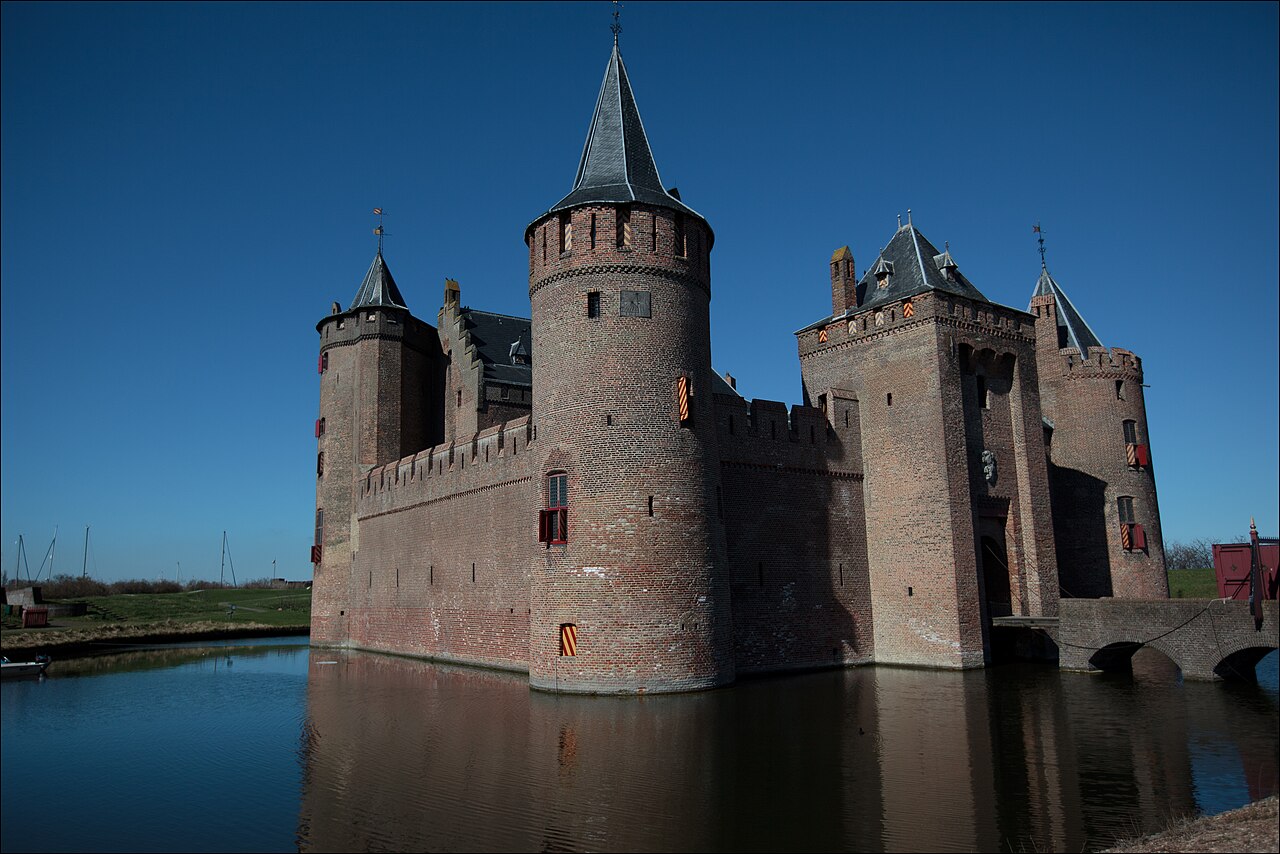
The castle stands at the mouth of the Vecht. There power, trade and water found one another for centuries. The Zuiderzee no longer exists under that name. Dykes, land reclamation and new water boundaries changed it for good. The IJmeer is calmer on the map than the old sea in the story. Yet the wind can still sweep low across it. Then the water sounds against the stones as if repeating something.
Walking along the harbour you see boats, terraces, bridges and walls. But imagine the town without the sense of security that dry land gives today. Dark sky. Ropes snapping. People walking to the quay because the sea is calling too loudly to stay indoors. And somewhere among them a pale figure smelling of weed, salt and depth.
The Mermaid of Muiden is no harmless fairy-tale figure.
She belongs to water stories in which the sea not only gives but also asks back. People pull something from the water and think it is theirs. Then comes the storm. Then comes the understanding. Then what has been captured must be released.
Stand at the river mouth when evening falls. Look at the water where the Vecht goes out. Sometimes a wave breaks differently from the rest. Sometimes something gleams just beneath the surface. For a moment it seems as if someone under the water is looking at the town. Waiting to see whether Muiden still remembers what it once had to return.