
The story of this place
A wolf made of water
The Water Wolf had no eyes, no teeth and no fur. Yet it devoured villages, fields, roads and shores.
It lay where the Haarlemmermeer polder lies today. Beneath straight roads, plots, business parks, villages and runways. Standing now at De Cruquius Pumping Station on the Ringvaart you no longer see a monster. You see brick, water, dyke and technology. But precisely there, on the edge of the reclaimed lake, it becomes possible to feel why people once called the Haarlemmermeer a wolf.
The Haarlemmermeer was not always one large sheet of water. In the peatland behind the dunes lay smaller lakes. The Leidsche Meer. The Oude Haarlemmermeer. The Spieringmeer. Through storms, erosion and human intervention those waters grew into one another. Where land once lay water appeared. Where people had walked ships later sailed. The shores were soft and vulnerable. In strong winds the lake kept taking back pieces of land.
So the water took on the shape of an animal that did not hunt in the forest but in the landscape itself. The Water Wolf did not creep. It sloshed. It did not leap. It struck. It did not devour prey with jaws but with waves. A farmhouse could disappear. A field could crumble. A village could slowly be erased from the world. Names such as Nieuwerkerk, Boesingheliede and Haarlemmerwoude became tied to land swallowed by water.
No one had to see an actual wolf walking across the lake to fear it. Its tracks were everywhere. Ragged shores. Churning water. Drowned land. Storm damage. Stories of old roads that no longer existed. The nickname turned water into an opponent with will and hunger. The lake became something that could grow, take and return.
In Holland water was never only water. It could protect, feed and connect. But it could also break, take and kill. The Haarlemmermeer lay dangerously between towns and villages. During storms the water could be driven high and threaten the land around Haarlem, Leiden and Amsterdam. The Water Wolf was no cosy fireside tale. It was fear with a name.
Too vast to tame for centuries
For centuries plans were made to subdue it. Jan Adriaanszoon Leeghwater wrote about drainage in the seventeenth century. Other planners calculated, drew and dreamed further. But drainage also meant loss. Haarlem feared problems for shipping. Leiden had fishing interests. Rijnland needed the lake as water storage. So the Water Wolf remained where it was for a long time. Larger. More threatening. Harder to ignore.
In 1836 the lake showed its strength again. Heavy storms drove up the water. The old nickname suddenly seemed less like metaphor than warning. The threat of the Water Wolf continuing to consume surrounding land became increasingly difficult to accept. In 1839 King William I signed the law for the drainage. The monster’s fate had been sealed.
But you do not kill a water monster with a sword. You build a ring around it.
Three machines against one wolf
From 1840 onwards work began on the long ring canal and ring dyke around the lake. Then steam pumping stations had to remove the water. Their names still sound like figures from a hydraulic epic. De Leeghwater. De Lijnden. De Cruquius. Three machines against one wolf.
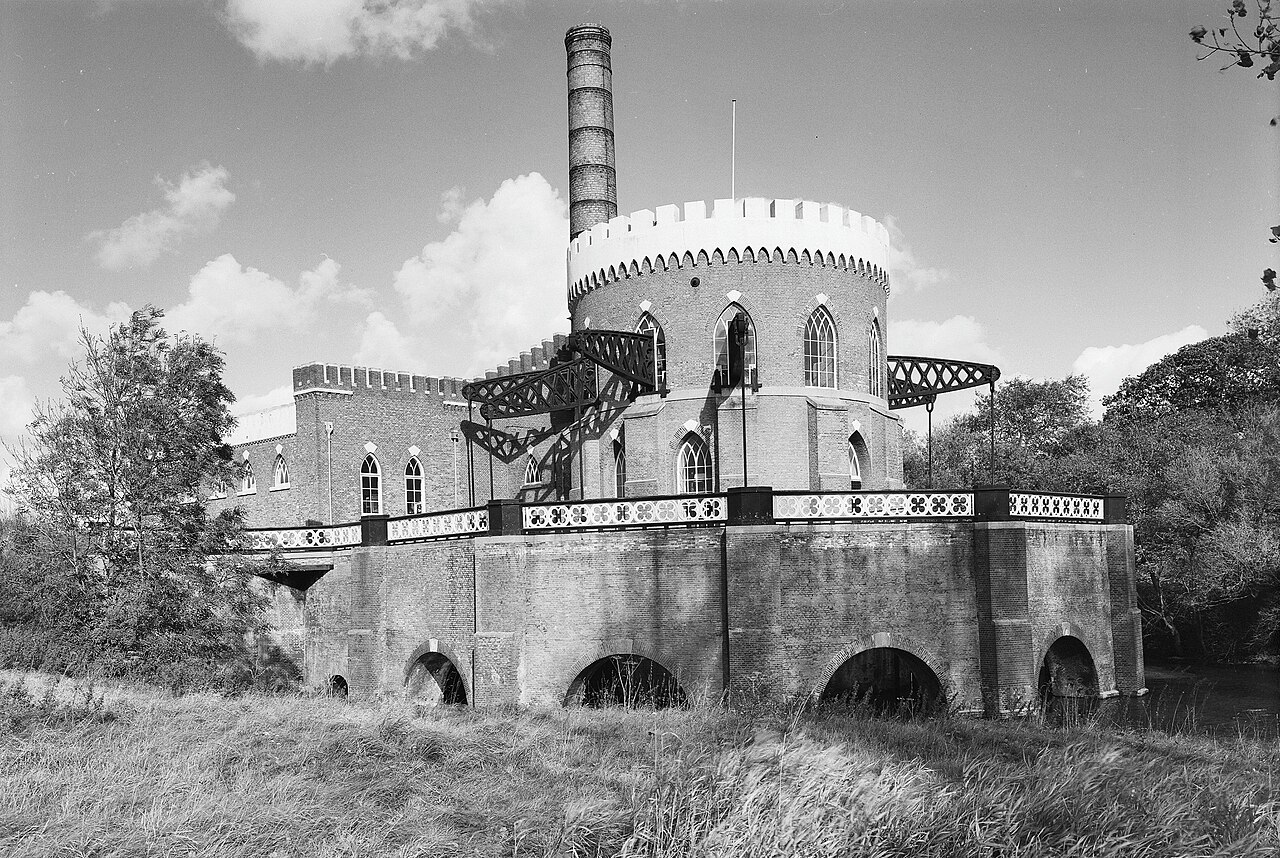
De Cruquius is the most striking surviving remnant of the three. The building almost seems too bold for an ordinary pumping station. Neo-Gothic, heavy and round. With battlements and pointed arches. Inside was a huge steam engine that had to draw the water out of the polder. Where the Water Wolf had taken land for centuries the machine now pulled the water back. Stroke after stroke. Pump after pump. As if technology finally cut off the monster’s breath.
Where water became land
By July 1852 the enormous lake lay dry. The bottom emerged. What had first been water became mud. Then polder. Then roads, villages, fields and later even airport landscape. The Water Wolf was subdued, but never entirely vanished from memory. When a monster is turned into land, a memory remains. The orderly polder landscape looks calm. Beneath that calm lies a reversal. Here was water. Here the wind once drove waves across the lake. Here shores disappeared.
At De Cruquius you can still sense it. On one side lies the Ringvaart. The boundary drawn around the old lake. On the other lies the polder. Low, straight and shaped by human hands. The pumping station stands between them like a guard at the cage of a defeated animal. The Water Wolf no longer roars. Its outline can still be read in dyke, canal and change in height.
Travelling along the Ringvaart or standing at De Cruquius today, you are looking at a place where an old monster has been locked into lines. The dyke is its collar. The canal still traces its outline. And beneath asphalt, clay and grass remains the memory of water that devoured land long enough to earn a name.