
The story of this place
A road pointing towards death
The Death Road to Hilversum sounds like a warning before you have even taken one step onto it.
Some names only point in a direction. Then they disappear from your mind. But Doodweg remains. The name conjures up a cart carrying a silent load. Men walking wordlessly across the heath. A lantern held low in the hand. Family close together. And somewhere farther on a cemetery waiting outside the ordinary life of the village.
On the Westerheide between Laren and Hilversum old straight roads run through the open landscape. They point towards the Sint-Janskerkhof. A burial ground that long lay apart on the edge of the heath. The church disappeared. The dead remained. That gave the place something uneasy. A cemetery without an obvious village around it. Reached by silent lines through sand, grass and wind.
Where people carried their dead a path changed. Every procession left something behind. Perhaps no visible trace. No stone. No sign. But a direction. The road became more than a road. It became the final passage between house and grave. Between voice and silence. Between the village of the living and the ground where someone was left behind.
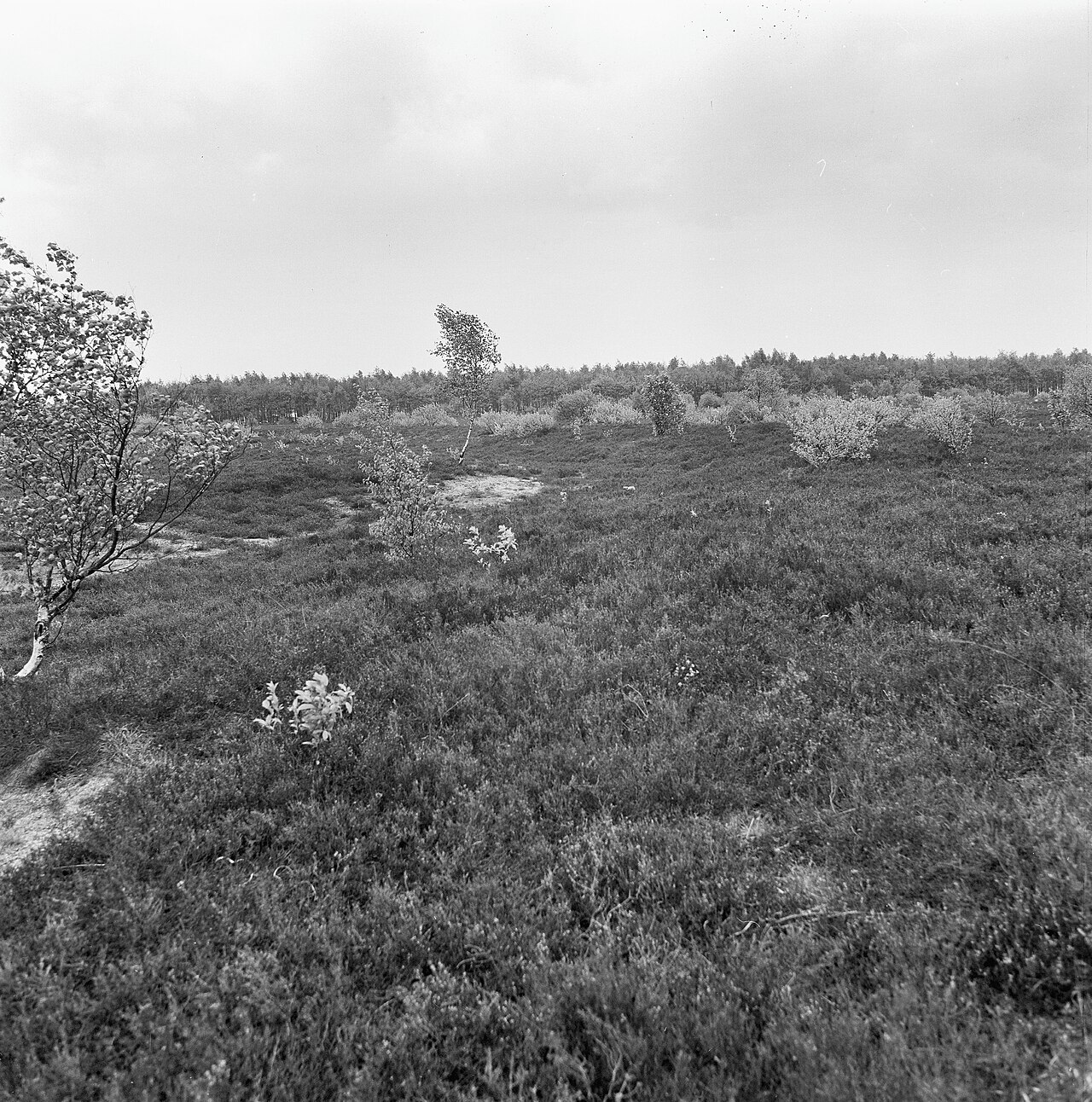
On the Westerheide it does not take much to feel that. The paths are straight. The space is open. The sky can hang low. The edge of the woods stands on the horizon like a dark rim around the land. Nearby lie older places of death and memory. Burial mounds. Urnfields. Traces of people who buried their dead here long before the villages existed.
The Doodweg is not a stray eerie name. It lies in a landscape where death is older than the cemetery itself. Beneath the sand and among the heather lie layers of farewell. Prehistoric graves. An old burial ground. Straight roads. Later stories. As if different ages remained in the same place and at dusk rose closer to the surface again.
The fixed road to the grave
In earlier times a dead person was carried along fixed roads. No wandering. No cutting across. No simply choosing another route. The procession had its direction and that direction had to be respected. The road led the dead away from the house. But what if a soul found the way back? What if the path did not only lead to the cemetery but could also point home again?
That was the old fear.
A death road was both passage and boundary. The deceased had to be brought to the resting place. Not back to the front door. The living walked along to the end of the journey and then turned back. The dead remained. The road held both movements. Carrying away and returning. That is what makes such a path uneasy.
When the landscape begins to listen
By daylight the Westerheide seems clear enough. Walkers. Cyclists. Dogs. Sunlight on the sand. Towards evening the landscape changes. The path stays paler than the heath around it. The shrubs turn dark. The trees draw closer. Sounds carry farther than expected. A branch cracks somewhere out of sight. A bird shoots low across the field. Then there is nothing again.
Then a straight road can suddenly feel too straight.
Looking back you may see no one. Yet it can feel as if something is following. Not quickly. Not threateningly. Rather slow and regular. The pace of people who do not speak because speaking no longer feels right. The imagined wheels of a cart. Clothing brushing against heather. A lantern moving low and vanishing again and again in the mist.
The Doodweg has no ghost with a name. No white woman by a tree. No spirit that appears in one fixed place. The unease lies in the direction itself. In the idea that a road can remember something. That footsteps can settle into sand. That a path centuries later may still know what it was used for.
The Sint-Janskerkhof strengthens that feeling. A cemetery in the middle of a village lies among windows, voices, doors and daily life. Here the burial ground long lay looser in the landscape. You did not simply pass it by. You went there for a reason. Whoever followed the road knew what lay at the end.
Around that ending lay something older still. The burial mounds on and around the heath make this part of the Gooi more than an ordinary walking area. It is a landscape in which the dead were given a place again and again. Not once. Not in one age. Again and again. People came. Buried. Disappeared. The heath remained.
Perhaps that is why the Doodweg so easily lodges in the imagination. Nothing has to appear. The name does the first work. The straight line does the rest. An open path to an old burial ground with burial mounds nearby and evening wind over the heath needs no great spectacle.
A second rhythm
After dark the road can fill without showing anything. A procession of shadows. A cart whose horse you cannot hear. A hand around a lantern. Footsteps that seem to fall just behind you and stop as soon as you stand still. The silence then does not become emptier. It becomes fuller.
Whoever walks there walks across sand, but also through an old idea. That the dead sometimes leave their own direction behind. That some paths do not only lead to a place but to a boundary. And that a boundary crossed often enough does not forget who was carried over it.
By day it is a path through the heath. At dusk it becomes narrower. Not because the sand changes. But because you begin to listen differently. You hear your own steps. You hear the wind. And perhaps for a moment something behind it.
A second rhythm.
Slow. Heavy. On its way to the cemetery.