
The story of this place
Two castles in one story
At the harbour of Medemblik, Radboud Castle stands solidly in the light.
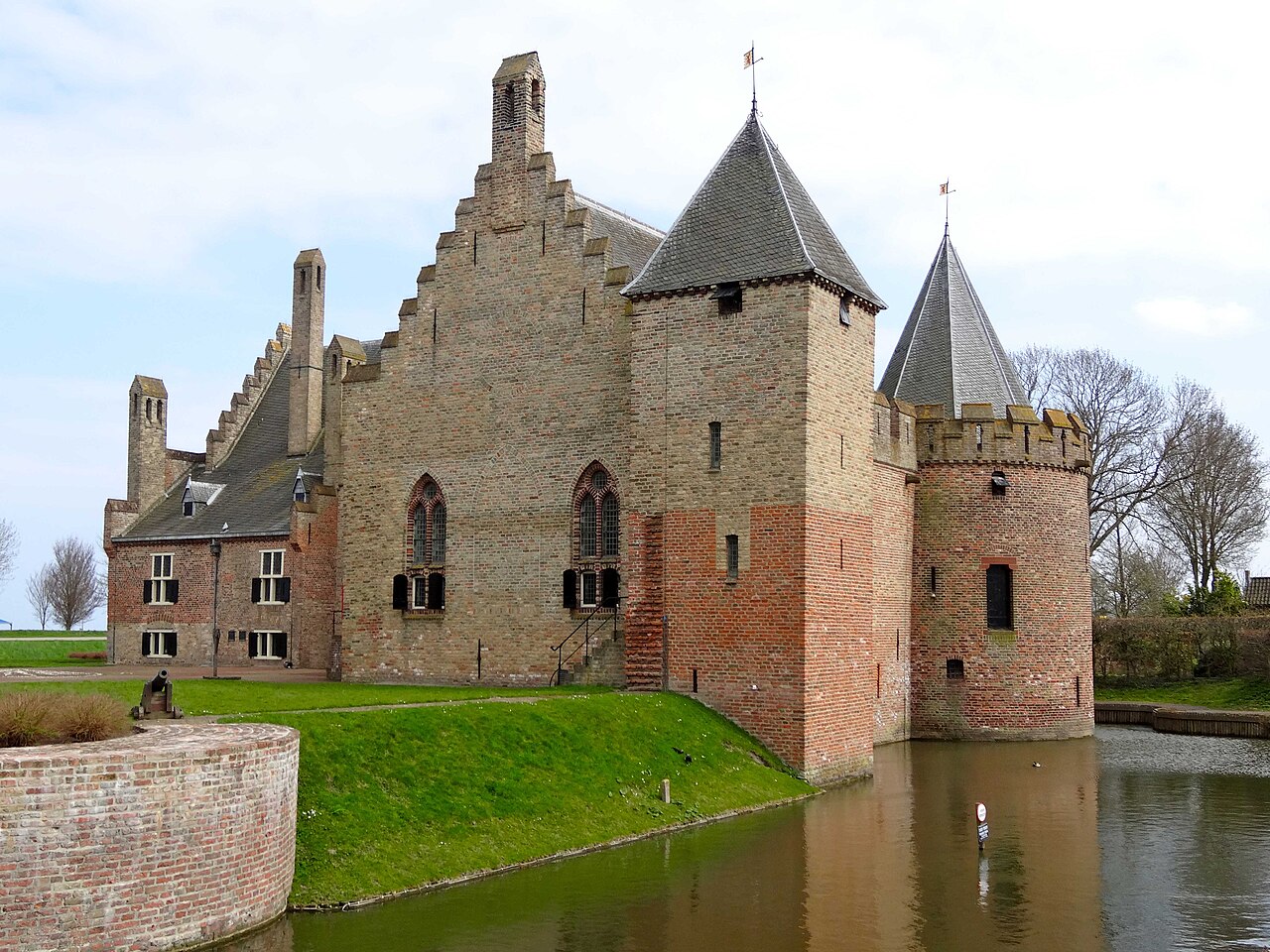
Brick walls. Towers. A moat. Water close by. By day the castle can easily be read as a medieval fortress. It was built at the end of the thirteenth century on the orders of Count Floris V as part of his attempt to bring West Friesland under Holland’s control. The visible castle belongs to that struggle. It does not belong to King Radboud.
He lived centuries earlier.
Radboud was a Frisian ruler from the early Middle Ages, connected with a world that existed long before Floris V’s brick fortress. As far as is known, he did not live in the present castle. Yet his name became attached to it. Perhaps because people imagined Medemblik must have held an older seat of power before Floris. Perhaps because a castle bearing such a name almost inevitably calls for an older king.
In this way two periods came to lie on top of one another.
Above ground stands the fortress of Floris V. In the stories an older stronghold of Radboud lies beneath it. Not as a proven ruin neatly waiting below the foundations, but as a suspicion. A vanished seat of power. A darker layer beneath the brickwork.
A treasure meant to stay hidden
And such a vanished fortress almost demands a treasure.
The tradition does not always tell the same version. Sometimes the treasure consists of gold and silver. Sometimes of coins, jewels, weapons or valuables belonging to a king unwilling to leave his possessions to his enemies. The treasure has no reliable inventory and no fixed hiding place. It lies in a cellar, beneath a wall, deep underground or inside a chamber that exists only in the tale.
That is precisely what keeps it safe.
A treasure that is found becomes property. A treasure that remains hidden continues to threaten.
Imagine it being concealed in haste. Not in a quiet hall with witnesses and torches, but on a night when a kingdom was faltering. Stone was moved. A floor was opened. Valuables disappeared into earth and darkness. Afterwards the opening was closed and only a small circle knew where the riches lay.
Or no one remembered anymore.
King Radboud gives that imagination additional weight. In later Christian tradition he appears as the pagan ruler who nearly accepted baptism, but withdrew at the final moment after hearing that his ancestors would not be in the Christian heaven. Whether this happened exactly as told is uncertain. The image remained: a proud king who refused to bend and would not casually abandon his old world.
In a legend such a king does not easily surrender his riches either.
His treasure becomes stubborn. It does not wait for fortunate diggers. It hides from those who desire too much. In some treasure stories wealth is not merely valuable, but dangerous. Those who search out of greed lose their way, hear voices or discover the following day that the hiding place can no longer be found.
King Radboud and the legend
Nothing of such hidden riches is visible at Radboud Castle. The moat lies quietly around the walls. The towers overlook Medemblik and the harbour. The former Zuiderzee once made this place a frontier of trade, shipping, conflict and danger. Almost everything visible belongs chiefly to the late Middle Ages.
Yet the name is older than the building.
That is where the tension lies.
Someone passes a gate, stairway or heavy wall and knows rationally that this is Floris V’s castle. But once Radboud’s name is spoken, a cellar becomes a possible hiding place. A thick wall might conceal something. A floor becomes not merely a floor, but a boundary between the documented castle and the castle of tradition.
The real question is therefore not where the treasure lies.
It is why so many people wanted to believe it had to be here.
Perhaps because the visible castle did not seem old enough for the name it carried. Perhaps because Medemblik needed a past reaching deeper than the thirteenth century. Perhaps because a proud pagan king seemed incomplete without hidden wealth.
In this way a second fortress grew beneath the real castle.
The first is built of brick. It belongs to Floris V and the subjugation of West Friesland. You can walk around it, touch its walls and enter its rooms.
The second fortress has no reliable plan. It belongs to Radboud, to an older world of power and to a treasure that never needs to be found. Its corridors grow longer as less is known about them. Its cellars become deeper whenever someone says nothing lies there.
What lies beneath the name?
This does not mean that an early medieval palace truly lies beneath the present castle. Convincing evidence for that is lacking. Nor does it mean that Radboud personally buried gold here. The legend connects people, periods and buildings that do not historically form a single whole.
Stories have little difficulty crossing such distances.
They lay centuries on top of one another. A Frisian king disappears beneath a Hollandic fortress. A name becomes older than the walls. A treasure fills the empty space between what is known and what people hope to find.
Walking beside the moat, both castles can be felt at once.
Above the water stands the visible structure. Brick, towers and windows catch the light. Beneath the name lies something else. A vanished fortress. A king who refused to bend. Riches that remain safe only as long as no one reaches them.
So do not look only at the towers when standing at Radboud Castle.
Look at the ground as well. At the heavy foot of the walls. At a stairway leading down and a door that remains closed. Not because the treasure demonstrably lies there, but because that is precisely where history ends and legend begins.
The real castle stands above ground.
The other lies beneath the name.
And somewhere between them something continues to glimmer. Just deep enough never to need finding.