
The story of this place
From competing companies to one powerful enterprise
The East India House stands between the Oude Hoogstraat and Kloveniersburgwal in Amsterdam. From the beginning of the seventeenth century, the brick buildings and enclosed courtyard housed the administrative centre of the Amsterdam chamber of the Dutch East India Company. Voyages were prepared here, ships and crews were directed, financial decisions were made and reports from Asia were processed.
The story began at the end of the sixteenth century. Amsterdam merchants wanted to participate directly in the Asian trade, which had long been dominated by Portugal. In 1595, a first Dutch fleet under Cornelis de Houtman departed for Java. The voyage cost many lives and produced little profit, but it proved that the route was possible. Several competing trading companies subsequently emerged.
To limit competition and strengthen their position against foreign rivals, these precursor companies were united in 1602 as the VOC. The States General granted the company a trade monopoly over a large part of Asia. It was divided into six regional chambers. Amsterdam raised half of the capital and became by far the largest and most influential chamber.
The new organisation required far more space than an ordinary merchant house could provide. The Amsterdam chamber initially used parts of the Bushuis, the municipal armoury. A separate wing was added in 1606, creating the East India House. The complex was later enlarged further. Wings from different building phases eventually enclosed the courtyard and provided space for administration, meetings, storage and reception.
An administrative building as an organisational machine
The East India House was not an ordinary warehouse, but the administrative heart of the Amsterdam chamber. Directors, secretaries, accountants, cashiers, clerks, lawyers, cartographers and examiners processed letters, ship journals, cargo lists, contracts, personnel records and financial accounts. Many documents had travelled for months before being read in Amsterdam.
The Amsterdam directors usually came from influential merchant families. They contributed capital, commercial knowledge and political networks. Amsterdam also supplied eight of the seventeen members of the central governing body, the Gentlemen Seventeen. When this council met in Amsterdam, the East India House became the administrative centre of the entire company.
Its meeting rooms were used to decide on ships, cargoes, money, appointments and commercial aims. War, diplomacy, fortifications and military deployment were also discussed. Instructions were sent to captains, merchants and officials in Asia; reports, account books, complaints and political information returned from Batavia and other settlements.
Maps were essential. Knowledge of coasts, currents, routes and harbours could determine whether a voyage ended in arrival or shipwreck. Reliable charts were therefore treated as confidential company material. Observations made by captains and navigators were incorporated into increasingly accurate maps intended to support future voyages.
Amsterdam as the hub of a worldwide network
The building was connected to a much larger Amsterdam network. Ships were built at several yards, later mainly on Oostenburg. Warehouses held merchandise and shipbuilding materials. Suppliers delivered timber, rope, sailcloth, weapons, food and drink. Sailors and soldiers could enlist at the East India House. Many came from other parts of Europe and departed for low wages on voyages from which return was uncertain.
Ships carried silver, coins, weapons, textiles and supplies to Asia. There the VOC traded in pepper, cloves, nutmeg, cinnamon, tea, coffee, porcelain, silk and cotton textiles. Much of this commerce took place within Asia itself. Batavia became the main administrative and logistical centre, although the local government remained accountable to the directors in the Netherlands.
The VOC was more than a trading company. Its charter allowed it to conclude treaties, build forts, employ troops, mint coins and wage war. Trade was therefore closely connected with coercion, violence and colonial power. In several regions the company attempted to exclude competitors and control the production or sale of particular goods.
Trade, state power and violence
Its power was never absolute. Asian rulers, merchants, sailors, soldiers and intermediaries helped determine what was possible. The VOC often depended on existing trading networks, local knowledge and political alliances. Its position varied greatly between regions. Behind the orders issued in Amsterdam lay a world of negotiation, resistance, cooperation and conflict.
The proceeds of trade contributed to Amsterdam’s rise as a commercial and financial centre. Asian goods were stored in warehouses and sold at auction. Merchants, shareholders, carriers and suppliers profited. At the same time, those profits were linked to dangerous voyages, exploitation, warfare, forced production and the lives of large numbers of European and Asian workers.
The East India House also served a representative purpose. Foreign guests and high-ranking visitors were received there. Maps, paintings and valuable products were intended to display the company’s reach and prosperity. In 1638 Maria de’ Medici attended a banquet in the building. Its interiors presented an image of order and success, while shipwreck, disease, violence and difficult negotiations remained outside the picture.
During the eighteenth century, the company’s problems increased. The costs of ships, forts, garrisons and administration rose. Corruption, smuggling, warfare and competition weakened the enterprise. The Fourth Anglo-Dutch War brought severe losses from 1780 onwards. Ships were captured, revenues declined and debts increased.
From decline to university building
After the establishment of the Batavian Republic, the VOC came under state supervision. Its charter expired on 31 December 1799 and the company was dissolved. Its possessions, debts and administrative tasks passed to the state. The East India House consequently lost its original function.
During the nineteenth century, various government services used the complex and parts were altered. In the twentieth century it became part of the University of Amsterdam. Restorations revealed historic façades and interior elements. The room known as the VOC chamber recalls the former directors’ meeting room, but its present interior is largely a later reconstruction.
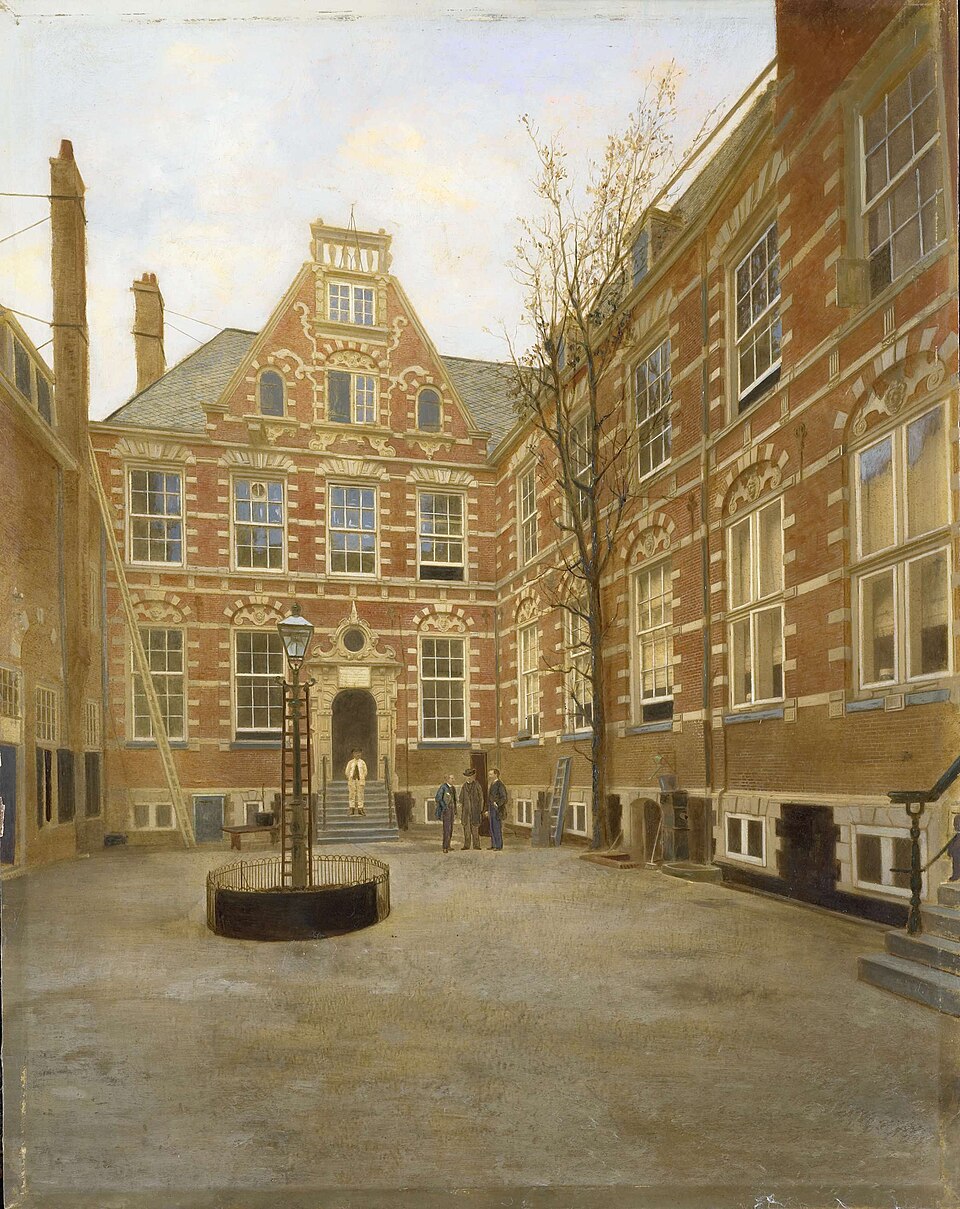
The courtyard still conveys the scale of the former administrative apparatus. Tall wings enclose the space. Regular rows of windows recall rooms where letters were written, accounts checked and maps studied. Differences between the façades show that the complex did not arise in a single campaign, but expanded together with the company.
From this Amsterdam courtyard, connections extended to shipyards on the IJ, warehouses on Oostenburg, trading posts in Asia and wars on the other side of the world. The East India House therefore preserves more than the architecture of an old trading company. It is the place where trade, administration, information, colonial power and violence were converted into decisions on paper.