
The story of this place
A peat landscape full of islands
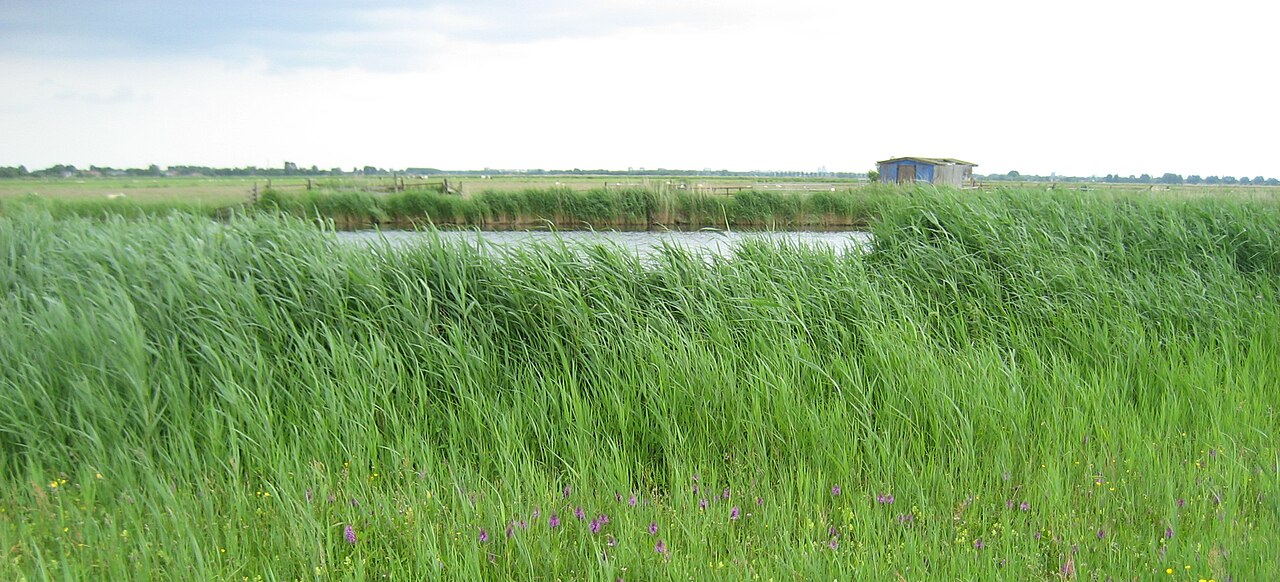
The Ilperveld lies directly north of Amsterdam, between Landsmeer, Den Ilp, Ilpendam and the North Holland Canal. On a map it resembles an open polder, but at close range the landscape consists of hundreds of narrow peat islands. Long ditches and waterways divide wet meadows, reed strips and marsh. Land and water are so closely interwoven that the area has a completely different character from a boat than it does from the road.
The ground consists of peat formed over thousands of years from dead marsh plants. From the Middle Ages onwards, the area was drained and used for farming and turf cutting. Digging and extraction created long waterways and narrow plots. Not all peat was removed or dried out. A finely divided landscape remained in which grasslands, reeds, ditches and peat remnants lie close together.
The Ilperveld forms part of a larger lowland peatland complex with Varkensland, Oostzanerveld and the Twiske. The former influence of brackish water, patterns of old reclamation and the continuing struggle against land subsidence remain visible. The landscape is therefore neither purely natural nor an ordinary agricultural polder. Centuries of use and water management created a half-wet world that now has great ecological value.
Meadow birds, reeds and quaking bog
In spring, the open grasslands are important for black-tailed godwits, lapwings and redshanks. They breed on low plots and feed in damp soil and along ditch margins. Their success depends on sufficiently high water, late mowing, tranquillity and abundant insects. Wide skies and open views are as important to these birds as wet ground.
Reed beds and marsh edges support different species. Marsh harriers hunt low above reeds and water. Bitterns usually remain hidden, but their deep calls can carry far in spring. Sedge warblers and other small marsh birds move among stems and rough banks. The transition from open meadow to dense reed makes the area suitable for a wide range of birds.
The vegetation below eye level is equally remarkable. Peat mosses grow in some wet places and form quaking bogs: floating or unstable mats that move with the water. Such vegetation develops slowly and is highly sensitive to drying and nutrient-rich water. Cross-leaved heath may add a purple tint to peat-moss-rich areas.
Hidden species in wet habitats
The root vole lives in wet rough vegetation and is almost never seen. It benefits from isolated habitats that remain regularly wet. Its presence shows that the value of the Ilperveld is not determined only by conspicuous birds, but also by hidden species dependent on a stable marsh landscape.
The area does not remain open by itself. Grasslands are mown or grazed by cattle, sheep and goats. Elsewhere, reeds, scrub or nutrient-rich topsoil are removed. Water levels are managed to prevent the peat from drying and oxidising too quickly. Without this work, meadows would become overgrown, quaking bogs would disappear and the peat would continue to subside.
Water management is complex. Levels that are too low accelerate subsidence and drying, while poor water quality can also damage vulnerable peat vegetation. Nutrients from farming, atmospheric deposition and imported water favour fast-growing plants. Restoration therefore requires not only more water, but also cleaner water, suitable grazing and sufficient tranquillity.
The landscape makes sense from the water
A walking path and bird hide are accessible from the visitor centre on the Kanaaldijk. They reveal mainly the edge of the area. Independent visits are free along the public paths, but the scale becomes clearer from a boat. The narrowness of some islands and the depth of the waterways then become apparent. Paid boat trips and excursions are offered at scheduled times.
The proximity of Amsterdam remains noticeable. Buildings and infrastructure may appear on the horizon, but traffic and city quickly disappear behind the reed margins. What remains is water, wind, birds and low green islands. This contrast makes the Ilperveld distinctive: a fragile peat marsh in one of the busiest parts of the Netherlands.
The Ilperveld does not tell a story of untouched wilderness. It is a landscape excavated, drained, grazed and managed by people. Yet that long history produced a valuable mosaic of meadow-bird grassland, reed marsh, quaking bog and open water. The future of that mosaic depends on the same factor that has shaped the area for centuries: the way water is managed.
What can you see when?
The months below show when a sighting is most likely. Wildlife remains unpredictable.
Black-tailed godwit
In spring, look for black-tailed godwits on wet grasslands and open plots, where their calls, display flights and long bills are part of the characteristic peat-meadow scene.
Northern lapwing
Lapwings are conspicuous for their tumbling display flights and calls above open grassland, especially in early spring while the fields are still wet and low.
Common redshank
Redshanks are often heard on damp grassland and along ditch margins, recognisable by their alert calls and red legs.
Western marsh harrier
Marsh harriers hunt low above reed beds, wet grassland and open water, alternating slow wingbeats with long glides.
Eurasian bittern
Bitterns are rarely visible in the reeds, but in spring their deep booming calls can give the marsh a hidden presence.
Sedge warbler
In reed margins and rough bankside vegetation, sedge warblers are often detected by their song and movement before they are seen clearly.
Root vole
All yearThe root vole is almost never seen. It lives in wet, rough peat vegetation and is an indicator of the quality and isolation of this lowland peat landscape.
Peat moss
Sphagnum belongs to the vulnerable wet vegetation of the Ilperveld and reveals where the landscape still retains genuinely peat-forming conditions.
Cross-leaved heath
On suitable sphagnum-rich ground, flowering cross-leaved heath can add a subtle purple tint to the wet peat vegetation.
Common reed
All yearReeds define banks, waterways and quiet corners throughout the area and provide cover for marsh birds.
Dragonflies
On warm days, dragonflies patrol ditches, waterways, reed margins and sheltered corners of open water.
Sheep, cattle and goats
Sheep, cattle and goats are part of the management of open grasslands and margins, keeping parts of the peat landscape short and open.