
The story of this place
Where the sea threatened the land
On the Hondsbossche coast darkness can seem to fall early.
Not because the sun sets faster here, but because the sea always remains close. Between Petten and Camperduin the wind can turn suddenly. Marram grass bends. Sand races across the path. Behind the dunes the polder lies low and flat, barely higher than the water that had to be kept outside for centuries.
Here a dyke was never merely a bank of earth, timber and stone. It was the narrow boundary between an inhabitable landscape and the North Sea. As long as it held, houses, fields and animals remained in place. When it failed, a village could disappear, farmland could turn salty and the coastline could change in a single night.
Petten knew that danger only too well. Storms and coastal erosion repeatedly forced the village inland. During the Saint Elizabeth’s Flood of 1421, the Petten of that time and its church disappeared into the water. The sea defence remained vulnerable afterwards. Every reinforcement was necessary, but no reinforcement removed fear for good.
In such a landscape unexplained events could easily be given a human cause.
The sea was too large to accuse. The wind could not be questioned. A storm could not appear before a court. A neighbouring woman could. A woman who lived alone, differed from those around her or had long been distrusted could become the centre of suspicion after illness, death or other misfortune.
A woman from the Hasepolder
A case from 1665 and 1666 is known from the Hasepolder near Petten in which a woman was associated with witchcraft. The surviving references are too limited to reconstruct one complete local witch tale. We therefore do not know whether all the motifs later associated with witch stories actually formed part of this case. There is no reliable basis for simply claiming that she summoned storms, held gatherings on the dyke or flew through the night.
What does become visible is the distrust of a period in which misfortune was rarely accepted as mere chance.
When misfortune takes on a face
In the seventeenth century illness, failed harvests, dead animals and sudden disaster could be attributed to sorcery. Such accusations often arose not from one great supernatural incident, but from small conflicts that accumulated. An argument at a doorway. A threat remembered later. An animal becoming ill shortly after a visit. A remark that afterwards sounded like a curse.
Imagine the Hasepolder on an evening when the sky turns yellow-grey. The ditches lie dark. The cattle stand close together. From the west comes a sound that is still only wind at first, but slowly grows heavier. Shutters close in the houses. Someone speaks a name. Not because there is proof, but because fear rarely accepts a cause without a face.
From suspicion to witch
That was the real danger of a witchcraft accusation.
A storm passed. A sick animal died or recovered. But suspicion remained attached to a person. Everything that happened afterwards could confirm it. A strange look became hostility. Knowledge of herbs became suspicious. Solitude became secrecy. Silence became guilt.
The woman from the Hasepolder should therefore not be imagined as a fairy-tale witch. It is more likely that she was a real person caught in a pattern of rumours and accusations. Perhaps she was poor. Perhaps she quarrelled with neighbours. Perhaps she knew more about animals, herbs or childbirth than others did. Perhaps all that was needed was someone to whom the misfortune could be attributed.
In the broader European imagery surrounding witchcraft, other familiar motifs also appear: spoiled milk, sick livestock, nocturnal gatherings, cats, crows and women supposedly able to influence wind and weather. Such images fit the fearful atmosphere of the period, but they should not all be read as established parts of the Hasepolder case.
That uncertainty makes the story darker rather than weaker.
No woman needs to walk through a storm for us to understand what could happen here. A rumour was enough. Suspicion could travel from farm to farm and grow firmer with every repetition. Once someone had been called a witch, she no longer needed to do anything remarkable. Her presence alone could become sufficient.
The Hondsbossche coast provided a powerful setting. On one side lay the North Sea. On the other lay low polders, houses and farms. Between them stood a sea defence that had to be reinforced, repaired and rebuilt over centuries. The danger of the water was real. Precisely for that reason imagination could easily place something human or supernatural beside it.
When the dyke groaned, cattle grew restless and rain struck the shutters, it was easier to believe that someone had helped the storm than to accept that the entire landscape depended upon clay, timber, labour and luck.
What the landscape still tells us
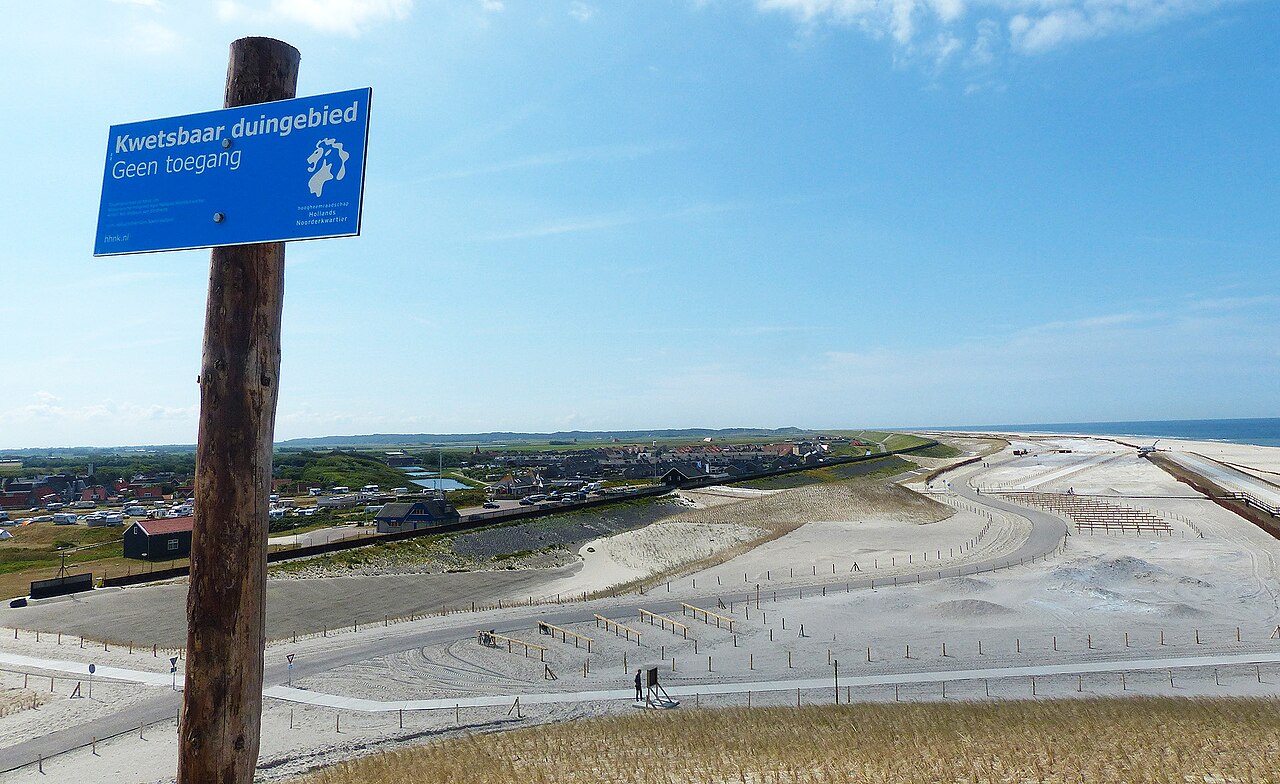
The coast looks different today. Broad new dunes now lie in front of the old sea defence. There are cycling and walking paths, beach entrances, birds and marram grass. The sea is continuously measured and the coastline is technically monitored. The old dyke largely disappeared beneath millions of cubic metres of sand.
Yet the historical relationship between high water and low land remains tangible.
When the wind rises the beach empties. Sand shoots across the paths and the sky sinks towards the horizon. Behind the dunes the polder still lies low. From the coast it is easy to understand why storm, loss and accusation once entered the same stories.
The witch of the Hasepolder therefore does not need to emerge from the dunes. Her presence does not lie in a broomstick, a cauldron or supernatural footprints. She remains in the memory of a woman who may have been singled out because those around her needed an explanation for what they could not control.
Walking here you see sand, water, grass and a carefully defended landscape. But stop when the wind comes from the sea. Listen to the waves and look towards the low land behind the dunes. Then imagine not only the supposed witch, but above all the people who began whispering her name.
That whispering alone could become truly dangerous.