
The story of this place
A life between convent and city
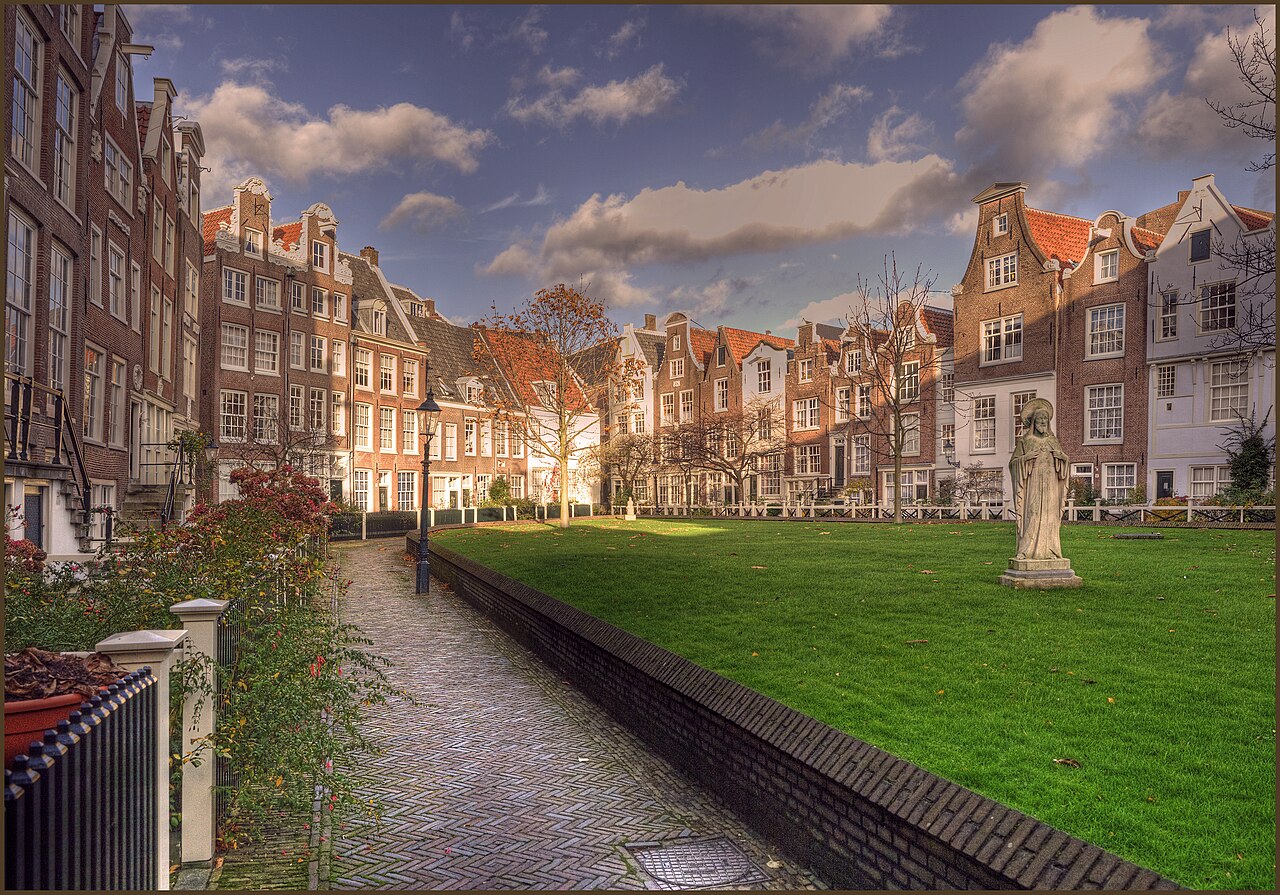
As soon as you pass through the gate, the Begijnhof closes around a small lawn. Houses, churches and narrow passages form an enclosed world in the middle of the city. For centuries, women lived here whose homes, work and faith were closely connected.
Beguines were Catholic women who led a religious life without being nuns in the strict sense. They prayed, worked and cared for others. At the same time, they retained more independence than women in a monastic order. Their lives unfolded between community and city.
This unusual position shaped the character of the courtyard. Religion was present not only in chapel services, but also in daily life. Living, praying and caring belonged together. Their faith took shape through daily prayers, shared rules, work and mutual care.
The precise origins of the Begijnhof cannot be reduced to a single date. Beguines in Amstelland are mentioned in 1307. In 1346, a ‘Beghynhuys’ is recorded as property belonging to the beguines. During the late Middle Ages, the courtyard developed into a community within the city walls. Amsterdam expanded, but the Begijnhof retained its intimate scale.
The chapel at the centre
The beguines’ chapel stood in the middle of the courtyard. The English Reformed Church now occupies the site of the medieval Begijnhof Chapel. For the women, this was the spiritual centre. Masses were celebrated and prayers spoken here. The building was later rebuilt and altered, but the position of the chapel continued to shape the layout of the courtyard.
Fires and rebuilding changed the Begijnhof over the centuries. What you see today is therefore not a completely medieval ensemble. Older fabric survives behind seventeenth- and eighteenth-century façades. The Wooden House at number 34 dates from before 1452 and is among Amsterdam’s oldest timber houses. Its front and rear façades are wooden, and its Gothic timber frame also survives.
A courtyard after the Alteration
The greatest rupture came with Amsterdam’s Alteration of 1578, when the city acquired a Protestant government. The beguines were allowed to remain as a Catholic community, partly because many of the houses were privately owned. They did, however, lose their chapel. In 1607, the city authorities gave the old chapel to English Presbyterians. It has since been known as the English Reformed Church.
For the beguines, the heart of the courtyard had changed. Their old chapel remained standing, but no longer belonged to their worship. The building continued to have a religious purpose, now serving another community and another tradition.
A church behind ordinary façades
Catholic worship did not disappear. It withdrew into the houses of the courtyard. At first, Mass was still celebrated in the sacristy of the old chapel. When that was no longer possible, the beguines moved into residential buildings. In the seventeenth century, two houses were combined to form the present Begijnhof Chapel, dedicated to Saints John and Ursula. From the outside, it was not allowed to be clearly recognisable as a Catholic church.
This is an essential part of the Begijnhof’s meaning. The courtyard shows how faith adapted to new circumstances. A public church gave way to a hidden interior. Behind ordinary façades, a Catholic community continued to pray and celebrate Mass.
The English Reformed Church and the Catholic Begijnhof Chapel therefore represent two different religious histories on the same small site. The English Reformed Church occupies the beguines’ old chapel. The Catholic chapel was hidden inside former houses. Together, they show how profoundly the Reformation changed daily life in the courtyard.
What this place tells today
Yet the buildings were not the most important part of the Begijnhof. The women who lived here gave the place its meaning. Their lives centred on prayer, work and mutual care. Many of their names have been forgotten, but their daily presence made the courtyard a religious community.
The story of Cornelia Arens also belongs to the Begijnhof. According to tradition, she did not wish to be buried in the church, but in the gutter of the courtyard. This was said to be an act of penance for her family’s conversion to Protestantism. How literally the story should be taken is uncertain. Above all, it shows how faith, family and burial place became intertwined here.
Today, the Begijnhof is simultaneously a monument, a residential place and a religious space. It calls for restraint. People still live here and the chapel remains active. This is not a place designed entirely for visitors.
Look carefully and you can read the history in the courtyard’s layout. The gate marks the transition from the city. The English Reformed Church preserves the site of the old chapel. The Catholic chapel hides behind an ordinary façade. The houses recall the women who developed their own form of religious life here.
Pause for a moment after entering. Do not look only at one building, but at the courtyard as a whole. Behind you lies the busy city. Before you is a place where living and prayer were interwoven for centuries. The Begijnhof speaks softly, but its history is present everywhere.