
The story of this place
A high place in a wet landscape
The White Church stands on a coastal ridge. Such long sandy rises offered dry and relatively safe ground in the wet coastal landscape. Long before Heiloo grew into the place it is today, this higher ground attracted people.
Here, houses could be built, routes followed and the dead buried without the water constantly causing problems. The location of the church is therefore no coincidence. It stands where landscape, settlement and faith came together at an early stage.
The Heerenweg still follows that old raised line through the landscape. Anyone walking to the church today through traffic and buildings is still moving along the same natural ridge on which Heiloo developed.
According to tradition, a first timber church already stood here around the year 700. The story connects the early Christianisation of the area with Willibrord and other missionaries. The precise events can no longer be fully reconstructed. What is clear is that this site has held religious meaning for a very long time.
The name Heiloo is also often linked with a sacred wood or holy place. Such explanations require caution because linguistic history and later tradition can easily become intertwined. Above all, the name shows how strongly Heiloo came to connect itself with an ancient sacred origin.
The present church is therefore not the building of the eighth century. Its significance lies in the place itself: generations rebuilt here, used the same ground and kept the memory of an early Christian centre alive.
Tuff stone and a Romanesque tower
A stone church was built in the twelfth century. Tuff stone was used for parts of it. This material did not come from the immediate area and had to be transported by water. Its use shows that the community had resources and contacts extending beyond Heiloo.
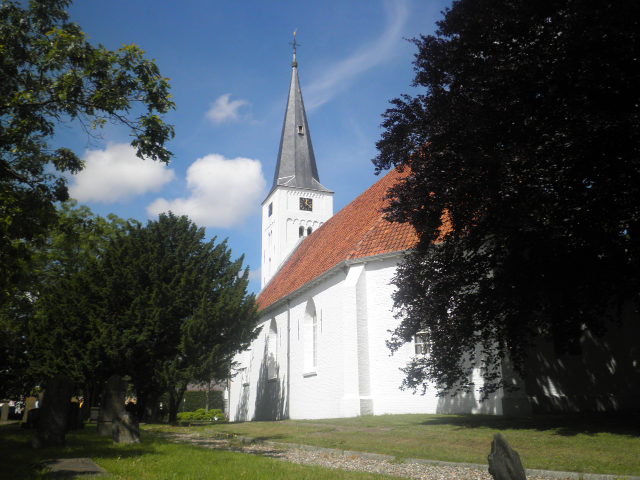
Around 1200, the Romanesque tower was built. It made the church visible in the flat landscape and also gave the village its own sound. The bell called people to worship, marked the hours and special moments and could ring for mourning or danger.
The tower is therefore more than an old part of the building. It connected church life with the daily rhythm of the village.
A church that grew larger
In the fifteenth century, the church was enlarged with a transept and a Gothic choir. The building became far larger than the present White Church. This expansion reflected a growing community and changing needs surrounding worship and church space.
Little of that larger form survives above ground. Yet it has not disappeared entirely. On the eastern side of the churchyard, lines in the paving show where the choir and transept once stood.
Anyone walking beside the white walls today would hardly suspect that the church was once almost twice as large. The present church shows what remained. The paving shows what disappeared. Together they form a ground plan of loss and recovery.
The Willibrordusput beside the church
Beside the church lies the Willibrord Well. Well and church together form an old religious centre. Water was naturally essential to daily life, but it also acquired a place in stories of origin, blessing and healing.
The connection with Willibrord gave the well a Christian meaning. It is not always possible to establish precisely how old each part of that tradition is. More important is that the well remained part of how Heiloo understood its religious past for centuries.
The closeness of church, churchyard and well shows how landscape, faith and village formation became intertwined here. The place did not become sacred through a single story. Its meaning grew through prolonged use and repeatedly renewed memory.
What this place tells today
In 1573, the church was badly damaged during the fighting around Alkmaar. The Gothic choir and transept were lost. Parts of the Romanesque building and the tower survived.
The large medieval church was therefore reduced to a much smaller whole. What had once extended eastwards now ended closer to the tower. The damage altered not only the appearance of the building, but also how the community used it.
The White Church thus also tells a story of war in the landscape. Major political and religious conflicts reached even a village church. The lines in the paving are quiet traces of that rupture.
The surviving part was not left as a ruin. The church was repaired and usable again by 1632. The south wall and three-sided eastern closure belong to this later reconstruction. The building became smaller and plainer, but the church site endured.
After the Reformation, the former Catholic church became a Protestant village church. Altars and images disappeared or lost their function. Preaching, Bible reading and psalm singing became central.
Yet this change did not mean abandoning the place. People continued to see the same tower, walk across the same churchyard and bury their dead around the same church. The form of religion changed, but the bond with the ground remained.
Inside, the furnishings are simple. A timber barrel vault covers the space. The pulpit, baptismal screen and gravestones suit the Protestant use that developed after the Reformation. When it is quiet, you notice how small and enclosed the church really is. Every footstep, voice and creaking bench feels close.
The simplicity makes the building’s age more tangible. Little distracts your eye from walls, floor and roof. It becomes clear that the church is not a single completed design, but the result of building, damage and repair.
The graves inside and around the church recall generations of Heiloo residents. Farmers, craftspeople, children and families came not only for Sunday worship, but also for baptisms, marriages and funerals. The church therefore remained connected with almost every stage of village life.
The white plaster gave the church its present name. Behind that calm exterior lie many centuries. Tuff stone, brick, a Romanesque tower, war damage and Protestant rebuilding all belong to the same building.
Walk around the church before going inside. Look at the tower and the different types of stone. Find the Willibrord Well and then follow the lines of the vanished church in the paving.
Villages grew, wars changed buildings and faith took another form. Yet people kept returning to exactly the same place. Perhaps that is Heiloo’s oldest tradition.