
The story of this place
Ancient dead beneath the heath
In daylight little seems hidden on the Westerheide.
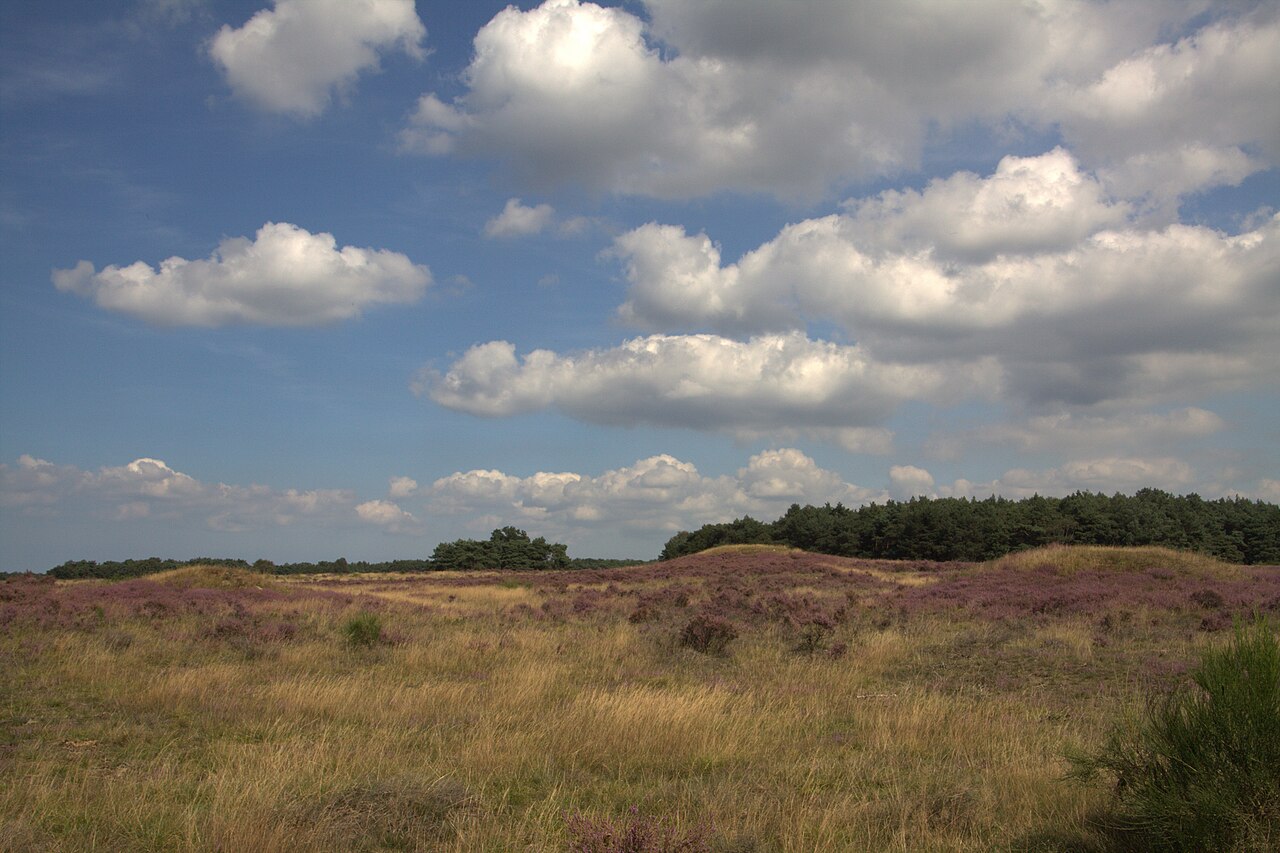
The sky is wide. The sandy path lies open between heath, grass and low vegetation. In the distance walkers drift past. Cyclists disappear around a bend. Dogs sniff along the path. Everything seems calm, visible and easy to understand.
But if you look more closely you notice that this landscape is not empty.
Between Hilversum and Laren ancient burial mounds lie in the heathland. Low rises in the sand. Sometimes barely noticeable. Yet older than the villages, older than the roads and older than almost everything you see here now. Beneath such mounds the dead were once laid to rest. People buried with care, covered with earth and absorbed into a landscape that would never again be entirely ordinary.
By day you can know that without feeling it. You read a sign. You look at the mound. You walk on. But in the evening light the Westerheide changes. The colours sink away. The open space becomes less friendly. The trees at the edge grow darker. Mist hangs low above the field. Then the mounds no longer seem merely prehistoric remains. They become silent watchers beneath the sand.
Apparitions between mist and heath
In landscapes like this stories of White Ladies could take shape.
They did not always arrive with noise. No chains. No screams. No thunder over the field. Sometimes they were only pale forms between mist and heath. A female figure where a moment before nothing had stood. A white movement at the edge of your sight. A shape that seemed to wait on a mound and vanished as soon as you came closer.
People did not tell such stories for no reason. An open heath can feel strange in the dark. Directions become uncertain. Sounds travel farther than expected. A bird in the night, a branch in the wind, a pale vapour above the ground: everything gains meaning when you know that the dead lie beneath that ground.
The White Ladies belonged to that boundary between seeing and suspecting.
Sometimes they were seen as spirits of women bound to the landscape. Sometimes as guardians of old places. Sometimes as seductive apparitions that could lure travellers away from the path. They were not always evil. Yet rarely comforting. Their whiteness did not make them pure or safe. It was precisely that pale, silent appearance that made them elusive.
What is a White Lady?
What exactly is a White Lady?
A ghost? A memory? A warning? A wisp of mist given a body by fear? Or an old story that keeps adapting itself to the place where it is told?
On the Westerheide such a story fits almost too well. The burial mounds give it a tangible core. Here you do not need a castle ruin or a dark cellar to feel unease. The strangeness lies lower. In the ground. In the knowledge that people left their dead here thousands of years ago and that later generations gave that presence new meaning.
Perhaps shepherds saw something in the mist. Perhaps travellers crossed the heath at dusk and thought they saw a woman in white standing between the mounds. Perhaps an ordinary encounter became a story. And a story became a warning. Do not cross the heath too late. Stay on the path. Do not disturb the old mounds. Do not laugh at what you do not understand.
That is often how folk tales work. They lay a thin layer over a place that is already unusual. The burial mounds came first. The dead came first. The silence came first. Only later came the names, the figures and the whispers.
Where the story begins
Walking here, you see no evidence of White Ladies. That is not what this place offers. You see open heath, paths, low mounds and the sky above the Gooi. But precisely because everything seems so visible the other layer becomes more noticeable. The thought that beneath this gentle landscape lies a much older world. A world of ritual, death, memory and fear.
Stand for a moment near one of the burial mounds when the light grows softer. Do not look only at the mound itself. Look at the space around it. At the path continuing onward. At the mist between the grasses. At the way a white birch trunk or a pale coat in the distance can for one instant seem like something else.
That is where the story begins.
Not because you immediately believe that a woman will step out of the mist. But because you understand why people once could have thought so. The Westerheide is not a backdrop found later to fit the legend. The landscape carries the ingredients itself. Ancient burial places. Open space. Silence. Mist. Fading paths. And the sense that some places remember longer than people do.
Between folklore and landscape
The White Ladies of the Gooi therefore remain suspended somewhere between folklore and landscape. They cannot be separated from the burial mounds. Yet they cannot be reduced to archaeology either. The mounds tell what is really there: ancient burials in a prehistoric landscape. The White Ladies tell what people came to feel about them. That such places do not fall entirely silent.
Perhaps that is exactly their power.
They do not appear in broad daylight as proof. They wait until the edges soften. Until the heath darkens. Until you are no longer sure whether you saw something move or whether your imagination gave the landscape a body for a single moment.
Then, between Hilversum and Laren, a white figure stands for an instant near the old mounds.
You look again.
There is nothing.
Only heath, sand and evening sky.
But on the way back, you stay just a little closer to the path.