
The story of this place
A coastal light that did not come easily
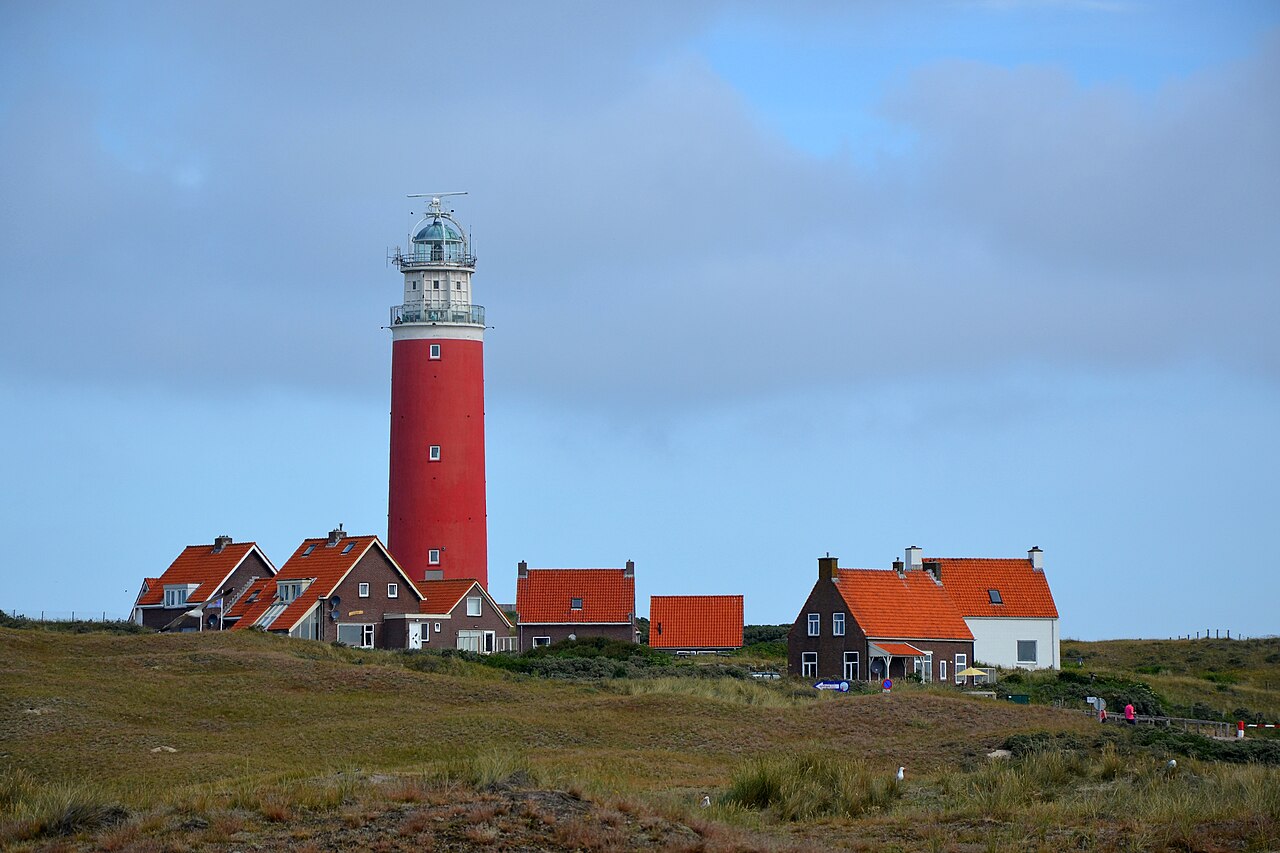
Eierland Lighthouse stands at the northern tip of Texel, near De Cocksdorp, on a high dune between beach, sea and open sky. The red tower is recognisable from far away, but it was not built as an island icon. Its origins lie in danger. Offshore lay the treacherous Eierlandse Gronden, where sandbanks, currents, darkness and bad weather threatened shipping.
Until the nineteenth century, this was a notorious stretch of sea. Between the existing lighthouses, a dangerous dark gap remained precisely around Texel’s northern point. In poor visibility, ships could easily run aground on the shallows. Wrecks off the coast made clear that an additional light was necessary. The Eierland tower therefore did not arise from beauty or tourism, but from the need to prevent the loss of ships and lives.
Johannes Ludovicus Kikkert, a notary on Texel, played an important role. For years he campaigned for a lighthouse at the island’s northern tip. Using maps of shipwrecks, letters, meetings and persistence, he tried to show how dangerous the darkness around Eierland was. After about ten years, permission and funding were finally secured.
Construction began in 1863. One year later, the lighthouse was complete. Quirinus Harder, an important Dutch lighthouse designer, drew a round, tapering brick tower. Its position on a high dune increased the visibility of the light over the sea. It was lit for the first time on 1 November 1864.
The location explains the significance of the site. The North Sea lies on one side and the Wadden Sea on the other. Currents, shoals and shipping movements come close together here. The tower therefore marks not only the end of Texel, but also a transition zone where orientation and disorientation, safety and danger lay side by side.
A working beacon between two seas
A lighthouse was not an unchanging monument, but a working navigational aid. Lighting technology, maintenance and safety had to be continually adapted. In 1907, the tower received a cast-iron lantern. Such changes altered its appearance, but above all served to keep its function reliable.
The most severe event took place in 1945. During the uprising of Georgian soldiers against the German occupiers, heavy fighting took place on and around Texel. The lighthouse came under intense fire and was badly damaged. A building intended to provide direction and safety became a target and a casualty of war itself.
Two towers in one
After the war, the old tower was not demolished. In 1948 and 1949, a new outer shell was built around the damaged core and the upper section received a concrete addition. In effect, two towers were created in one: the battered nineteenth-century core inside and the post-war exterior around it. Damage and impact marks are still visible in the space between the two walls.
From outside, the tower appears clear and simple. Inside, it becomes obvious that the red outer shell is a later layer. The old tower still exists and carries traces of shipping, war and recovery. Eierland Lighthouse is therefore not a monument from a single period, but a building in which different eras have literally been built around one another.
The surroundings are also part of that story. Wind, salt, sand and open water define the northern tip of Texel. The tower does not stand sheltered behind buildings, but in a landscape where visibility and direction could be matters of life and death. A light here meant the difference between passing safely and running aground, between returning home and being lost at sea.
Eierland as a shaped coastal landscape
The name Eierland also refers to the landscape history of northern Texel. For a long time, this area was a separate island or detached stretch of land before it was connected and reclaimed. The lighthouse therefore stands not only in a maritime landscape, but also in an area created by coastal formation, dunes and hydraulic engineering.
For many years, the tower was staffed. Lighthouse keepers kept the light working, carried out maintenance and remained on duty at night, during storms and in poor visibility. In 2003, control was transferred to the Brandaris lighthouse on Terschelling. An old form of lighthouse life disappeared, but the tower remained as a recognisable beacon.
The value of Eierland Lighthouse lies in the combination of design, function, location and damage. The tower is maritime infrastructure, war monument and landscape landmark at the same time. It tells how danger at sea was confronted, how technology developed and how a badly damaged building was preserved after the war without completely erasing its scars.
From lighthouse life to monument
As you walk around the tower, you first see the red form against sand, sea and sky. Then the details begin to stand out: the round brick exterior, the lantern, the height and the relationship with the coast. Inside, the second tower appears, with the old wall and the space between both shells. The building itself thus becomes a cross-section through history.
Eierland Lighthouse stands where ships were lost, where people campaigned for years for a coastal light and where traces of wartime damage were preserved in the walls. The red tower at the end of Texel is therefore more than a landmark. It shows how danger, technology, persistence and recovery can become fixed in stone along the coast.