
The story of this place
A vanished passage between two water worlds
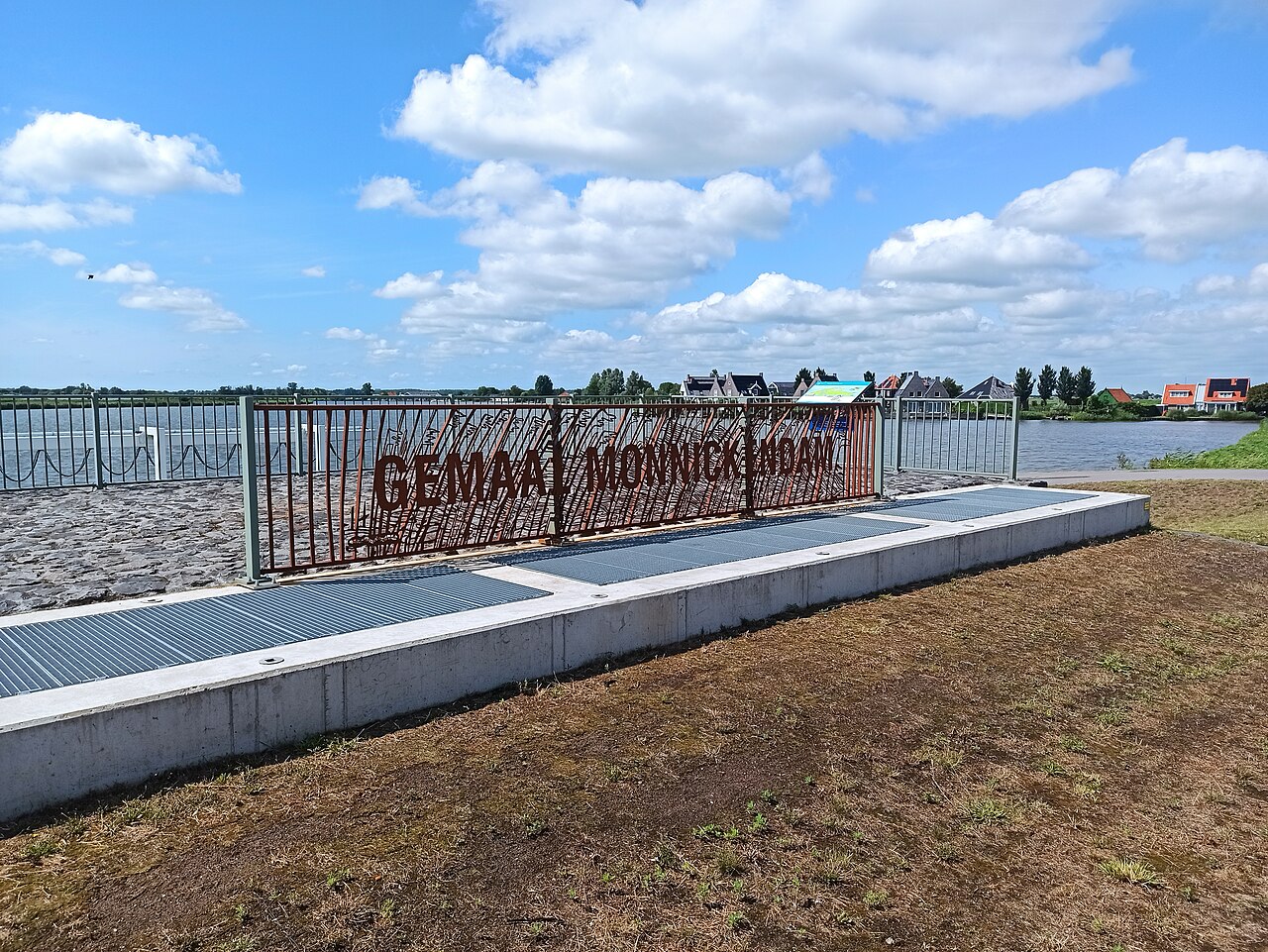
Just north of Monnickendam, near the Nieuwendam and the N247, lies a place where cars, cyclists, water and pumping technology meet. It is neither a quiet ruin nor a picturesque old lock with weathered gates. Asphalt, dike, water, bridges, modern engineering and the open space of the Gouwzee now define the view. Yet for centuries a waterwork stood here that only very recently became visible again, not above ground, but in a construction pit.
The vanished lock belonged to a crucial transition. On one side lay Waterland’s inland waters and the Purmer Ee. On the other lay the former Zuiderzee, later the IJsselmeer and Markermeer. Water had to be controlled between those worlds. A dam without a passage blocks navigation, while an uncontrolled opening allows sea and inland waters to interact too freely. A lock made both possible: closing off and allowing passage.
Archival research indicates that a first lock already existed here, or in this dam, in 1401. It was filled in during 1534. Monnickendam then had a new wooden lock built in the Nieuwendam between 1565 and 1567. Centuries later, during construction of Gemaal Monnickendam, the remains of that second lock reappeared. Timber still survived beneath the modern structure, well preserved in the wet clay.
Wood preserved beneath clay and groundwater
That timber matters. In dry conditions, such a structure would largely have disappeared. Below the groundwater level, however, wood could survive for centuries. Archaeologists were therefore able not only to establish that a lock had stood here, but also to examine parts of its construction. It was not a matter of a few loose planks, but of remains from a large water-control structure that once formed a carefully built passage through the dam across the Purmer Ee.
The lock did not lie here by chance. Monnickendam was a town on the water. Trade, fishing, shipping, supply, drainage and protection were all connected with the link between inland waters and the sea. The Purmer Ee connected the hinterland with the outside world. A lock in the dam determined when ships could pass and when water had to be held back.
The lock was therefore more than a technical structure. It set rhythm and direction. The passage regulated navigation, drainage, the habitability of the hinterland and the protection of town and polders against excess water. Such large questions took physical form in wooden beams, lock gates, sills, walls, clay and craftsmanship.
A small lock with a major function
What has now almost entirely vanished was once part of daily life. Skippers knew the passage. Water managers maintained it. The town paid for maintenance, repairs and replacement. Water rose and fell, gates opened and closed, vessels waited, passed through and moved on. The lock was a small place with a major function.
But waterworks age. Timber decays, dams settle, currents change, towns expand and new solutions replace old ones. The sixteenth-century lock remained in use until the beginning of the seventeenth century. It was then filled in because of structural decay. Two years later, work began on a new lock elsewhere, the Grafelijkheidssluis, which is still a familiar visible lock near Monnickendam.
The older lock then disappeared from view. Not because it had been unimportant, but because new waterworks, roads and layers literally covered it. The town continued to manage water, while the former passage vanished from everyday awareness. Generations drove, walked and cycled above a wooden structure that had once controlled access between inland water and sea.
Old logic beneath modern technology
The visible present is modern and functional. The new pumping station manages water on a large scale with electrical pumps and contemporary hydraulic engineering. Beneath that modern layer, however, lay an older logic: timber, clay, dam, gate and water level. The question remained the same, while only the means changed. Water had to leave the land when necessary and be kept out when dangerous.
The water lines explain the meaning of the place. The Purmer Ee on the inland side, the openness towards the Gouwzee, the dike as a hard boundary and the road as a modern layer above older connections all belong to the same system. The vanished lock was a wooden passage through the dam, a controlled link between two water worlds.
A hinge in the landscape that disappeared from view
The surroundings make that logic clear. Monnickendam does not stand apart from the landscape, but lies on the edge of Waterland among polders, former sea, old waterways and dikes. The region was shaped by water and by attempts to hold it back. Without dams, locks, quays and pumping stations, this landscape would look entirely different. The vanished lock was one part of that larger system, but became exceptionally tangible when its timber reappeared from the clay.
The 2021 discovery is a reminder that infrastructure is often built on top of infrastructure. A new pumping station does not appear on an empty site, but on a hydraulic junction that has existed for centuries. Precisely because such places continue to function, older layers often go unrecognised. They lie beneath roads, embankments, new concrete and the familiarity of daily use.
The vanished lock near Monnickendam is therefore not a place of substantial visible remains. Its significance lies in understanding what once existed beneath the surface. The lock itself does not lie as a ruin beside the cycle path. What remains visible are the lines that explain its function: dam, dike, water, passage and pumping station. The old structure was investigated, recorded and once again disappeared from ordinary view. Its history now survives mainly in the site, the sources and the way the landscape is arranged.
That is true of much Dutch water heritage. Not everything survives as a visible monument. Sometimes the most important parts disappear underground precisely because they were always functional. A church or castle was meant to be seen. A lock primarily had to work. Once it no longer worked, it was replaced, filled in or built over. Memory then survives only through the relationship between landscape, archives and archaeology.
Where the Purmer Ee, the Nieuwendam and the modern pumping station meet, there is therefore more than a present-day hydraulic junction. Beneath the ordinary lines of traffic, water and technology lay a wooden lock that connected Monnickendam with sea and hinterland. What disappeared was not a minor detail. It was a hinge in the landscape.