
The story of this place
A burial ground beneath a busy city square
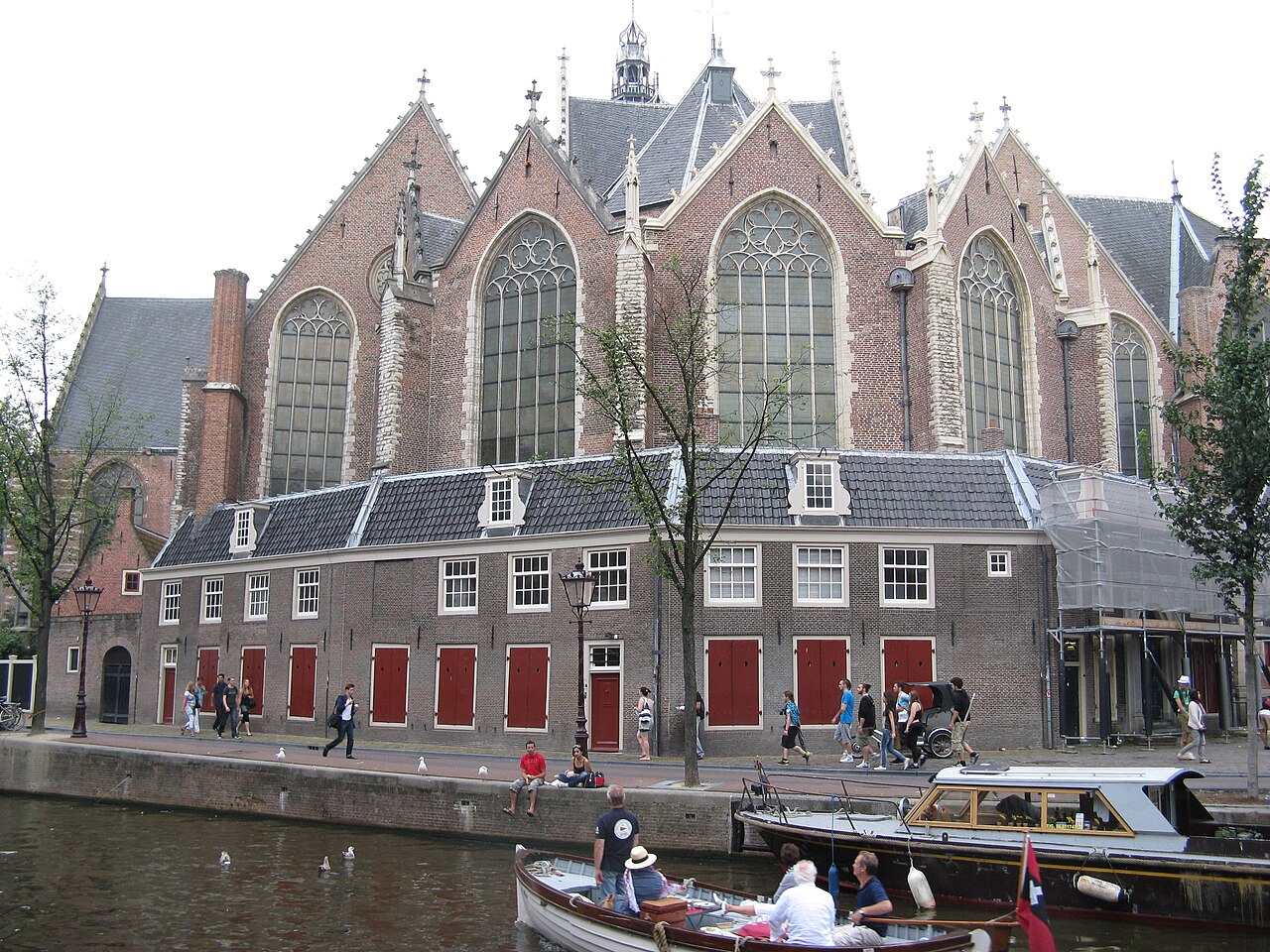
Oudekerksplein is not a quiet place. It lies in the middle of the Red Light District, among streams of tourists, cafés, façades, bridges, bicycles and windows. The Oude Kerk stands large and solid among them as Amsterdam’s oldest building, yet the square around it often feels more like a passageway than a place of remembrance. That contrast defines the site: what is now stone, bustle and urban use was once a burial ground.
For centuries, the dead were buried around the Oude Kerk. That suited the medieval city. The church was not only a place of worship, but also the centre of life, death, trade, power and community. People wished to be buried close to the church because proximity to the altar, prayer and sacred space carried meaning. Ordinary Amsterdam residents were buried outside, around the church; inside the church, burial was largely reserved for those who could afford it.
The origins of this place reach back to the earliest city. Around 1300, soil was deposited on Oudekerksplein to create a mound-like elevation for the stone church. A ditch was also dug to mark the boundary of the church grounds. That detail matters. It shows that the church did not simply stand in the city, but occupied a defined site: a sacred and social space distinct from the rest of the settlement. Within that boundary, people prayed, buried their dead and commemorated them.
Burial around and inside the Oude Kerk
The ditch was later filled in and the church expanded. Amsterdam grew with it. The city became fuller, wealthier and more densely built. The space around the church changed with that growth. Where open churchyard ground had once lain, more and more walking routes, houses, passages and urban functions appeared. The dead remained, but the city pressed ever closer around them.
Burial around the church continued into the seventeenth century. In 1681, however, the churchyards around the Oude Kerk were cleared. A visible layer of urban memory disappeared with them. The square that now seems self-evident is therefore a later urban form laid over an older space of the dead. Where burial ground had lain, a square gradually emerged. The name Oudekerksplein only later became customary for the entire area around the church.
Inside the Oude Kerk, burial continued much longer. The floor still consists largely of grave slabs. Over the centuries, tens of thousands of known and unknown people became connected with this place: mayors, merchants, sailors, artists, craftspeople, children, women and men whose names or grave numbers are sometimes all that remains. The church is therefore not only a building, but also an underground city of the dead.
From burial ground to square
Outside, that layer is much harder to sense. On Oudekerksplein there are no longer rows of gravestones ordering the space. There is no churchyard wall separating the site, no gravel path beside graves and no quiet edge that naturally creates distance. The vanished churchyard has merged into the city. The history remained in the ground, but lost its visible form.
The contrast is sharp. Inside the church, death remains visible in stone. Outside, the same history lies beneath everyday use. Terraces are set out, bicycles are parked, groups stop, photographers point their cameras at the church and streams of people move through the Red Light District. The place is constantly in motion, but the ground carries a much slower history.
That is not exceptional in Amsterdam. The old city is full of places where burial, building, demolition and reuse followed one another. On Oudekerksplein, however, the contrast is unusually strong because the surroundings are so busy and charged. Few places reveal so clearly the contrast between memory and everyday urban life, devotion and entertainment, silence and noise.
The Oude Kerk is therefore not only a monument among canals and façades, but the centre of an old landscape of the dead. The church was built on a site where people had already been buried and which continued to serve as a burial ground for centuries. The surroundings were once sacred space, then churchyard, then square and later part of one of the best-known urban neighbourhoods in the Netherlands. Each layer did not completely erase the previous one, but made it almost unreadable.
The narrow spaces between façades and church wall, the paving, the edges of the square and the places where the city almost touches the church still preserve something of that layering. The vanished graves have not been reconstructed, but the old layout of the space remains woven into the square around the church. People were buried here because this was their parish, their neighbourhood, their religious community and their city.
Who remained visible and who disappeared
The vanished burial ground also tells of inequality. Those with money and status could be buried closer to the heart of the church. Those with less remained outside or received a simpler place. Even after death, the city remained ordered by wealth, family, name and position. The floor of grave slabs inside the church still shows that hierarchy; the vanished churchyard outside is instead the layer of the many who remained less visible.
That makes memory fragile. Famous names survive more easily than ordinary people. A grave slab inside the church can be read, photographed and studied, while a cleared churchyard beneath a square disappears much more quickly from view. The ground remains, but recognition disappears. What remains is a square that almost conceals its own past.
A silent layer beneath the Red Light District
Yet the past has not vanished completely. The name Oudekerksplein preserves the connection with the church, the shape of the square still reflects the space around the building and the church itself remains an anchor. Knowing that people were once buried here changes the meaning of the cobbles and the bustle. Amsterdam proves here to be built not only on water and trade, but also on memory and loss.
The vanished burial ground of Oudekerksplein no longer exists as a cemetery in the city, but as a silent layer beneath one of its loudest places. Its absence is the essence of the experience: no gravestones outside, no enclosure and no visible field of the dead, only a square where the city grew over a former burial ground. Beneath the bustle of the Red Light District lies a landscape of the dead that has almost disappeared from urban memory.