
The story of this place
A castle that vanished into the landscape
Ter Coulster lies in Heiloo as an estate in which the memory of a vanished castle has almost dissolved. An avenue, tall trees, a gate with lions, water lines, paths and later buildings now form the visible whole. Beneath that quiet estate layer lies the older structure of a house that was connected for centuries with power, property and status in Kennemerland.
Ter Coulster long belonged to the old power structure of Heiloo. The history of the estate goes back at least to the late Middle Ages. Around 1400 a castle or fortified house stood here, connected with noble families who held land, rights and status in Kennemerland. The name remained, while the building itself almost entirely disappeared from view.
That makes Ter Coulster unusual. There is no ruin with high walls and visible towers. The vanished castle has been absorbed into an estate landscape. The gateway, the avenue, the watercourses and the position of Ter Coulster Hof still offer clues. Where there are now trees, grass, paths and farm-like buildings, there was once a moated house with a bridge, tower, rooms and a clear boundary between inside and outside.
Gate, lions and a straight avenue
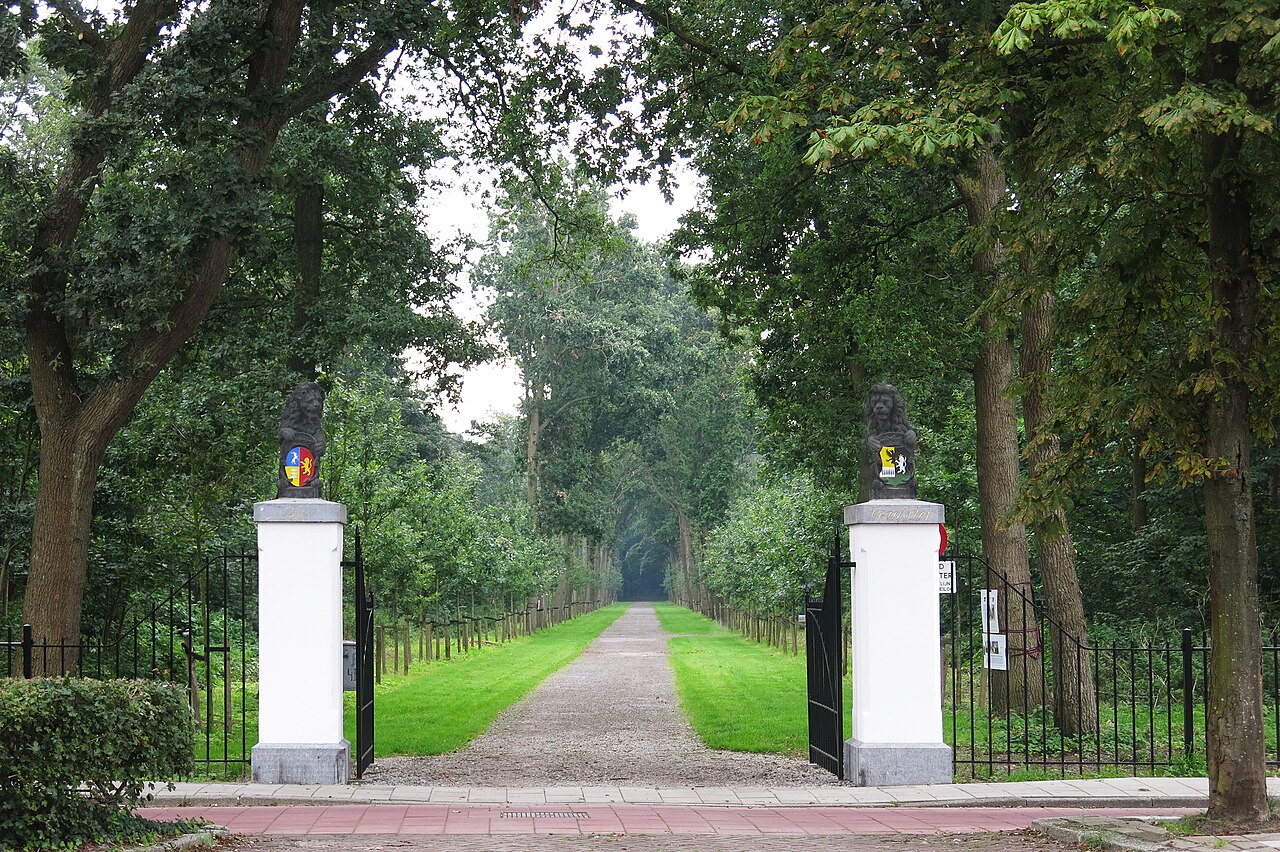
The entrance on Kennemerstraatweg is the most visible anchor. Two white gateposts, each crowned by a stone lion and coat of arms, mark the approach to the former house of Ter Coulster. They are national monuments in their own right and still preserve something of the status once attached to this place. An ordinary farm or woodland edge would not have had such guardians. The lions recall property, lineage and representation.
Behind the gate, the avenue runs straight into the estate. Such an avenue was never merely practical. It directed the view, slowed the arrival and made the transition from public road to private domain tangible. The route toward the house belonged to the way in which property and rank were shaped in the landscape. Even now that the woodland is publicly accessible, that old ordering remains legible in the straight line of the avenue.
Destruction, rebuilding and final demolition
Ter Coulster Castle did not have a quiet history. In 1517 it was destroyed by Grote Pier and his Gelderland Frisians. Later it was rebuilt. In 1573, during the Dutch Revolt and the fighting around Alkmaar, it was occupied by troops moving through the region. The place did not stand outside history, but in the midst of unrest over power, war and possession.
In the seventeenth century the complex took on more of the character of a country house. There were swans, an orchard and, according to later descriptions, dozens of rooms. The defensive house increasingly became a country residence. That is an important shift. Power no longer had to express itself only through defensibility; it could also appear in avenues, views, comfort, ownership and a managed landscape.
Yet the old house remained difficult. It was large, damp, cold and expensive to maintain. In 1788 it was demolished. With that, the main building of Ter Coulster disappeared from the landscape. Not through one dramatic battle, but through cost, loss of use and the practical value of stone and rubble. Many castles and country houses disappeared in this way: not as legend, but as calculation.
After the demolition, the place gained a new life. In 1808 Gijsbert Fontein Verschuir, mayor of Alkmaar, bought the estate. He had a wooden country house built there, but that too did not survive. It was demolished again in 1847. Later, a farm called Ter Coulster Hof was built on or near the old foundations and cellars of the vanished castle. In this way, a noble residence slowly became an agricultural and landscape ensemble.
Water, farm and later layers
The present appearance of Ter Coulster mostly consists of those later layers. The woodland, avenue, gate, farm, water features and tea pavilion belong to different phases. They are not arranged neatly like a museum display, but have grown through one another. The castle is not gone in the sense that nothing remains. It is gone in the form in which a castle is usually expected to appear.
The old moat is an important trace. Water shaped the castle site. A moat was defence, boundary and status at the same time. Where the water structure is still present or readable, the outline of the old house briefly returns. Not as a wall, but as a line in the landscape. A ditch or pond can say more here than a loose stone.
Ter Coulster Hof is also more than a rural building in the green. It stands where the castle site was later reused. That reuse makes such places both vulnerable and meaningful. A vanished castle is not always left empty. People live, work, demolish, build, plant and adapt. Each new function slides over the previous one.
Ter Coulster therefore tells not only of nobility, but also of disappearance. The castle did not vanish from history all at once. First it changed from fortified house to country house. Then it was demolished. Then a new country house appeared. Then a farm. Meanwhile the name, gate, avenue, water and estate remained. The form changed, but the place held on to its old meaning.
An estate that preserves its old form
The woodland makes that history both visible and invisible. Trees soften the lines, but also preserve the sense of enclosure. The straight avenue, plot edges and open spaces show that this is not spontaneous woodland. It is a designed, managed and used landscape. The older layer comes forward in direction, access, water structure and terrain layout.
The nineteenth-century tea pavilion adds another tone. Where the medieval house evoked power and defence, the tea pavilion belongs to country-house culture, view and leisure. That layer too has now become old. The estate is therefore not a single-period place, but a sequence of shifts: castle, country house, demolition, farm, woodland, walking area.
The strength of Ter Coulster lies in this succession of forms. It offers no grand spectacle and no clearly defined ruin. The white gateposts are visible, but the rest is subtler. In the avenue, the waterways, the transition from road to woodland, the site of Ter Coulster Hof and the sense of enclosure behind the gate, the vanished castle still remains embedded.
Ter Coulster is therefore more than a pleasant estate. It is a landscape in which a vanished castle still just preserves its form. The old power is no longer present as a building, but as name, entrance, water line, estate structure and memory. Precisely because the castle has dissolved into later layers, the place continues to speak of property, demolition, reuse and the slow disappearance of noble landscapes.