
The story of this place
A church site on the old beach ridge
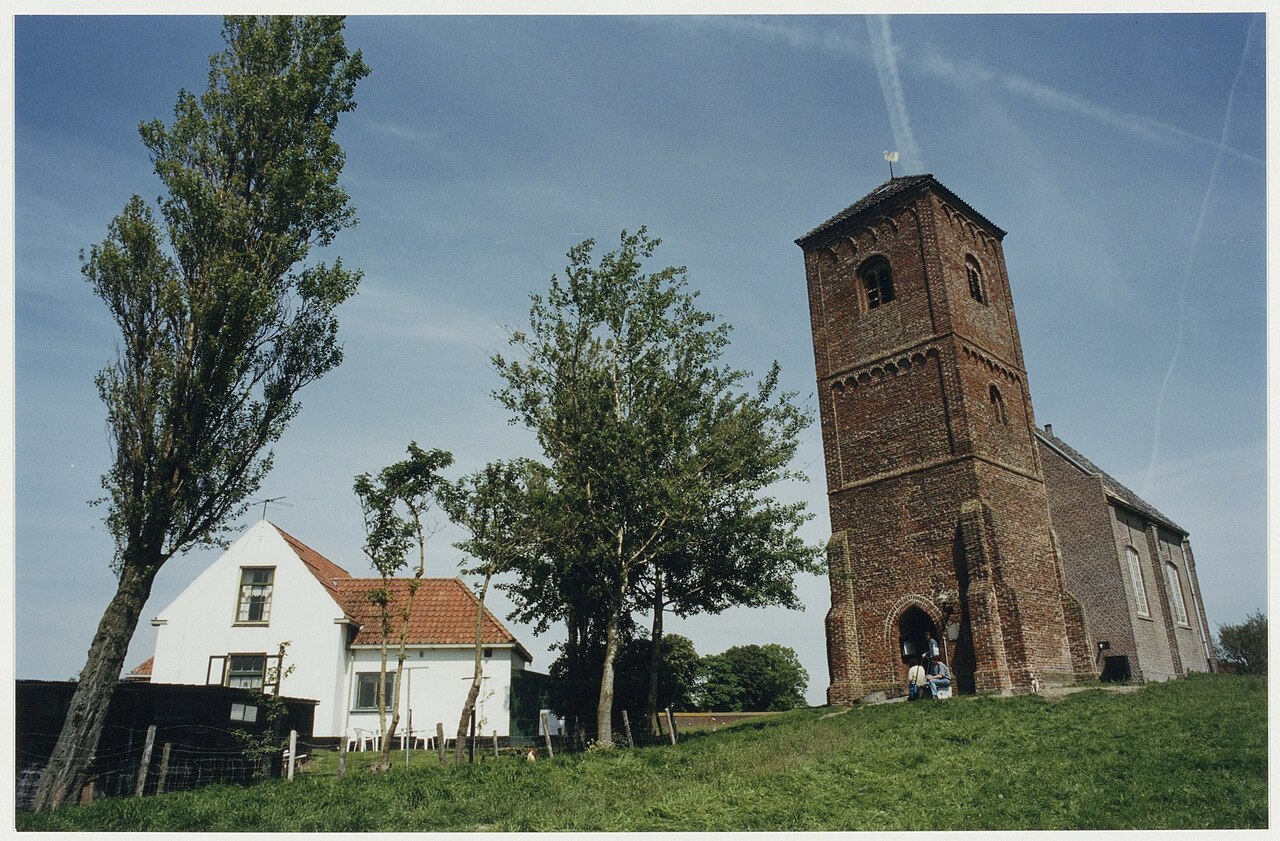
Stump Tower of Spaarnwoude first appears to be a modest old church building in the greenery: brickwork, a short tower, a low roof and a churchyard around it. Yet that small, truncated form carries a larger story. The tower is striking not because of its height, but because of the absence of it. Its name preserves a loss.
The tower once had a spire and rose differently above Spaarnwoude. It belonged to a church site much older than the present building. A church in this area is already mentioned in the eleventh century. Later, a medieval church dedicated to Saint Gertrude stood here. Of that older world, not the whole has survived, but a remnant: the tower, the churchyard, the site on the rise and the memory of a village centre.
Spaarnwoude itself is older than the modern surroundings suggest. The village lies on an ancient beach ridge, a higher sandy strip in a landscape later shaped by peat, water, dikes, roads and recreation land. The church site is therefore not placed randomly in the landscape. It belongs to an old higher piece of land where habitation, burial, gathering and orientation were possible from early on.
That makes the tower more than a separate building. It belongs to a landscape in which height mattered. In low, wet land, a higher place was important. A church on such a site naturally became a landmark. Not only for the village itself, but also for movement through the surrounding land and water. The tower was a sign in space: Spaarnwoude, church, churchyard and village came together here.
Centuries of building and repair
The tower itself dates back to the thirteenth century. It was built in heavy brick, with walls meant to carry the weight of centuries. The present church building attached to it is younger and dates from 1764. The building therefore already shows that time here does not fit neatly into one period. Tower and nave belong to different centuries. Together they form not a complete medieval whole, but a composite church site that was repeatedly adapted.
Damage and loss are also part of that story. In 1573, during the conflict around Haarlem, Spaarnwoude was struck by war. The church building was later repaired, but in 1747 it was badly damaged again, this time by storm. In 1764 the present church was built. The site therefore preserves not only age, but also recovery after rupture. The church site remained, even when the building changed.
The spire that disappeared
The most striking loss came in the nineteenth century. In 1844, the tower required restoration. There was not enough money to preserve it in its old form. The spire disappeared, the tower was shortened and given a low roof. Since then, it has been blunt. The name sounds almost friendly, but carries a sharp historical meaning: part of the tower was literally lost here. Spaarnwoude’s skyline therefore became simpler, lower and more sober.
the Stump Tower shows how history sometimes survives as reduction. Not everything disappears completely. Sometimes something is shortened, repaired, adapted and then used further as if it had always been that way. The short tower is therefore not an accidental architectural detail, but a visible scar in the village image.
De Akker Gods and changing use
Around the church lies De Akker Gods, the old churchyard. That name gives the site a quiet weight. A church without regular worship, a tower without a spire, a churchyard with old and newer graves: together they tell of a village community whose centre of meaning shifted. Services, burials, remembrance and gathering came together here for centuries. Later, the place became quieter, more cultural and more strongly heritage than village necessity.
Since 1880 the church has no longer been used for ordinary worship. After that, the building gained other functions. It was used as a studio, a dwelling, a cultural centre, a museum space, a wedding venue and a place for concerts and exhibitions. That is not only loss, but also survival. Each new use laid a layer over the previous one. The building remained in use, while its original religious function receded into the background.
A tower that speaks through what it lacks
The meaning of the Stump Tower lies in the relationship between what still stands and what is missing. The brick tower, the low roof, the rise in the landscape, the churchyard and the open space around it together form a story of presence and absence. The tower speaks not only through its walls, but also through its truncated form.
Spaarnwoude is now easily associated with recreation land, roads, green strips and the edges of larger settlements. At the Stump Tower, an older village layer comes forward. Not as a complete medieval scene, but as a remnant that has not quite allowed itself to be pushed aside. The old beach ridge, the church site, the churchyard, the tower, the vanished spire and the reused space all belong to the same story.
People lived, prayed, buried their dead, repaired, shortened, forgot and reused here. the Stump Tower is therefore more than a short tower on Kerkweg. It is a remnant of Spaarnwoude itself: a village older than its surroundings suggest, and a tower that continues to speak precisely through what it lacks.