
The story of this place
After closing time
At Brederode it never becomes entirely silent.
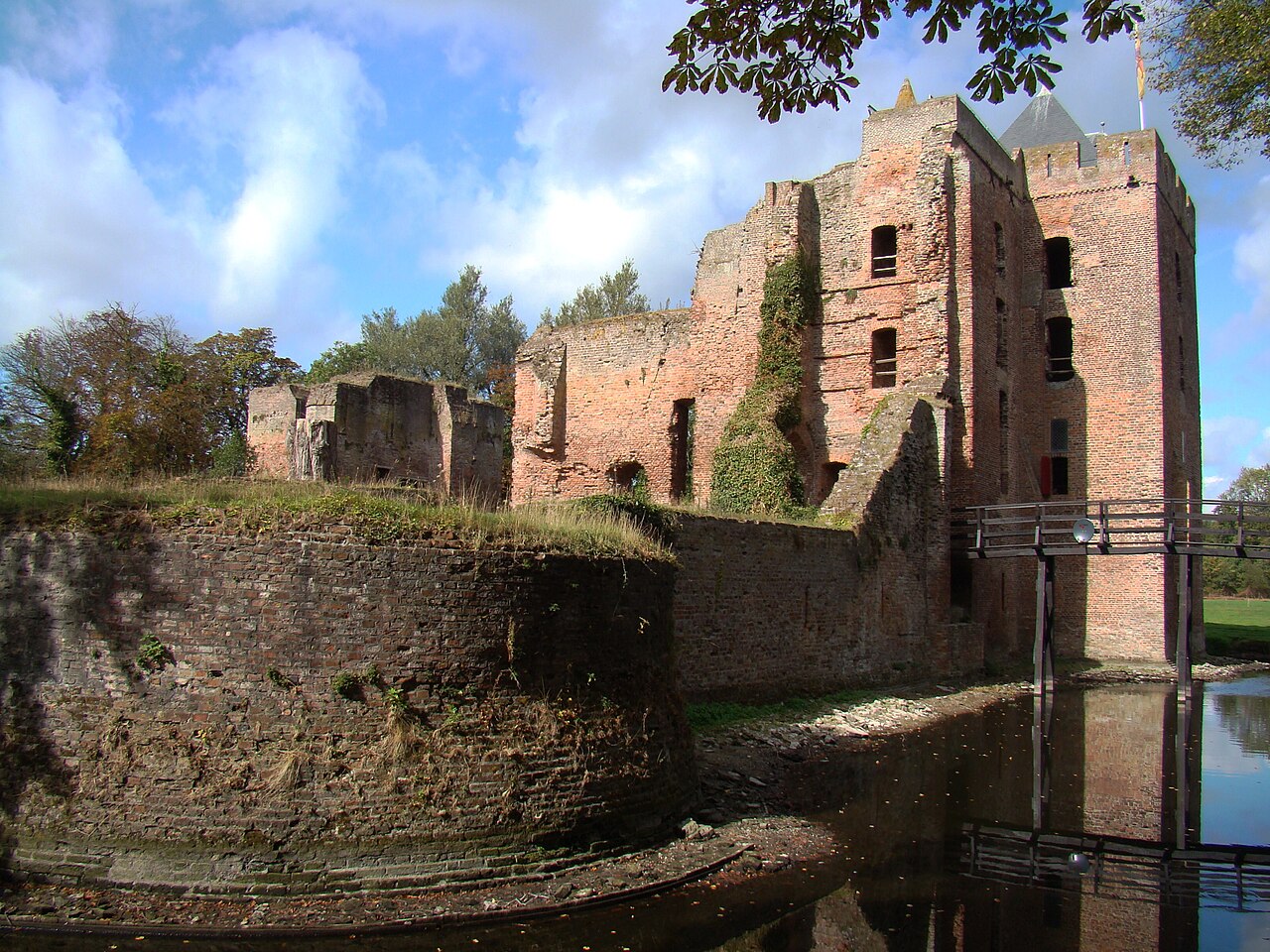
Not when the visitors have gone, the gate has closed and the last voices disappear along the road. Then the walls remain in the fading light. High and broken. With glassless windows, open towers and stairways leading towards vanished floors. The moat around the ruin grows dark. What is stone by day gains something watchful by evening.
The woman between the walls
A specific name became attached to these walls: Yolande van Lalaing.
She was not a nameless white maiden invented for a later ghost story, but a historical lady of the castle. She lived at Brederode during the sixteenth century. She was married to Reinoud III van Brederode and remained connected with the castle and her family’s interests after his death. In later tradition, she became the woman who could never quite free herself from the fortress.
That is why she, in particular, is said still to appear between the walls.
Sometimes as a pale female figure near a tower. Sometimes behind an empty window. Sometimes across the moat, where a white form stands briefly before disappearing. The stories provide no fixed place or hour. Yolande does not appear reliably every night or at an appointed stroke of the clock. She remains just outside certainty.
A glimpse. A movement. Something white where no one should be standing.
Look directly and there is only stone and shadow. Look away and afterwards it seems someone must have been there.
A castle that disappeared
The historical Yolande probably never saw the ruin as it appears today. In her time Brederode was still an inhabited castle with roofs, rooms, corridors and hearths. Servants crossed the courtyard. Fires burned behind windows now open to the sky. The towers belonged to a house, not to a skeleton.
Afterwards the castle lost layer after layer.
War, damage, plunder and prolonged abandonment turned the fortress into a ruin. First the inhabitants disappeared. Then roofs and floors. Rooms became open air. Corridors ended above nothing. What remained was large enough to reveal former power and empty enough to make every sound suspicious.
In such a place a footstep can linger.
Stone on stone. Brief. Then nothing.
The sound may come from a bird, from water touching the bank or from an old wall reacting to the cold. Yet the body listens before the mind has chosen an explanation. The ruin works slowly. It does not need to show anything spectacular. A small sound where no one should be walking is enough.
The tradition surrounding Yolande fits that emptiness. She became the face of everything Brederode lost: the inhabited house, the family, life behind the walls and the final link with a time when the fortress was not yet empty. Her apparition therefore need not be spectacular. She is more like someone returning to rooms that no longer exist.
A woman beside a vanished window.
A skirt brushing a wall where a passage once ran.
A hand near a door that rotted away centuries ago.
Whether she truly wanders as a spirit cannot be established. The stories developed later around a historical woman and a ruin that naturally invites imagination. Yet because Yolande genuinely existed, the legend carries more weight than a nameless white lady from later folklore.
She lived here. She knew the rooms. She probably looked across the same moat, although the walls stood differently around her. Where an anonymous ghost would provide only atmosphere, her name carries a real life with it.
The moat makes the apparition still more unsettling.
Water beside a ruin doubles everything. It pulls walls and towers downward and builds a second castle beneath the surface. Windows break apart in the reflection. Dark openings become deeper. When the water moves, the ruin seems to move as well.
At times it appears that the vanished rooms survived not above the water, but beneath it.
A step sounds in a corridor that no longer exists. A door closes on a floor that disappeared. Something white passes through the reflection and dissolves when a ripple breaks the walls apart.
One last look back
By day Brederode can be explained. You see building phases, towers, walls and remains of aristocratic power. Names and dates still fit the stones. The ruin is a historical structure that can be examined and understood.
Towards evening that relationship changes.
The empty windows turn black. The courtyard seems larger. The road outside the grounds feels farther away. An opening that appeared shallow by day becomes a place where someone might be standing. Mist may resemble a veil. A branch may become a hand. An edge of stone may briefly carry a face.
Yolande is not the only presence later associated with Brederode. Old castles easily gather stories of soldiers, servants, children and other inhabitants who supposedly never left. Yet her name remained the strongest anchor. The final lady of the castle beside a house slowly disappearing from the world.
Perhaps that is why she continued to return.
Not because her ghost demonstrably walks through the towers, but because her life stands closest to the last inhabited Brederode. She gives the emptiness a face. Through her name the open spaces become windows once more and the vanished halls turn back into rooms.
Stay near the ruin until late and Brederode changes gradually. First it becomes more beautiful in the low light. Then older. Then less reassuring. The water turns black. The gate seems narrower. Shadows remain in place longer than expected.
Then somewhere a footstep sounds again.
Not enough to prove anything. Enough to become silent.
It may be the wind. A bird. Moving water. Stone cooling after the day. There is probably an ordinary explanation. But the story of Yolande lives precisely in that brief moment before the explanation. In the few seconds when an abandoned place no longer seems empty.
When you leave, the ruin remains behind. The windows black. The moat still. The towers open to the sky.
No one stood behind the window.
No woman crossed a vanished floor.
Yet you look back once more.