
The story of this place
A green answer to poor housing
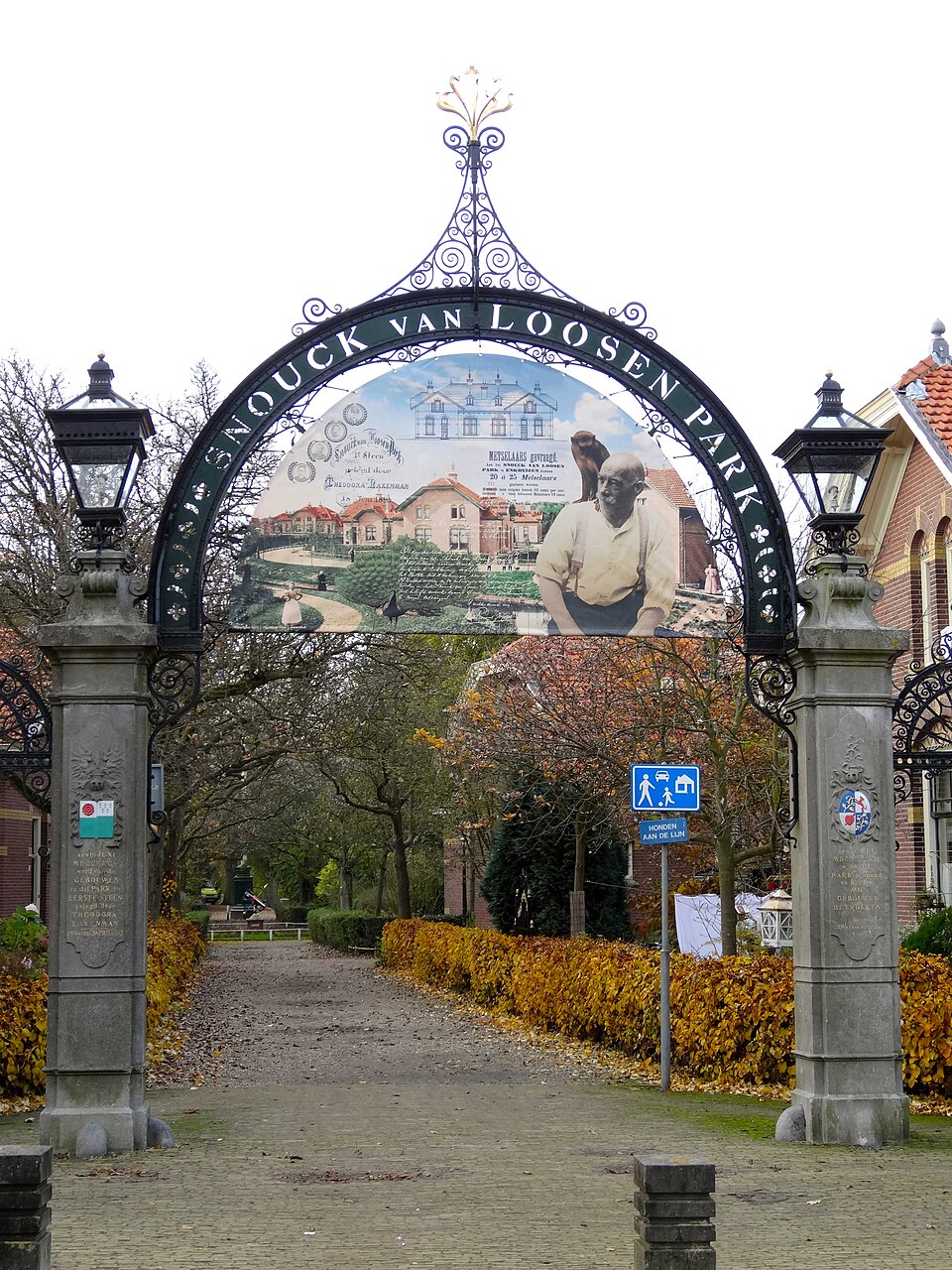
Snouck van Loosenpark lies on the edge of Enkhuizen’s old town, close to the station and harbour. Behind the entrance is a green residential park with historic workers’ houses, winding paths, planting, a pond, bridge and mature trees. The atmosphere is quiet and almost idyllic, but the origin of the park lies in a much sharper social issue: the nineteenth-century search for better housing for working families.
The park was created from the legacy of Margaretha Maria Snouck van Loosen, the last descendant of a wealthy Enkhuizen patrician family. She died in 1885 and left a large part of her fortune for charitable purposes in Enkhuizen. From that capital emerged, among other things, the Snouck van Loosen Fund. The fund financed facilities that would permanently change the town, including housing, care institutions and other forms of organised charity.
Snouck van Loosenpark was laid out between 1895 and 1897. The houses were designed by C.B. Posthumus Meyes, the park layout by H. Copijn. The whole consisted of fifty single-family houses and a supervisor’s house. It was therefore one of the earliest social housing projects in the Netherlands. Its layout was unusual: workers’ houses were not placed in a cramped street or back neighbourhood, but in a green, carefully designed environment.
That choice was significant. In the nineteenth century, awareness grew that poor housing was linked to disease, poverty, moral decline and social unrest. Dark rooms, damp dwellings, overcrowding and lack of fresh air were increasingly seen as problems that affected not only individual families, but the town as a whole. Good housing, reformers believed, could contribute to health, order and respectability.
Housing, selection and supervision
Snouck van Loosenpark translated that ideal into space. Light, air, greenery, separate houses and a well-kept environment were meant to contribute to a better life. The houses were spacious compared with many workers’ homes of the period. The park-like layout gave living a dignity far removed from the overcrowded, confined and often poor housing in which many working families elsewhere ended up.
Yet the park was not a modern social housing project in the later, egalitarian sense. The houses were intended for a selected group of working families. Help was linked to ideas about industriousness, good conduct, morality and suitability. Philanthropy offered opportunities, but also set conditions. The park therefore tells not only of improvement, but also of selection and social control.
The supervisor’s house belonged to that order. A residential park for working families was not only built, but also managed, watched and regulated. The presence of a supervisor fitted a paternalistic form of social care. Residents gained access to good housing, but within an environment in which order, behaviour and maintenance mattered. Charity and supervision lay close together.
The architecture of the houses reinforced the park’s special character. The houses appear small-scale, well-kept and almost rural. Brickwork, roofs, wooden accents, gardens and placement around the greenery give the whole a friendly appearance. That friendliness was not only aesthetic. It belonged to an ideal in which a neat home and green surroundings could elevate, discipline and protect people from the pressures of poverty and urban decline.
Greenery, wealth and social uplift
The park layout also played a major role. H. Copijn designed an environment with geometrical and landscape elements, winding paths, a pond, bridge and planting. The greenery was not accidental decoration around the houses, but an essential part of the plan. The park was meant to radiate calm, health and order. The living environment itself became an instrument of social improvement.
This combination of housing and greenery makes Snouck van Loosenpark related to later garden village ideas. Yet the park was created before the major wave of Dutch garden villages and Housing Act construction. The project therefore stands at a transitional moment: between private philanthropy and organised public housing, between patrician charity and modern social policy, between moral selection and the broader right to healthy housing.
The location in Enkhuizen adds meaning to the story. The town had known great prosperity in the seventeenth century, but later lost much of its economic importance. In the nineteenth century, Enkhuizen had become a smaller and more vulnerable town, with poverty, limited employment and decline. The Snouck van Loosen family fortune was therefore deployed in a town where social support could make a visible difference.
From philanthropic experiment to social housing
Margaretha Maria Snouck van Loosen herself lived a relatively withdrawn life. After her death, her name gained a public presence in Enkhuizen. The park, the fund and other institutions connected the family name to social care. Private capital thus became urban infrastructure. An inheritance became a spatial programme: housing, greenery, care and management took shape in the town.
When completed, the park was not just a collection of houses, but a staged residential world. Residents lived in an environment intended to express health, calm and neatness. The houses stood in a park, not on an ordinary workers’ street. That layout gave status and protection, but also made residents part of a visible social experiment. The park showed how workers, according to benefactors, could and should live.
That double character is essential. Snouck van Loosenpark was progressive because it offered working families good homes in a green environment. At the same time, it was rooted in a period when help came from above and when the poor or less well-off were often judged by behaviour and merit. Social improvement was therefore not self-evidently universal, but tied to norms.
During the twentieth century, public housing changed profoundly. The Housing Act, housing associations, municipal housing services and large-scale expansion districts increasingly made social housing a public and institutional task. Snouck van Loosenpark thereby acquired a different meaning. What had once been innovative and exceptional became an early link in a much larger history of public housing.
An idyllic park with a complex social history
The site nevertheless remained recognisable as a coherent whole. The houses, greenery, water feature, bridge, paths and entrance gate still preserve the layout of the original project. Its monumental value lies not only in the individual houses, but in the relationship between architecture and park design. That coherence shows how housing, morality, health and landscape were brought together in a single design.
Later recognition as a listed national monument confirmed that importance. Snouck van Loosenpark is protected not only because it is beautiful, but because it forms an early and rare example of socially inspired housing in a park-like setting. The complex preserves the history of a moment when housing, greenery and social uplift were seen as one task.
The present-day tranquillity of the park can easily obscure the more complex social realities of its origins. The houses look well-kept, the greenery is pleasant and the paths suggest slow movement. Beneath that harmonious exterior, however, lies a history of poverty, selection, philanthropy, supervision and the search for dignified housing. The park is therefore not only idyllic, but socially charged.
Snouck van Loosenpark preserves the memory of a time when social progress often still depended on private wealth and moral judgement. Good housing was made possible here by an inheritance, shaped through architecture and landscape, and regulated through administration and supervision. Among the trees, houses and paths lies the history of a town trying to capture care, order and housing quality in one green form.