
The story of this place
A castle designed above all to impress
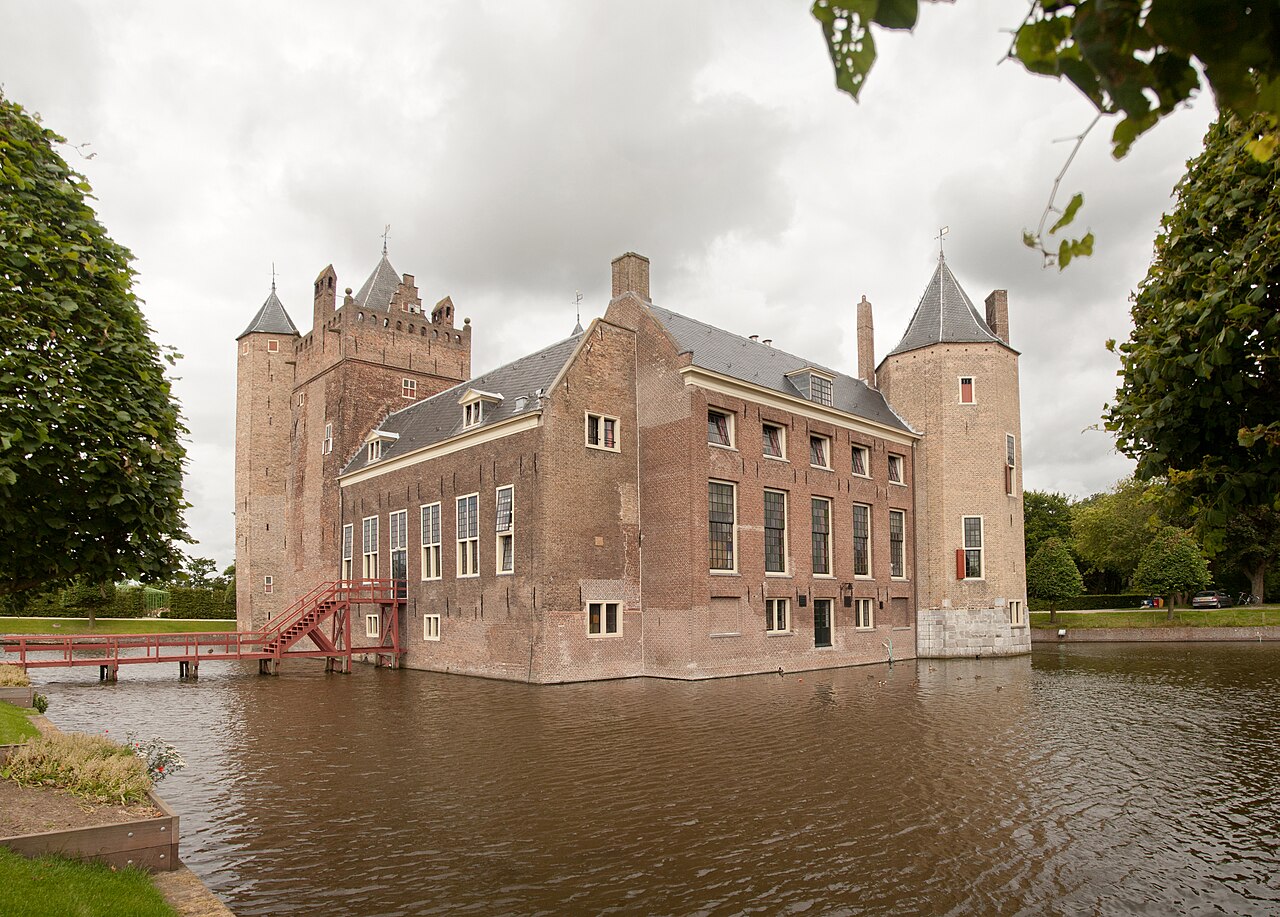
Assumburg Castle stands on the eastern side of Heemskerk, close to the old hamlet of Assum. The castle lies behind water, bridges and greenery. From Tolweg you first see the moat and, beyond it, the heavy mass of brickwork. Towers rise above the wings, the bridge leads towards the entrance and on the far side the formal garden opens out. Every part of the layout makes clear that a separate domain began here.
The castle image is convincing. Assumburg has the enclosed form, water and towers expected of a medieval stronghold. Yet it was not a heavy frontier fortress built chiefly for siege and warfare. It was first and foremost a noble residence. Protection mattered, but appearance, status and representation were at least as important.
A medieval core with many later layers
The history of the site reaches back to the Middle Ages. Even before the present castle, a house stood here that became associated with the name Assumburg. During the fifteenth century, the basis of the complex that can still be recognised today took shape. The castle was subsequently rebuilt, repaired and adapted many times. What you see now therefore does not belong to a single building phase, but combines a medieval core, later alterations, restorations and new uses.
This makes Assumburg less straightforward than it first appears. The building presents itself as one coherent old castle, while several periods lie hidden behind its façades, towers and roofs. Some elements refer to the medieval residence, while others belong to a time when comfort and representation became more important. Restorations have also shaped the version of the past that visitors believe they are seeing today.
Towers, wings and an enclosed courtyard
The four wings surrounding the courtyard give the building its compact and enclosed character. Two square corner towers and a later octagonal tower define the silhouette. These towers were not merely practical architectural elements. They made the house present itself unmistakably as a castle. Even when its military function became less important, the architecture continued to express power, age and prestige.
The courtyard is the hidden heart of this enclosed plan. From the outside you mainly see walls, water and towers. Within the complex, living, working, receiving guests and governing were brought close together. The four wings turned the castle into more than a detached house: they formed a small world with a clear inside and outside. That separation reinforced the sense that different rules and social relationships applied here than in the surrounding village.
Water, access and authority
The moat also contributed to this image. Water created distance between the castle and the ordinary landscape. The brick bridges made the boundary passable, but only along a clearly defined route. Access was therefore directed, while the building remained recognisable as a separate world. Power was expressed not only through thick walls, but also through distance, direction, bridge and threshold.
Anyone approaching the castle moved step by step from the public surroundings into a controlled domain. First came the water, then the bridge and finally the entrance to the building. This sequence gave even a peaceful visit a ceremonial quality. The architecture determined not only where someone walked, but also how small or important that visitor might feel in relation to the house.
A late Gothic gallery with a court of justice once stood beside the courtyard. This feature refers to justice, administration and local authority. Assumburg was therefore more than a noble house behind a moat. Residence, ownership and governing power came together here. The architecture showed who was allowed to enter, who dispensed justice and who controlled the estate.
From residential castle to country estate
Behind the castle lies a formal garden with hedges, paths, patterns and long sightlines. The present layout is a reconstruction of a Baroque garden based on an eighteenth-century example. As a result, Assumburg changes character as you walk around the building. On the moat side, enclosure, brickwork and towers dominate. On the garden side, the castle takes on the character of a country estate in which order, taste and rank are central.
The garden turned the surroundings into part of the display. Paths determined where people walked, hedges created outdoor rooms and sightlines connected the house to the landscape. Where the moat created distance, the garden introduced overview and control. Nature itself was ordered here. In this way, the owner showed that not only the building but the entire estate stood under his direction.
This transition is what makes the site distinctive. Assumburg did not remain merely an old castle, but also became a setting for noble residential culture. The garden added a new layer without erasing the older ones. Stone, water and greenery came together as a carefully staged whole. The estate had to be not only practical, but also distinguished and controlled in appearance.
Assumburg therefore says more than a first glance at its towers and moat might suggest. The wings enclose the courtyard, the bridges direct access and the garden organises the view. None of these elements stands alone. Together they form a landscape of residence, status and authority.
The age of the castle lies precisely in this accumulation of periods. A medieval core, early modern alterations, later restorations and modern reuse together form the building we see today. The question is therefore not only what was originally built, but also how later residents and custodians wished to preserve and reshape the visible past.
Restoration always involves choices. Some elements are repaired, others recede into the background and sometimes an earlier situation is made visible again. Assumburg therefore tells not only the story of its first builders and residents, but also that of generations who decided what should be preserved. Today’s castle image is both historic heritage and the result of later ideas about how an old castle ought to look.
Assumburg Castle is neither a ruin nor a hidden archaeological site. It stands prominently in the landscape and almost effortlessly creates the impression of an ancient castle. Behind that familiar image, however, lies a layered history of residence, prestige, justice, garden design and restoration. The site shows how power could become fixed in brick, water and sightlines, and how a castle could sometimes impress more through what it projected than through what it could actually withstand.