
The story of this place
From medieval chapel to large village church
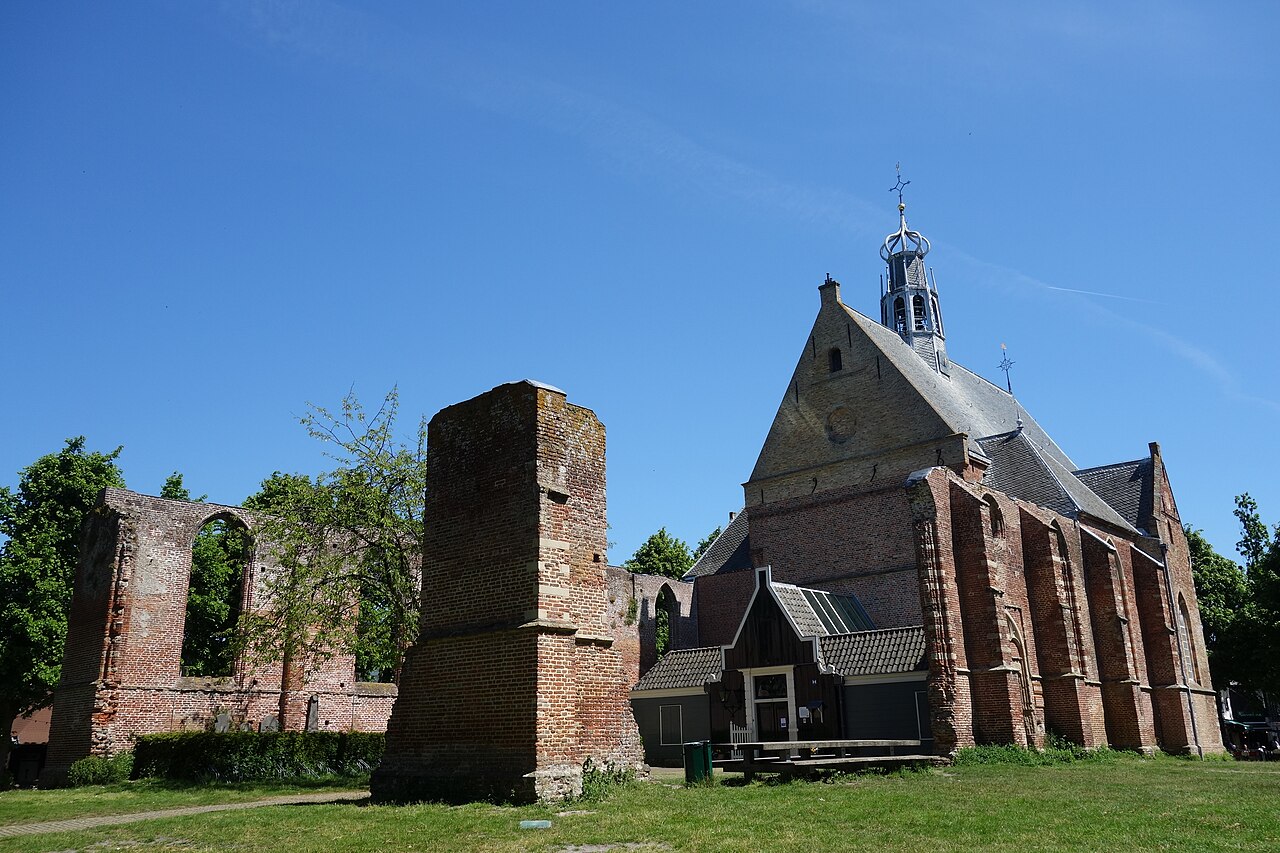
The Ruined Church stands in the centre of Bergen, but the present building tells only part of the story. What is used as a church today was once the choir of a much larger whole. The nave extended across the open space beside it and a tower also stood here. The low walls around the church are therefore not isolated remnants. They trace the outline of what disappeared.
The site almost works like a full-scale ground plan. You do not need a reconstruction drawing to understand the old church. You can walk through it yourself. Where there are now grass, gravestones and open sky, there were once walls, columns and a roof.
A place of worship already stood here in the Middle Ages. A chapel in old Bergen is recorded in 1094. People came here to pray, have their children baptised and bury their dead. The church was connected not only with faith but with almost every important transition in village life.
Miracle, pilgrimage and popular devotion
In the fifteenth century, the meaning of the site changed. According to tradition, after the St Elizabeth’s Flood of 1421 a ciborium containing consecrated hosts from Petten washed ashore near Zanegeest. The water in which the hosts lay was later said to have turned red. Believers saw the blood of Christ in it. The story became known as the Miracle of Bergen.
Pilgrims came to Bergen to pray, do penance or seek protection. In the fifteenth century, the older church gave way to a larger brick building. The pilgrimage that developed after the miracle contributed to further expansion and to the church’s growing importance.
A trace of popular belief also survived on the south side. According to tradition, people scraped stone dust from a corner stone and dissolved it in water. The water was believed to protect against the plague. In this way, even a fragment of stone became part of the faith surrounding the site.
Fire, Reformation and a smaller church
In February 1574, during the Eighty Years’ War, the church was plundered and set on fire. This was probably done to prevent Spanish troops from using the building as a strongpoint. Much of the church was lost. The tower disappeared as well.
For Bergen, this meant more than the loss of a building. The place where generations had prayed, buried their dead and gathered together lay open and damaged in the middle of the village.
The church was not rebuilt in full. Only the choir was restored and was usable again by the end of the sixteenth century. This smaller section became the church space. The walls of the nave remained standing as a ruin. This created the form that still defines the site: a living church within the remains of a vanished church.
After the Reformation, the use of the building changed. The Catholic pilgrimage tradition disappeared from public life and the restored choir received a Protestant interior. Yet the older history remained present in the ground, the walls and the name of the place.
The Ruined Church therefore contains several layers of belief. It began as a Catholic chapel, grew into a pilgrimage church and later became a Protestant village church. None of these periods completely erased the previous one.
The ruin as visible memory
Bergen was also touched by later warfare. In 1799, heavy fighting took place nearby between a British-Russian army and Franco-Batavian forces. Damage in the south wall is associated with those battles. The masonry therefore tells not just of one act of destruction, but of several moments when larger conflicts reached the village.
The remains of the nave could have disappeared. They could have been demolished or completely rebuilt. That did not happen. The ruin remained part of the church grounds and became one of Bergen’s most recognisable sights.
That is precisely what gives the site its strength. Many monuments mainly show a restored final result. Here, the loss remains visible as well. Visitors see both what still exists and what is missing.
Bergen continued to grow around the church. The site remained a churchyard, meeting place and landmark. Today, the church hosts services, concerts, lectures and other gatherings. Its function changed, but people continued to come together here.
Those who look only at the present church see an old choir. Those who also read the ruined walls see a complete history of growth, faith, destruction and restoration.
That is the power of this place. The Ruined Church does not preserve its past behind glass. You walk straight through it. Beneath the open sky, you stand in a vanished nave. A few steps further on, you enter the part that remained alive.