
The story of this place
A castle at the edge of the dunes
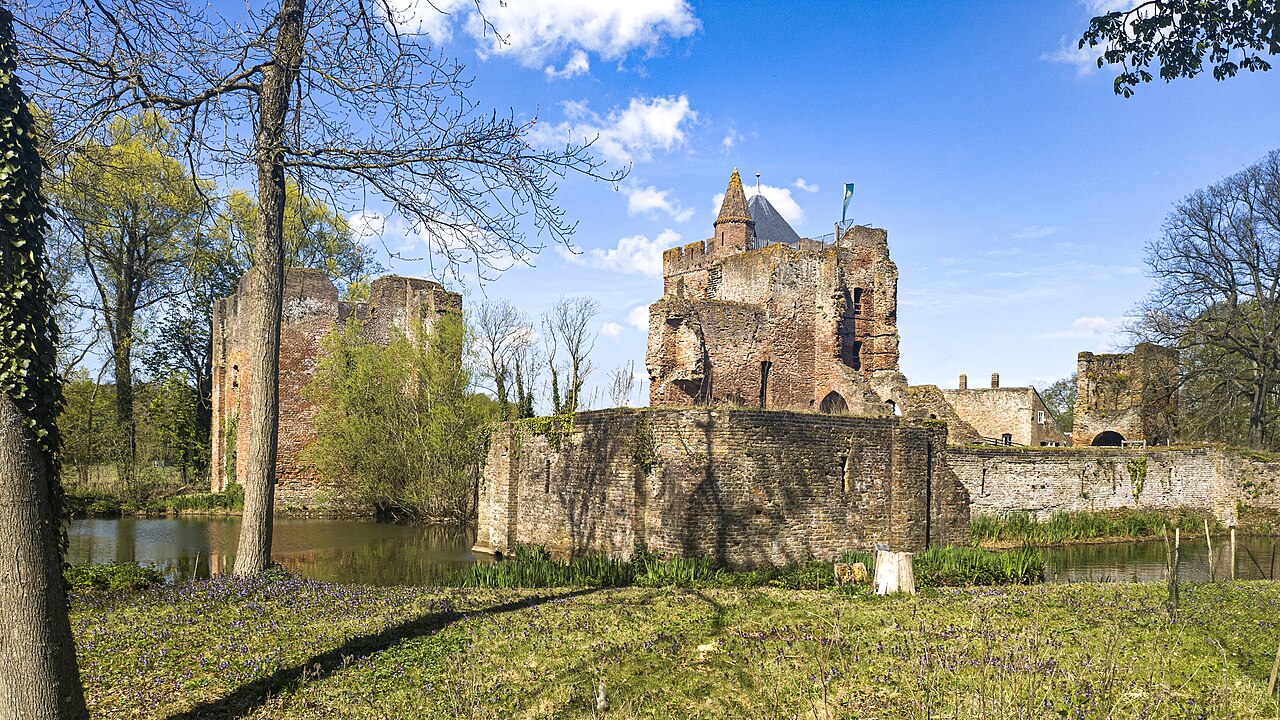
The Brederode Ruins lie near Santpoort as the exposed core of a vanished world of power. Moats, weathered walls, roofless towers, bridges and grass between the stones immediately show that a castle once stood here. Yet Brederode is more than a romantic remnant of the Middle Ages. The ruin preserves traces of noble power, war damage, loss of function, drifting sand and early monument care.
Brederode Castle was founded in the second half of the thirteenth century by William I van Brederode. The Van Brederode family was related to the lords of Teylingen and stood close to the counts of Holland. The castle was therefore more than a noble residence. It belonged to a political world in which landownership, family ties, feudal relations, military power and closeness to the count reinforced one another.
Its location was not accidental. Brederode lay near Santpoort, on the edge of Kennemerland, between dunes, routes, villages and access to the hinterland. A castle here was not only a place to live, but also a declaration of power in the landscape. Walls, moats and gates made visible who claimed authority. Stone and water together formed a message of control.
The lords of Brederode
What remains today are the moated remains of a late medieval castle with a main castle and an outer bailey. That distinction is important. The main castle was the strongest and most representative part. It held the most important residential and defensive functions. The outer bailey belonged to the working of the whole: access, storage, labour, service, movement and control. A castle was not a single tower, but a small organised world behind moats and walls.
The ruin still preserves that ground plan. Gates, bridges, moats, wall remains and open spaces show the logic of access and enclosure. Bridges made passage possible, but also controllable. Moats show that water was also a defensive tool here. Wall remains indicate where rooms, towers and passages once stood. The whole is damaged, but not unreadable.
Brederode was repeatedly affected by conflict in the late Middle Ages. During the struggle between the Hook and Cod factions, the castle was damaged and partly destroyed. Later it was restored, but the site remained vulnerable. Noble houses were not only residences; they were political strongholds as well. When power relations changed, such castles could become targets.
From battlefield to abandoned castle
In 1492 the castle was plundered during the revolt known as the Kaas- en Broodvolk uprising. After that Brederode lost much of its residential function. The history of the ruin is therefore not one sudden disaster, but a sequence of breaks. Damage, repair, loss of function and political change accumulated. The castle slowly became detached from the daily life for which it had been built.
The decisive turning point came in 1573, during the Dutch Revolt. After the siege of Haarlem and fighting in the region, Brederode was plundered and set on fire. From then on the castle remained a ruin. That date matters because it shows how long this place has existed as a remnant. Brederode has not only recently become a ruin; it has been a landscape of loss for centuries.
After that, time did its work. The dunes of Kennemerland blew drifting sand over the remains. Parts of the ruin disappeared under sand and vegetation. What had once been a visible centre of power increasingly became a remnant half lost in the landscape. Not everything was removed, but much was covered. The place did not disappear completely, but sank out of ordinary view.
From ruin to romantic monument
That is an important layer of Brederode. The ruin is now well known and accessible, but the castle itself partly disappeared from the landscape for centuries. Its present openness is therefore not an original condition. It is the result of decay, covering, excavation, restoration and management. What is visible is both a medieval remnant and a later heritage form.
In the nineteenth century Brederode gained a second life. The remains were excavated and restored. The state became involved in caring for the ruin, making Brederode an early site in the history of monument care in the Netherlands. The ruin therefore tells not only of medieval castle decay, but also of the nineteenth-century discovery of heritage as something that should be preserved.
The ruin carries two histories at once. On the one hand it speaks of noble power in medieval Holland. On the other, it shows how later generations began to look at that past. The walls have not simply remained as they were. They have been excavated, consolidated, restored and opened to the public. The ruin itself has also been shaped by choices.
What the walls still reveal
Some parts still stand high enough to make the scale of the castle tangible. Others are low remains, foundations or open spaces. The alternation between presence and absence gives the ruin its strength. Enough remains to recognise the structure, but not enough to reconstruct the complex automatically. Brederode’s force lies precisely in that tension between wall and void.
The moats and the transition between main castle and outer bailey show that the complex was larger than a single stone residence. The walls mark the boundaries of former rooms, corridors, storage spaces, hearths and stairways. Where there is now air and grass, there were once floors, levels and working spaces. The openness of the ruin is therefore not emptiness, but the visible result of loss.
The name Brederode evokes grand history, but the ruin also works on a human scale. A gate determined who could enter. A bridge could grant or deny access. A wall separated habitation from the outside world. A tower gave a view over the surroundings. A moat created distance between inside and outside. Power here was not only imagined, but built, guarded and used in daily life.
At the same time Brederode is not a silent place without a modern layer. The ruin is used for visits, activities, weddings, concerts and events. That changes the atmosphere, but it also says something about the long life of the place. The old power has vanished, the residential function has vanished and the defensive function has vanished, but the form remained strong enough to gain meaning again.
Brederode is not valuable only because its decay is picturesque. The ruin shows how power can disappear without being entirely gone. The family left the place, the castle lost its function, sand covered the remains, the state uncovered them again, and what was once enclosed and guarded later became public heritage.
The Brederode Ruins therefore preserve an open wound in the landscape of Kennemerland. Medieval power, war damage, drifting sand, loss of function and heritage conservation lie layered here. The castle has disappeared as a habitable stronghold, but not as a form, a name or a memory. It is precisely as ruins that Brederode has remained visible.