
The story of this place
From persecution to a visible house of prayer
The Portugese Synagoge stands in the heart of Amsterdam’s old Jewish quarter. On Mr Visserplein you see a large freestanding building with low surrounding buildings and a forecourt. The exterior is sober. Even so, it is immediately clear that the synagogue claims a visible place in the city.
That matters because the story of this place begins with people who had long been unable to live openly as Jews. The Sephardic Jews who settled in Amsterdam during the seventeenth century came from families that had left Spain and Portugal after persecution, expulsion and forced conversion. Many had lived as New Christians for generations. Jewish memories and family ties nevertheless survived.
Amsterdam offered more room than many other European cities. That freedom was not complete, but it was sufficient for a visible Jewish community. Portuguese Jews established their own institutions. They founded schools, cemeteries, poor relief and houses of prayer. Trade and international contacts also helped the community grow.
The construction of the Portugese Synagoge between 1671 and 1675 was therefore more than an architectural project. A community shaped by flight and forced adaptation built a house of prayer that did not need to remain hidden. The building showed that Amsterdam’s Jewish community had gained a visible place in public life that was often denied elsewhere in Europe. The synagogue stood openly on the square.
A room for reading and listening
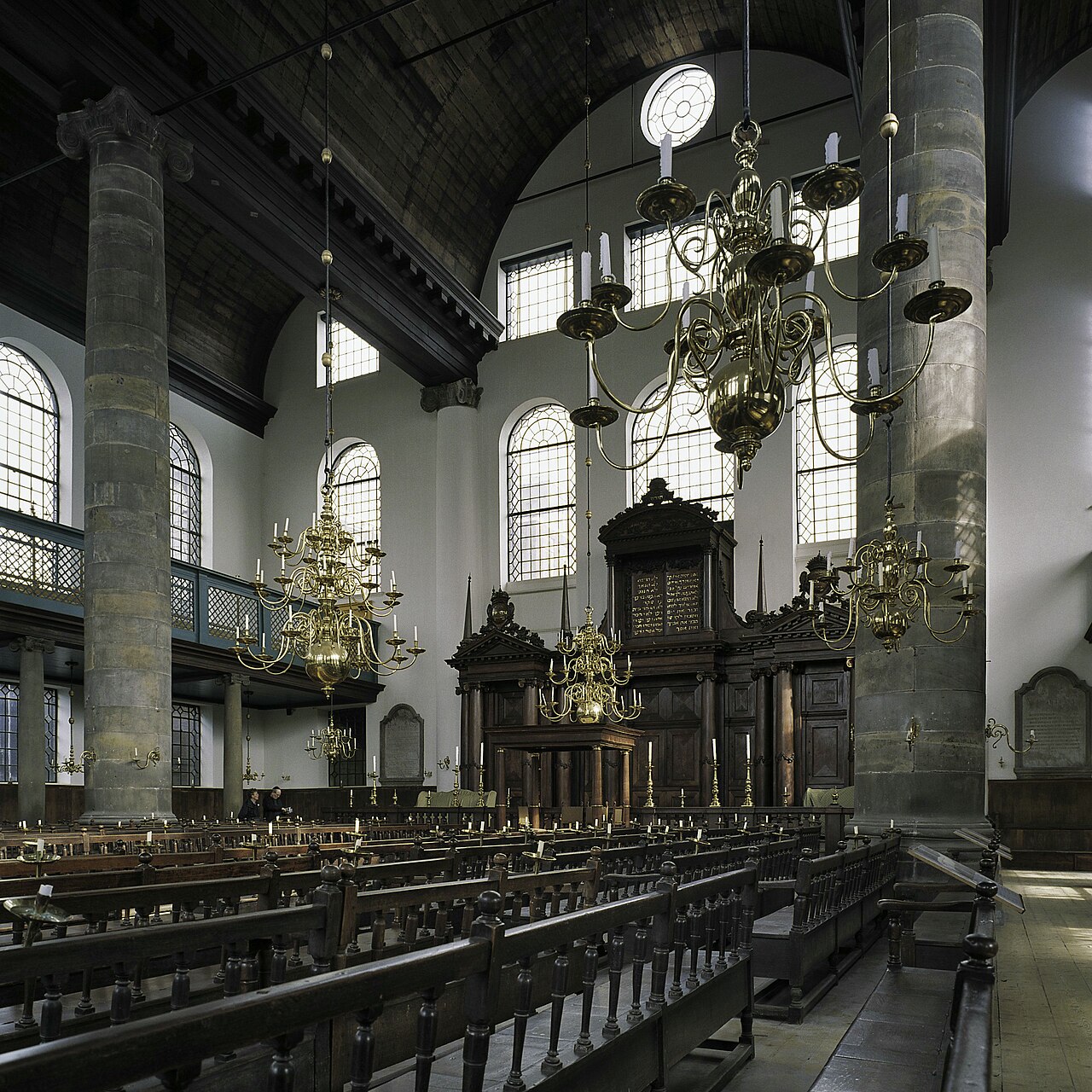
Inside, that visibility takes on a different character. The room is high and light without being lavish. Sandstone columns support wooden galleries and a timber barrel vault. Benches, chandeliers and the large hechal create a restrained interior. Fine sand covers the wooden floor, a distinctive feature of the historic interior. Candlelight strengthens the sense of a room that remains close to its seventeenth-century origins.
The layout differs clearly from that of a church. There is no altar that draws all attention. The hechal holds the Torah scrolls. The Torah is read from the tebá. The room is arranged for reading, listening and communal prayer.
The Portugese Synagoge was built to be used. Hebrew words, Sephardic melodies and the opening of the hechal belong to the room. Carrying the Torah scrolls and lighting the candles are also part of its ritual order. Its sobriety is not emptiness. It makes room for voice and action.
A Sephardic house in Amsterdam
The names Esnoga and Snoge refer to the community’s Sephardic tradition. This synagogue is not only an Amsterdam monument. It belongs to families with roots on the Iberian Peninsula and to a history of departure, adaptation and renewed Jewish life.
For many families, the synagogue meant a return to open religious practice. Here they could educate their children and follow their calendar. They could pray, commemorate their dead and gather visibly as a community. The building therefore offered not only space, but also a restoration of dignity.
Continuity after persecution
The story does not end with seventeenth-century prosperity. In the centuries that followed, both the community and the surrounding Jewish quarter changed profoundly. During the Second World War, Amsterdam’s Jewish community was devastated by deportation and murder. The synagogue remained standing. The world around it was deeply damaged.
The benches, timber and hechal therefore represent more than beauty. They make continuity visible after a devastating rupture. The fact that prayer still takes place here sets the synagogue apart from a purely museum-like setting. It is both a monument and part of a living religious tradition. The buildings around the forecourt belong to the same whole. They provided space for administration, teaching and ritual facilities.
What this place tells today
The buildings around the forecourt form part of this whole. They provided space for administration, education and ritual facilities. The sacred place therefore consisted not only of the main hall but also of the rooms around it.
The connection with Ets Haim is especially important. This historic library of the Portuguese Jewish community was founded in 1616. Prayer and study stand close together here. Ritual alone did not sustain the community. Books, interpretation and transmission between generations were equally important. Ets Haim is not included in every visit. Check in advance when the library can be visited.
The strength of the Portugese Synagoge lies in its open presence. Outside stands a sober and solid building. Inside is a room shaped around text, song and communal prayer. The synagogue tells how a community dared to become visible again after persecution.
Pause outside on the square as well. The synagogue belongs to Amsterdam’s history as a trading city and a city of migration, but also to its history of limited religious tolerance and persecution. It shows how a house of prayer can be both a place of memory and a place of living religious practice.