
The story of this place
A church behind a house façade
Along the Oudezijds Voorburgwal stands a row of tall canal houses. Anyone passing the façade of number 38 sees no church door, tower or religious image. Yet high inside the building lies one of the best-preserved Catholic hidden churches in the Netherlands.
The route to it leads through a seventeenth-century home. You pass rooms where people ate, received guests and worked. Narrow stairs and low passages follow. Only on the upper floors does the house suddenly turn into a church with pews, galleries and an altar.
After the Alteration of 1578
That contrast is no accidental effect. It shows how Catholic communities in Amsterdam had to function after the Reformation. Their faith disappeared from the public streetscape but found space behind ordinary façades. In 1578, during the Alteration, Amsterdam sided with the Revolt and came under Protestant government. Catholic churches and monasteries lost their public function. The old parish churches became Protestant and visible Catholic worship was banned.
The Catholic population did not disappear from the city, however. Many Catholics continued to live, trade and work in Amsterdam. They gathered in private houses, warehouses and rear buildings. There, priests could celebrate Mass, baptise children and bless marriages.
These churches were hidden, but usually not completely secret. Neighbours and the city authorities often knew what was happening. As long as a church was not recognisable from the outside and its gatherings did not disturb public order, it was regularly tolerated. That practice was not full religious freedom. It was a fragile balance between prohibition and permission.
Jan Hartman builds beneath the roof
The Catholic merchant Jan Hartman bought the house on the Oudezijds Voorburgwal in 1661. He later acquired two properties behind it. The lower floors remained in use as living and working spaces. He had the attics connected.
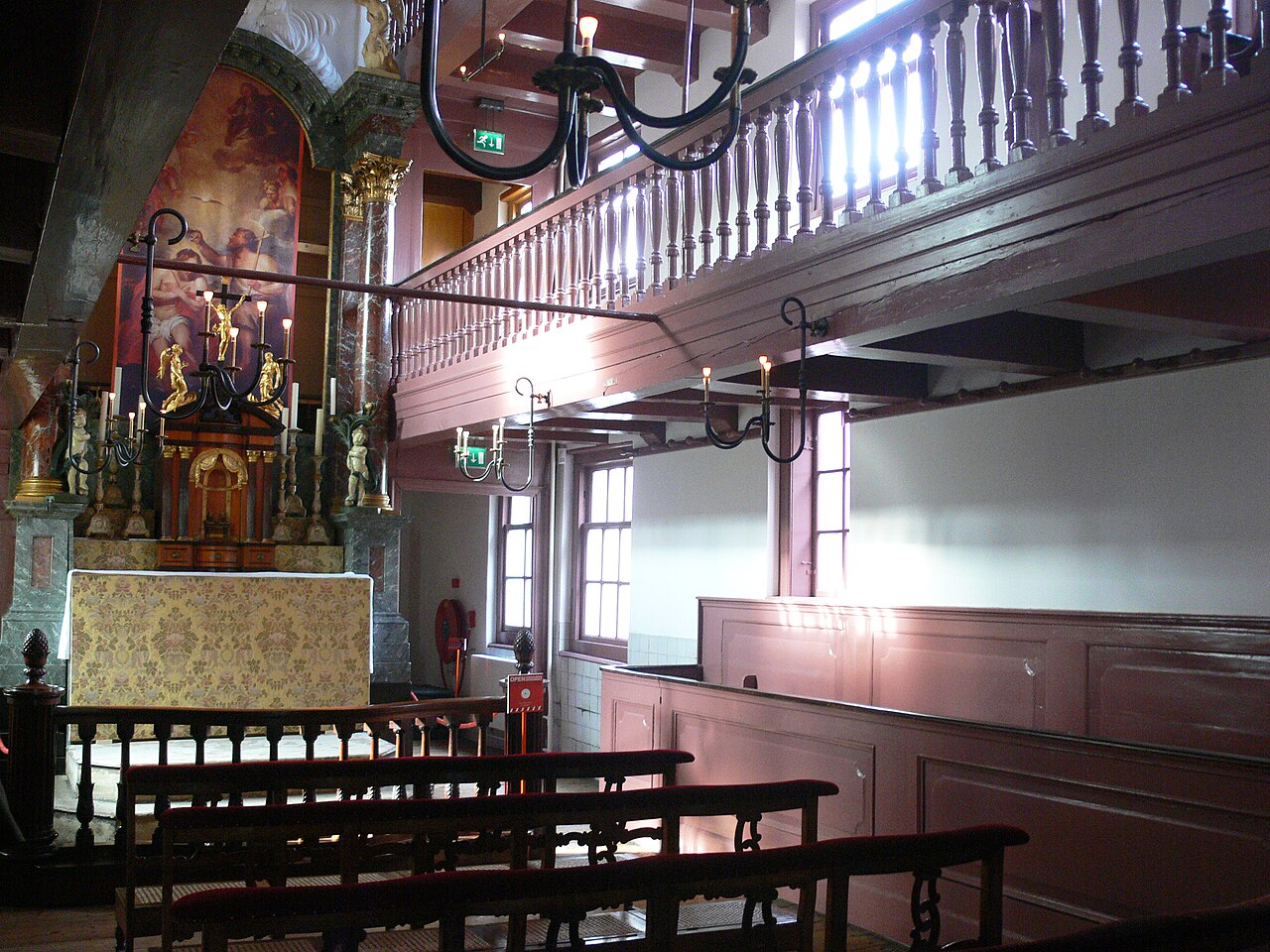
A church emerged there that was far larger than you would expect from outside. By partly removing floors and adding galleries, the space could accommodate a large congregation. The structure had to be fitted carefully between existing walls, beams and roofs.
The house church was known as Het Hart, a reference to the name of its owner Jan Hartman. It was dedicated to Saint Nicholas and served by priests who cared for the Catholic community in this part of Amsterdam.
A fully fledged church
Ons’ Lieve Heer op Solder was not a bare emergency space. The church was given everything needed for Catholic worship. There were pews, galleries, a pulpit, a confessional and a richly decorated altar. Statues and paintings gave the space a distinctly Catholic character.
The altar formed the visual centre. The interior developed in several phases and could be adapted to the liturgical year. The atmosphere therefore changed during major feast days and periods of reflection. The community did not merely want to preserve its faith, but to practise it as fully as possible.
The confessional also reveals much. The church was not only a place for Mass. People came for prayer, forgiveness, guidance, baptism and marriage. Behind the façade of a home, a complete religious life existed.
What this place tells today
Worshippers did not enter the space through a grand church portal. They came through an ordinary front door and moved upwards through the house. The climb along stairs and rooms formed part of the journey to Mass.
For present-day visitors, it still works that way. The church does not announce itself. It appears only after a series of small rooms and narrow passages. You therefore experience not only what the building looks like, but also how hidden faith was organised in the city.
Daily life took place downstairs. Upstairs, people prayed and celebrated. Both worlds existed in the same house, separated only by floors and stairs.
Jan Hartman made the construction possible, but the church did not revolve around one owner. Priests, worshippers and so-called spiritual daughters kept the community going. They cared for the liturgy, supported the poor and sick and helped with practical organisation.
The church therefore also shows how many people were needed to keep a hidden religious community alive. Money and architecture were not the only things that mattered. Trust, mutual help and discretion also kept the place alive.
In the nineteenth century, the position of Catholics changed. They could once again build recognisable churches and practise their faith more openly. In 1887, the nearby Basilica of Saint Nicholas took over the parish function.
The old hidden church then risked losing its significance. Amsterdam Catholics bought the building in order to preserve it. In 1888, Ons’ Lieve Heer op Solder opened as a museum. This makes it one of Amsterdam’s oldest museums.
That early rescue is remarkable. Many other hidden churches were altered or disappeared. Here, not only the church hall but also large parts of the house and the route leading to it were preserved.
Ons’ Lieve Heer op Solder is often regarded as evidence of Amsterdam’s tolerance. That picture is only partly correct. Catholics could continue to practise their faith, but they were not allowed to display it openly. Their freedom depended on invisibility and toleration.
That is precisely why this place is so valuable. It makes clear that tolerance is not the same as equality. The church was allowed to exist, but not to participate visibly in the public city. The façade had to remain silent about what happened behind it.
Pause upstairs before descending again. Look at the altar, the galleries and the pews. Think of the people who entered from the street through the same front door and climbed through the house. From outside, they saw an ordinary canal house. Beneath the roof, they found a complete church and a community in which their faith could continue. That double character still makes Ons’ Lieve Heer op Solder so impressive: the house does not merely hide the church, it explains why it had to be hidden.