
The story of this place
A village beneath the water
Near Etersheim the water can seem too smooth.
Behind the dyke the Markermeer lies open and still. As if beneath that flat surface there were nothing but cold, clay and dark water. But if you look longer, that emptiness does not feel empty. An older landscape lies beneath the water. Fields. Farmyards. A church site. Graves. A village that never returned to its old place.
Present-day Etersheim lies behind the dyke. Safe enough to make it easy to forget how vulnerable the land once was here. Older Etersheim lay closer to the former Zuiderzee, on an edge slowly eaten away by storms, erosion and subsidence. Water did not always arrive as one great disaster. Sometimes it came in bites. A piece of bank. A yard. A path. A place where someone had lived.
Then the sound disappeared too.
Not all at once. Not audibly. But imagine what a village loses when it sinks beneath water. Voices at doors. Footsteps over wet ground. Church singing. The striking of a bell above land that still lies dry. A bell calls people together. It marks Sunday, death, danger, celebration and mourning. If the village disappears such a bell should not simply fall silent.
The bells that kept ringing
That is why people kept listening.
The bells of the drowned land were said to lie somewhere beneath the water. Heavy and dark. Sunk with old Etersheim or with lost land on the edge of the Zuiderzee. No tower rises above them now. No church roof marks the place. Only water lies over it. Flat and silent.
But sometimes water can seem almost too silent.
Not in the middle of a busy day. Not when cyclists pass along the dyke or the wind lashes through the reeds. More likely in mist. At evening. When the Markermeer grows so still that sound travels farther than usual. When the air hangs heavy above the water and the horizon disappears. Then something may rise from the depths that at first seems less like a sound than a vibration.
Low. Dull. Far away.
As if somewhere beneath the lakebed metal is being struck by something that no longer has a hand.
Whoever heard it might say it was the bells. Not clear and festive. Not like a bell ringing above a village. But muffled. Slowed. Carried through water. A sound not from above but from below. Not from a tower, but from a drowned place remembering for a moment how it once sounded.
Then the Markermeer is no longer a lake. It becomes a lid.
Beneath that lid lies no invented emptiness. Around Etersheim enough traces have been found to know that people lived, believed, buried and travelled here. A medieval sarcophagus. Religious objects. Remains from a world that did not come from nothing and did not vanish without pain. You do not need to see a tower under water to understand why people kept imagining a voice down there.
A drowned bell is never only a bell. It is a village without streets. A church without walls. A community without breath. It does not ring to call people together. No one can come anymore. It rings to show that something beneath the water is not the same as something that never existed.
Where land disappeared
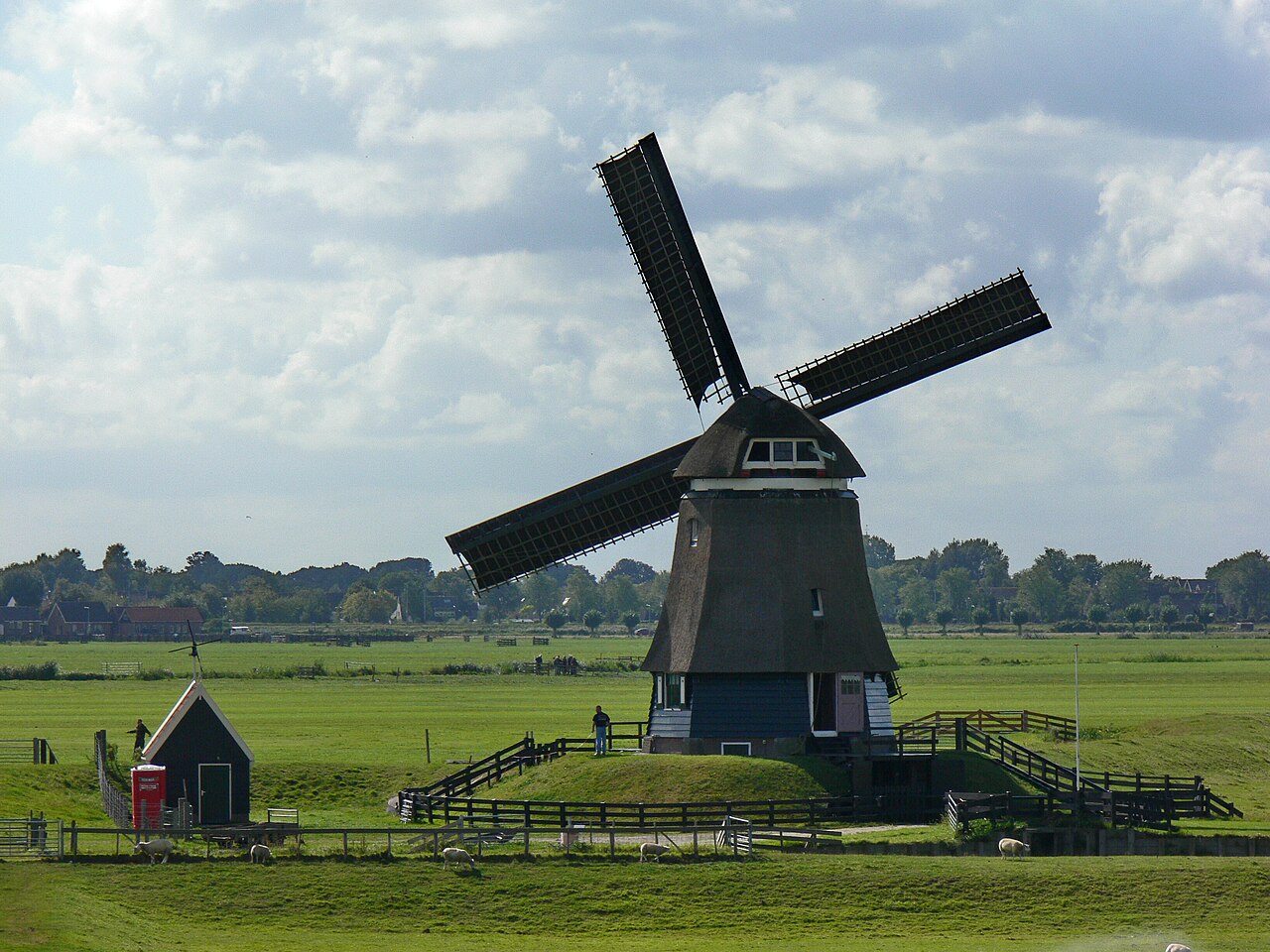
At the Etersheimerbraak that feeling grows stronger. A braak is the scar of a dyke breach: a pool left where water once broke through with force. The windmill recalls the work needed to keep low-lying land dry. The dyke says without words that the water must remain outside. Beyond it lies the lake, as if patiently keeping what it once took.
There is no ruin to point to. No tower stump. No cemetery wall rising above the water. That is exactly what makes the place uneasy. The vanished village does not show itself. It must be heard, imagined or feared when the mist hangs low above the water.
Imagine an evening.
The windmill stands dark against a grey sky. The grass along the dyke barely moves. The Markermeer is so flat that the sky disappears into it. The edge between land and water grows softer. As if the world no longer knows where it ends. At first you hear only your own steps. Then nothing.
And then something beneath that.
A dull stroke. Perhaps water against stone. Perhaps a boat far away. Perhaps wind in a gap. You stand still. The sound does not return. Precisely because of that, you listen more closely. Then it comes again. Lower now. Farther away. As if the lakebed itself were slowly answering.
A bell under water.
Or only the thought of one.
Listening to the drowned land
At Etersheim the boundary between the two is thin. Standing there, you know that land truly disappeared here. That water is not only a mirror but can also be a grave. That a line on a map does not always stay where people draw it. The bell does not have to be found in order to sound in the imagination. That is where it hangs: between what has been found and what remained lost.
Some say drowned bells warn. Some say they remember. Perhaps they do both. A bell sounding from the depths says not only that a village once stood there. It also says that water is more patient than people. That what has once been washed away need not be gone entirely. That a place can lose its name, its walls, its roads, and still keep one sound.
By day Etersheim is quiet. Polderland. Dyke. Water. Sky. Everything seems in place. But in windless weather that silence can grow fuller. Then the lake seems not open but closed, as if a second landscape were waiting beneath it. Dark, cold and unreachable. With a church without a tower and bells that no one rings anymore.
Whoever walks along the dyke does not need to hear anything.
Still, you may find yourself walking more softly. Stopping for a moment by the water. Listening for something that may exist only in your head. A low sound from the depths. A village that does not return. A bell that refuses to forget.