
The story of this place
A water barrier becomes a strategic passage
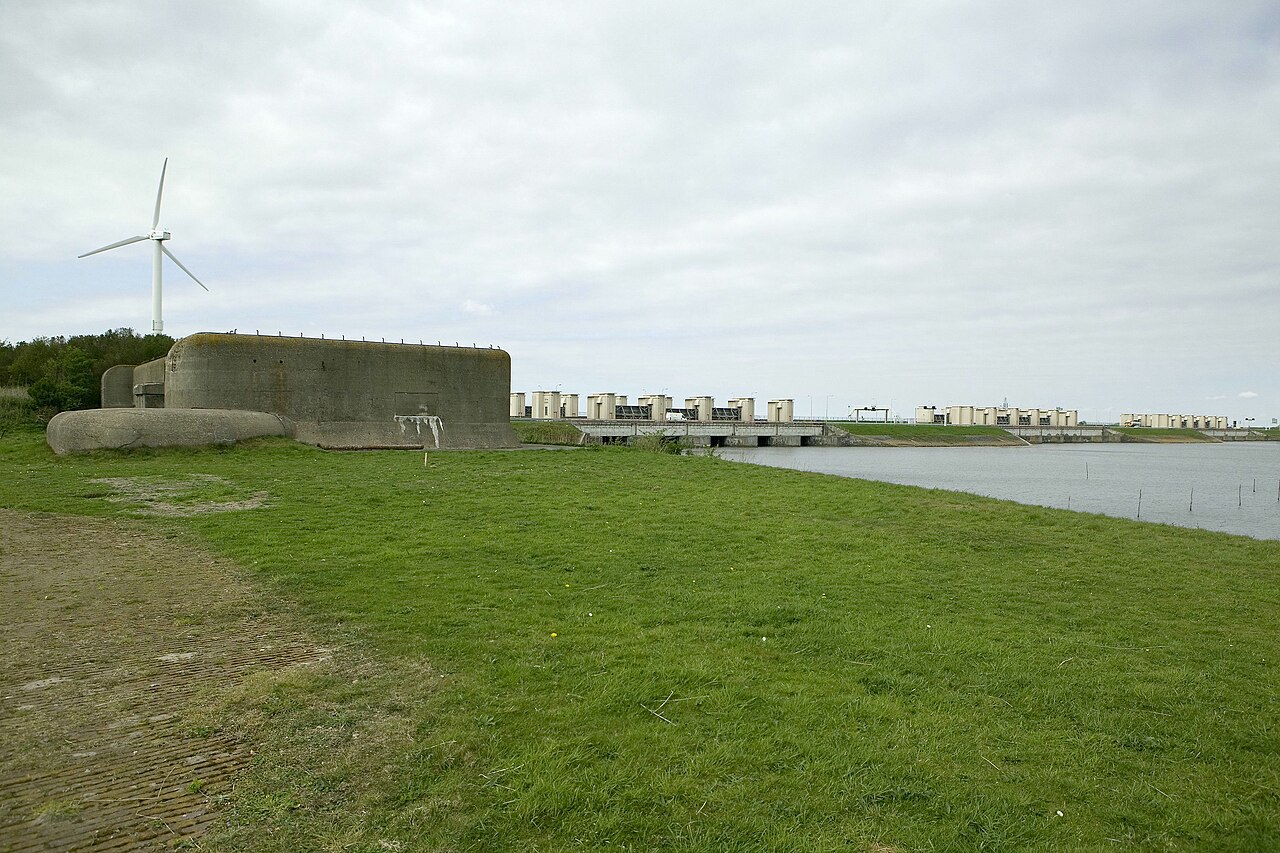
The casemates near Den Oever lie in a place where hydraulic engineering and military history almost literally interlock. At the North Holland end of the Afsluitdijk, around the Stevin locks, low concrete defensive works stand in a landscape of dike bodies, locks, grass, asphalt and open water. The Afsluitdijk is best known as a hydraulic engineering monument, but at Den Oever another meaning comes forward: the dike was also a strategic passage that had to be guarded.
The construction of the Afsluitdijk transformed the Netherlands profoundly. With the completion of the dike in 1932, the Zuiderzee was closed off and the IJsselmeer came into being. A centuries-old water landscape was turned into a new system of protection, reclamation, traffic and water management. The dike kept the sea out, but at the same time created a fixed connection between North Holland and Friesland. What was a triumph of water engineering also raised new military questions.
A fixed road across the former open water could become a risk in wartime. Where water itself had once been a barrier, there was now a narrow but usable route. The connection across the Afsluitdijk could move traffic, goods and people more quickly, but could also make an enemy advance easier. The dike was therefore not only designed as a sea defence, but also acquired a defensive layer.
Thirteen casemates around the Stevin locks
At Den Oever, the Den Oever defensive position came into being. Around the Stevin locks and on both sides of the dike, casemates and other military elements were built. The position had to protect the locks, the access to the Afsluitdijk and the connection toward Holland. This was not a classical fort with high walls, but a set of low concrete works absorbed into the dike landscape.
Den Oever received thirteen casemates on both sides of the dike. Together they formed a defensive system of machine-gun casemates, gun casemates, searchlight positions, earthworks and supporting rooms. Some elements were intended to cover the road and locks, others to control flanks, entrances and watersides. The defensive logic lay in position, line of sight, concrete mass and mutual connection.
The casemates were built in the 1930s, a period of rising international tension. Their heavy concrete forms were modern and functional. Thick walls, firing openings, protected entrances and earth covering were intended to offer protection against shelling. The works were kept low and partly incorporated into slopes or platforms, making them less conspicuous and better integrated with the dike body.
One of the heaviest elements was the double gun casemate IV. This work lay forward on a spade-shaped plateau and was largely surrounded by earthworks. The building had two floors, rooms for troops, ammunition stores, an observation space and casemate rooms for guns. The thick concrete walls and roof covering make clear that this was not an improvised bunker, but a carefully designed part of a larger defensive complex.
The Afsluitdijk in wartime
The Den Oever position belonged to the same strategic logic as the better-known position on the Frisian side at Kornwerderzand. Both ends of the Afsluitdijk had to be secured. Kornwerderzand later gained a more prominent place in memory because of the fighting in May 1940. Den Oever saw less fighting, but was no less logical militarily. Without protection on the North Holland side, the dike would remain vulnerable as a connection.
In May 1940, during the German invasion, the Afsluitdijk acquired its military meaning. At Kornwerderzand the German advance was halted. At Den Oever, major fighting did not take place, but the casemates formed part of the same defensive landscape. After the German occupation, the positions at Den Oever were used as a guarded passage. The strategic value of locks, dike and road also remained under occupation.
At the end of the war, the Stevin locks were heavily damaged. German troops destroyed the locks shortly before their retreat, leaving the lock complex in a desolate state after the war. The defensive position itself largely remained. The casemates thus stayed present as concrete reminders of a period in which hydraulic infrastructure was directly connected with war and control.
Concrete, dike and strategic passage
After the war, the casemates lost their original function. New military technology, changing strategic views and the reconstruction of the country made the old position obsolete. The concrete works remained, but in some places became overgrown or faded into the background of the dike landscape. Among locks, traffic and water management, they became less easily recognised as a coherent defensive system.
That modest visibility is precisely what makes the casemates significant. They are not medieval castle ruins and not high forts on the horizon. They are low, heavy objects that conform to dike, slope and grass. Their meaning lies not in height or decoration, but in function: cover, observation, line of fire, field of fire and the protection of a narrow passage.
The site shows that the Afsluitdijk was more than a struggle against water. The dike closed off a sea, but also changed the military map of the Netherlands. A water barrier became a road. A technical solution to flood risk became at the same time a point of defence. At Den Oever, that double meaning remains present in concrete and earth.
The location near the Stevin locks strengthens that layering. Locks regulate water, shipping and safety. In wartime such works became vulnerable nodes. Whoever controlled locks controlled water levels, passage and connection. The casemates were therefore not placed beside the lock complex by chance. They guarded a point where technology, traffic and military control came together.
Water safety and heritage in the same place
The modern strengthening and renewal of the Afsluitdijk once again made clear how sensitive this place is to change. The dike must continue to protect against rising sea levels, heavy storms and future water management challenges. At the same time, twentieth-century defensive works with national monument status lie along that same dike. The reintegration of casemates and islands shows that water safety and heritage must once again be reconciled here.
The Den Oever defensive position therefore consists of several layers. There is the hydraulic layer of Afsluitdijk, Stevin locks and IJsselmeer. There is the military layer of casemates, guns, searchlights, earthworks and fields of fire. There is the wartime history of mobilisation, occupation and destruction. And there is the later layer of preservation, restoration, overgrowth and renewed visibility.
The casemates near Den Oever preserve a restrained but important story. They show how a Dutch sea defence also became a defensive line. They reveal that infrastructure is never neutral when it creates strategic passages. Concrete, grass, locks and dike together form a landscape in which protection against water and protection against war touch one another.