
The story of this place
A castle on the boundary between town and water
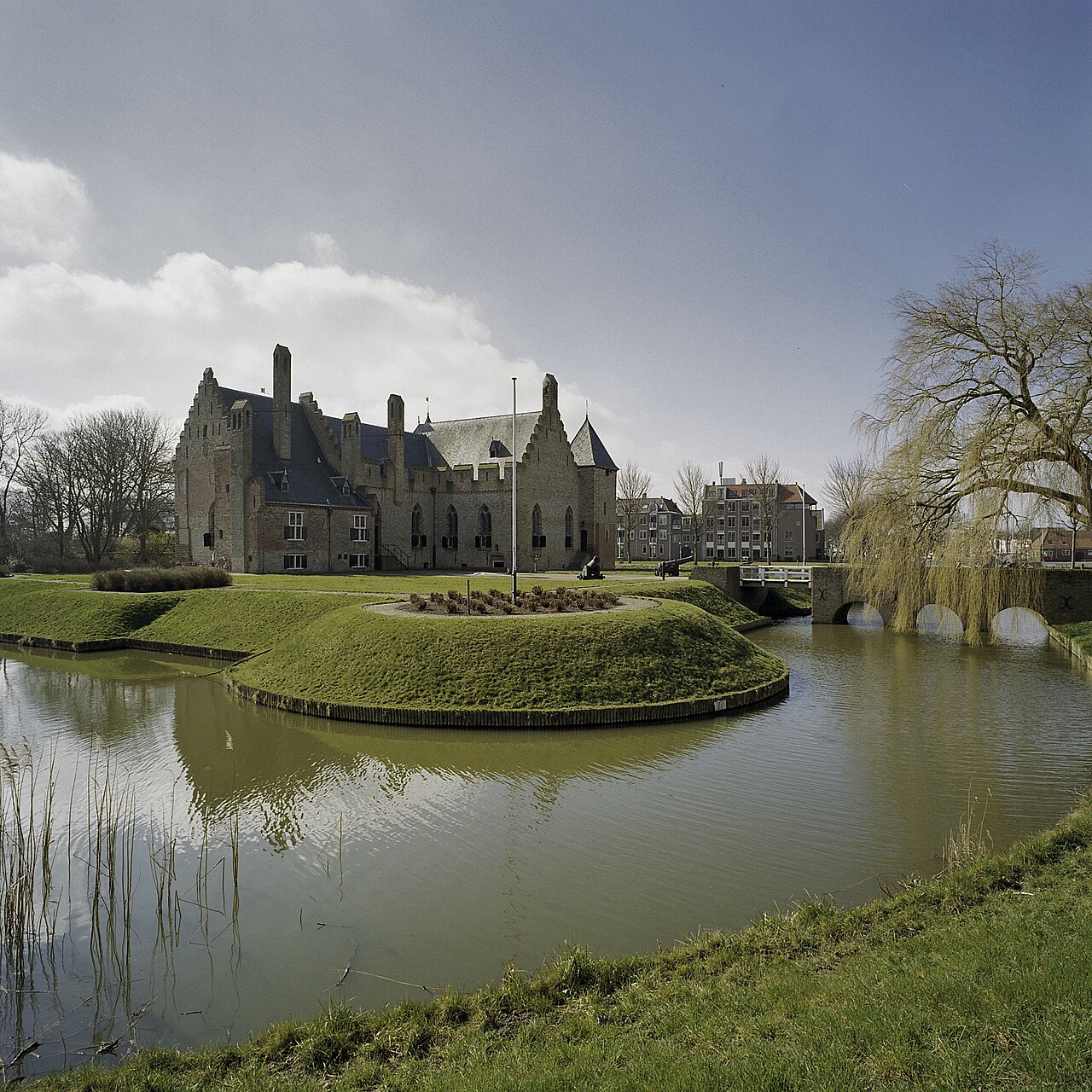
Radboud Castle stands on the eastern side of Medemblik, close to the harbour and the waters of today’s IJsselmeer. The compact brick building immediately appears medieval. Yet its history is far more layered than that first impression suggests. What you see today consists of late-medieval remains, later alterations and a major nineteenth-century restoration.
The location was chosen with care. Medemblik was an old settlement beside important waterways. From the castle, the harbour, coast and routes over land could be watched. Water was essential for trade, transport, military movements and communication. Control over town, land and water came together here.
Count Floris V and the subjugation of West Friesland
The construction is associated with Count Floris V of Holland. During the second half of the thirteenth century, he tried to bring West Friesland firmly under comital authority. The region had a strong identity of its own and resisted domination by Holland for a long time.
Around 1288, a castle was built near Medemblik to enforce comital authority. It was originally known as the House at Medemblick. Castles such as this were more than defensive structures. They provided space for troops, supplies and administration, but above all formed a permanent warning. The count’s authority was not meant to be temporary, but permanent.
Of the castles with which Floris V tried to secure his position in West Friesland, the one at Medemblik is the only one that still survives in a clearly recognisable form. Its walls therefore tell two stories at once: that of Holland’s conquest and that of the West Frisian resistance that made such a display of power necessary.
Not an untouched medieval time capsule
The present castle no longer shows the complete thirteenth-century layout. Parts disappeared, were altered or were reshaped by later building phases. Other elements tell of reuse, decline and changing functions. Radboud Castle is therefore not a building from a single moment, but a place where different centuries remain visible beside and over one another.
The name Radboud adds another layer. It refers to traditions surrounding the Frisian king Radboud, but he did not build the present castle. The name shows how historic buildings can acquire new stories and meanings that eventually become almost as familiar as their actual origins.
The restoration that shaped our view
The restoration carried out between 1890 and 1897 strongly determined the castle’s present appearance. The building was partly shaped by nineteenth-century ideas about what a medieval stronghold ought to look like. The round corner tower, the heavy brick mass and the recognisable silhouette therefore do not refer solely to the age of Floris V.
That restoration layer is precisely what makes the site interesting. You are looking neither at a purely medieval structure nor at a modern copy. Old walls, restored sections and later additions together form the castle as it exists today. Time has not stood still here; it has visibly accumulated within the building.
From stronghold to museum
Its current use as a museum adds another layer. The castle is not a silent ruin, but a maintained building in which its medieval origins, later history of use and restoration are explained. This makes clear that heritage never belongs to one period alone.
The significance of Radboud Castle therefore lies in more than its age. The building shows how power was expressed in stone, how West Friesland was brought under Holland’s authority and how a medieval castle could change in form and meaning over many centuries. It is at once a stronghold, museum, restoration project and bearer of West Frisian memory.