
The story of this place
A permanent resting place outside Amsterdam
Beth Haim lies along the Amstel, in the middle of Ouderkerk aan de Amstel, but the history of this cemetery begins much farther away. Its name means House of Life. In Jewish tradition, a cemetery is not a place where the dead are erased, but a place where graves remain and where the bond between life, death, memory and expectation is preserved. At Beth Haim, that meaning has remained exceptionally tangible.
The cemetery was founded in 1614 by the Portuguese-Jewish community of Amsterdam. That community largely consisted of Sephardic Jews with roots in Spain and Portugal. After persecution, forced conversion and the pressure of the Inquisition, many moved through trading cities such as Antwerp to the Dutch Republic. Amsterdam offered space for trade, printing, scholarship and religious life, but a Jewish cemetery within the city was not permitted.
At first, members of the Sephardic community were buried in Groet, near Schoorl. That place lay far from Amsterdam. The distance was impractical and fitted poorly with the Jewish duty to bury the dead quickly and with dignity. The purchase of land in Ouderkerk aan de Amstel therefore meant more than a practical solution. It gave the Portuguese-Jewish community a lasting place in the Dutch landscape.
The land in Ouderkerk was purchased in 1614. In that same year, the first burial took place: Joseph, the son of David Senior. In 1616, Beth Haim was officially taken into use. Those who had previously been buried in Groet were transferred to Ouderkerk. The community thereby received a lasting place along the Amstel, close to Amsterdam but outside the city boundaries.
By water to the burial field
The location by the water was essential. The dead were transported from Amsterdam to Ouderkerk by boat. The landing stage on the Bullewijk still recalls that route. From Amsterdam, bodies came by water to Ouderkerk. The Amstel and the Bullewijk were therefore not only arteries of trade and traffic, but also routes of mourning and ritual. Beth Haim cannot be fully understood without that water story.
Near the landing stage stands the Rodeamentoshuis, also known as the ritual preparation house. This building had a ritual function in the preparation of the burial. Here the deceased was brought inside before the procession continued to the burial field. The name refers to the circling around the coffin of a male deceased. The building shows that Beth Haim is not only a collection of graves, but a place of actions, prayers, order and prescriptions.
The site grew in the seventeenth century along with the Portuguese-Jewish community. In 1690 and 1691, further land purchases were made. Beth Haim eventually became an extensive whole of burial fields, paths, buildings and water connections. Tens of thousands of graves lie on the grounds. Some are recognisable by impressive stones, others are less visible because time, peat soil, subsidence and vegetation have left their marks.
Slabs, families and an international community
The burial culture of Beth Haim is distinctive. Unlike many Ashkenazi cemeteries, where upright gravestones are common, Beth Haim uses Sephardic slabs lying horizontally on the ground. These low stones form a landscape of their own: marble, grass, inscriptions, symbols and subsidence lie close together. The site therefore has no rhythm of vertical rows, but one of lying remembrance.
The seventeenth-century marble slabs in particular are famous. Many stones are richly carved with texts, family arms, symbols, biblical scenes and references to name, profession or life story. That is striking within a Jewish funerary culture in which the use of images can be sensitive. At Beth Haim, a funerary art emerged in which Sephardic tradition, Mediterranean forms, Amsterdam prosperity and personal status came together.
The cemetery therefore also preserves a story of migration and social establishment. Sephardic families played roles in trade, printing, diplomacy, medicine and scholarship. Names at Beth Haim connect Ouderkerk with Amsterdam, Antwerp, Portugal, Spain, the Mediterranean, North Africa and the Atlantic trading world. The small village along the Amstel thus became connected with a much larger Jewish and European history.
Among those buried here are well-known figures from the Portuguese-Jewish world. Menasseh ben Israel, rabbi, scholar and printer, is buried here. He played an important role in Jewish book culture and in contacts with England. The physician Samuel Sarphati, the diplomat Samuel Pallache and the parents of Baruch Spinoza are also connected with Beth Haim. The cemetery is therefore local, Amsterdam-based and international at the same time.
The slabs do not speak only of prestige. They also tell of loss, child mortality, illness, exile, family bonds and the desire to hold on to names. Some stones are large and richly carved, others simpler. Together they do not form a triumphal monument, but a field of life stories. The language of the stones is religious, familial and sometimes distinctly worldly at once.
Fragile stones, living remembrance
The peat soil of Ouderkerk has slowly changed the cemetery. Many stones have subsided, tilted or partly sunk into the ground. That vulnerability has become part of the image of Beth Haim, but it also remains a continuing conservation problem. Marble, moisture, soil movement, vegetation and time affect the stones. Preserving this place therefore requires not a single restoration, but long-term care.
In the nineteenth century, David Henriques de Castro played an important role in the study and preservation of Beth Haim. He recorded inscriptions, studied the slabs and published a standard work on the gravestones of the Portuguese-Jewish cemetery. His work mattered because much information on the stones was becoming vulnerable through wear and subsidence. Documentation became a form of rescue.
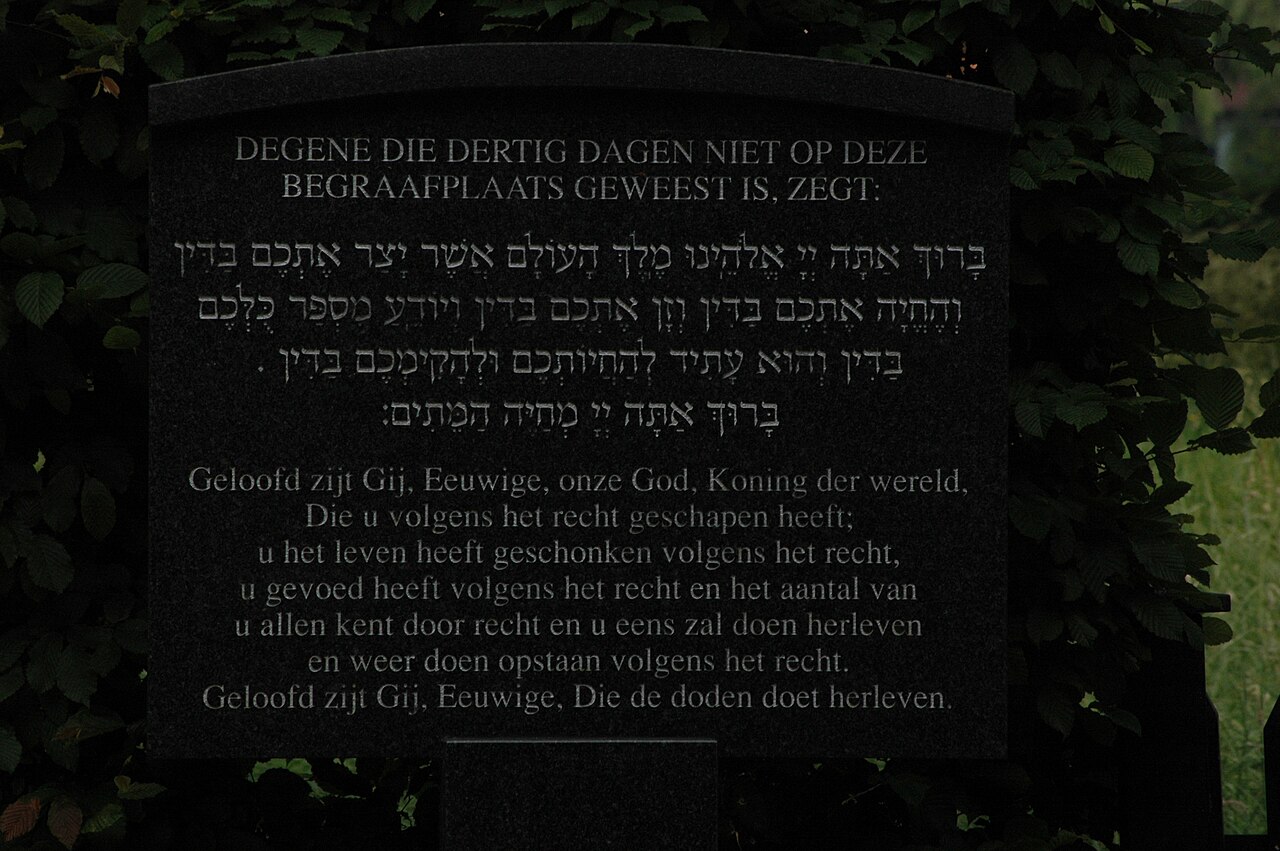
Beth Haim also remained in use in later centuries. It is not a closed seventeenth-century monument, but a living Jewish burial ground. This means that religious rules, respect for graves, opening hours, Sabbath rest and rules for entering the site remain part of the place. The site is heritage, but it is not detached from the community for which it was founded.
Religion, landscape and world history
The buildings on the grounds add meanings of their own. The Alvares Vegahuis on the Kerkstraat recalls management, guardianship and care for the site. The Rodeamentoshuis by the Bullewijk connects water with ritual. The paths for kohanim, the horizontal stones, the burial fields and the landing stage make clear that this cemetery is arranged according to religious rules that have been made visible in the landscape.
Beth Haim is therefore more than an old cemetery. The site preserves a world in which Amsterdam Jewish history, Sephardic diaspora, Amstelland water, funerary art and religious prescriptions come together. The place is quiet, but not empty. Beneath the grass, in the stones, along the water and in the buildings lies a history of arrival, recognition, mourning, learning, prosperity, vulnerability and persistence.
The Second World War also changed the meaning of Beth Haim. The cemetery remained while the Jewish community for which it had served as a resting place for centuries was devastated by persecution and destruction. The continuity of the site thus came to stand alongside a profound rupture in Jewish life in the Netherlands.
The meaning of Beth Haim lies in that combination of intactness and fragility. The site is exceptionally old and still in use. The gravestones are famous, but vulnerable. The cemetery lies in the middle of a village, yet refers to world history. The name House of Life therefore remains fitting: among the graves lies not a closed past, but a continuing memory of generations who received their place here.