
The story of this place
A closed world on the North Sea Canal
The Hembrug site in Zaandam now appears as a rough, layered urban landscape. Old sheds stand among trees, workshops and new uses. For more than a century, however, this was a closed world where military production, security and secrecy determined daily life.
Its location near the Zaan and the North Sea Canal was carefully chosen. Water, rail and the proximity of Amsterdam made supply and transport possible, while the factory remained outside the densely built city. For a military production complex, accessibility, space and safety were equally important.
From 1895, the site was developed for the Artillerie-Inrichtingen. That organisation came from Delft, where the production of weapons and ammunition had a much older history. Zaandam did not receive a single factory hall, but a complete military-industrial landscape of workshops, stores, offices, waterways, railway connections and screened-off zones.
Weapons, ammunition and state industry
The site was closely linked to the Defence Line of Amsterdam. That defensive system consisted not only of forts and inundation fields. It also required weapons, parts, ammunition, maintenance and storage, and Hembrug supplied that industrial backbone.
Weapons and ammunition were developed, manufactured, tested, maintained and stored on the site. There were metalworking workshops, stores for hazardous materials and buildings for assembly and repair. Vehicles and other military equipment were also maintained here. Hembrug was at once a factory, storage site, testing ground and training environment.
The site changed continuously. New buildings appeared, older ones were adapted or disappeared. Mobilisation, threat of war, technological renewal and changing military needs repeatedly left a new layer. The Hembrug site is therefore not a factory frozen in 1895, but a site in which more than a century of military industry has remained visible.
Built for safety and secrecy
The layout was determined by danger. Buildings stood apart and were separated by ramparts, green strips and water. These elements were not merely landscaping. They had to reduce the consequences of fire or explosion and prevent one incident from immediately spreading to the rest of the site. The greenery was therefore also a form of risk management.
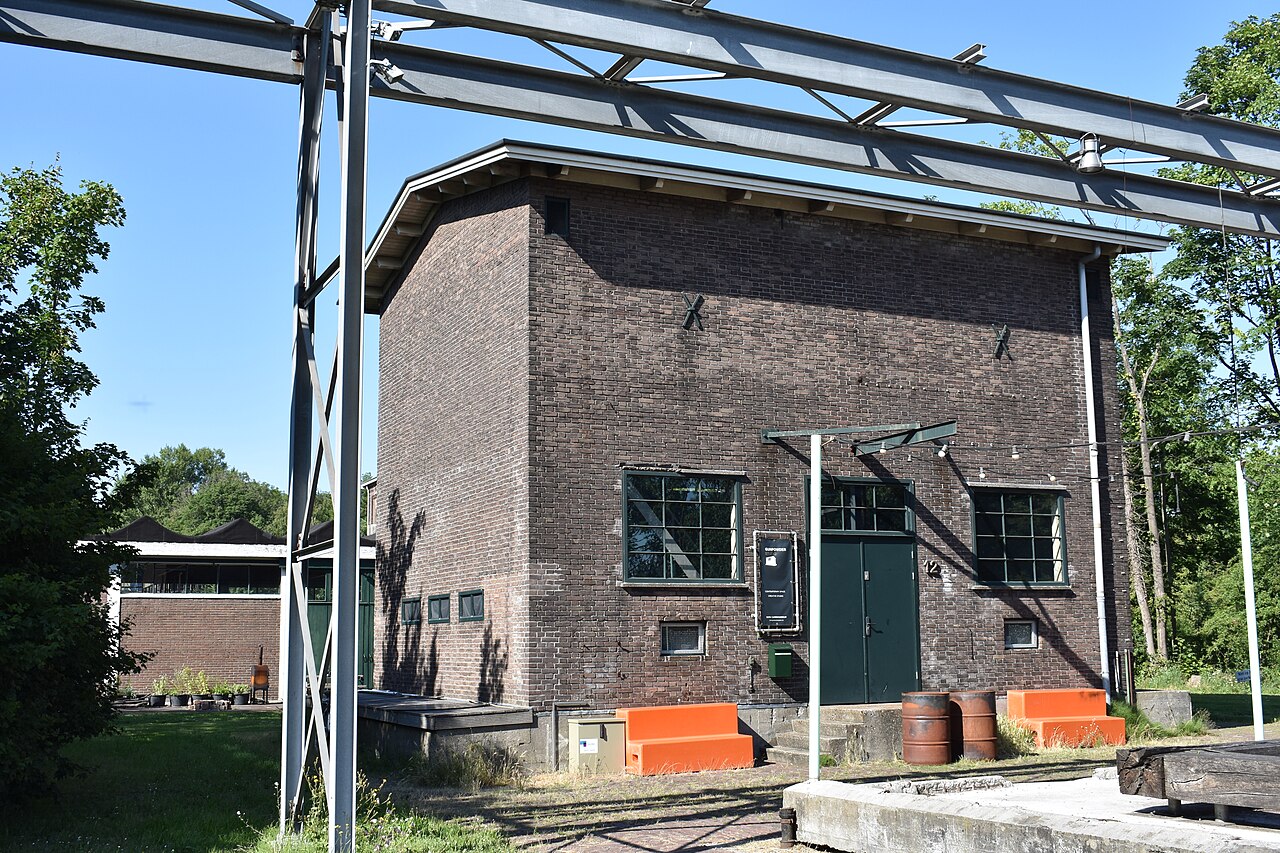
The buildings also reflect that function. Some are simple brick sheds. Others have heavy walls, wide doors or hardly any windows. Names and numbers referred to a tightly organised system of production, storage and control. The architecture did not primarily serve appearance, but safety, discipline and efficiency.
For the surrounding region, Hembrug was both familiar and mysterious. It was a major employer in the Zaan region, yet much of what happened behind the fences remained invisible. Generations of workers came and went through a world that outsiders barely knew.
That closed character belonged to the function. Weapons and ammunition production required security, secrecy and strict rules. Daily work revolved around metal, machinery and transport, but the products were connected with defence, threat of war and state power.
From closed site to new destination
After the Second World War, organisation and production changed. Military industry continued under names such as Eurometaal, but larger-scale production and new technology changed the site. The buildings remained usable, but the complex became increasingly difficult to fit into a changing urban environment.
In 2003, the production of weapons and ammunition ended. What remained was a large closed site with dozens of buildings, contaminated soil, monumental value and an uncertain future. The fences were still there, but the original reason for keeping the area closed had disappeared.
The site then slowly began to open. Buildings were surveyed, protected and reused. Artists, entrepreneurs, hospitality businesses and events moved into former workshops and sheds. The atmosphere changed markedly, but the old structure remained visible in the distances between buildings, the ramparts, the closed façades and the quiet side paths.
An industrial landscape that remained
During a walk, notice the transitions. An open route can suddenly disappear between trees and ramparts. A terrace lies beside a closed shed. A wide door or windowless façade reveals an earlier function. The site was not designed as a neighbourhood, but as a factory in which production, safety and logistics determined the space.
The name refers to the former Hembrug, the railway bridge across the North Sea Canal. That bridge has disappeared, but the name remained. That suits the site, where many functions were lost while routes, buildings and old names continued to carry their meaning.
The Hembrug site is therefore more than industrial heritage with new uses. It preserves the story of labour behind defence and of technology in the service of the state. Here, Dutch defence was not only planned, but actually produced.