
The story of this place
A miracle in a house on Kalverstraat
In the middle of the bustle of Kalverstraat lies a vanished sacred place. Among shops, façades and passing crowds, little reveals that pilgrims came here for centuries. Nothing remains of the chapel itself. What survived is a location, a route and a story that has been passed on for almost seven hundred years.
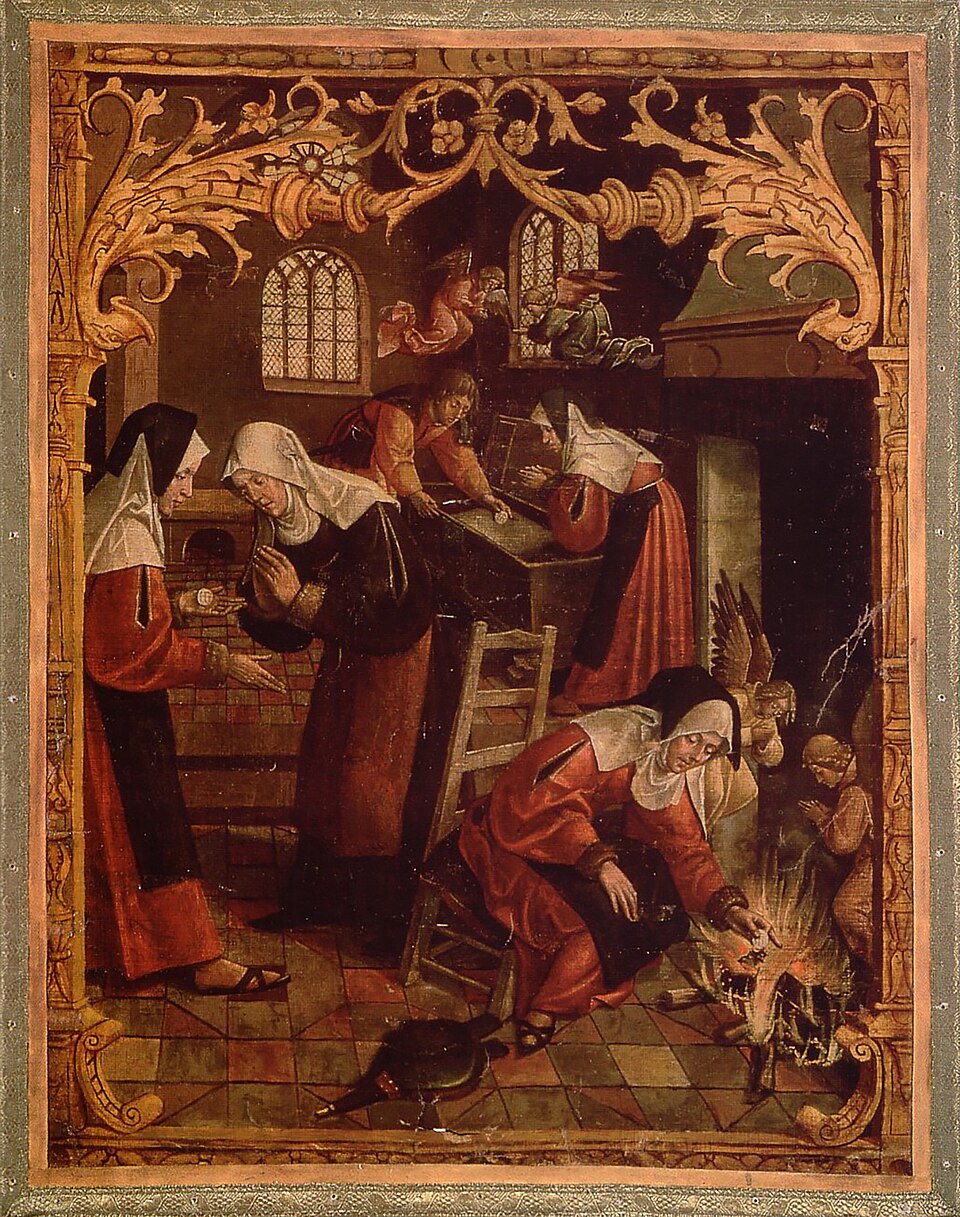
According to tradition, a sick man lay in a house on Kalverstraat in March 1345. A priest brought him the last rites. Shortly after receiving the consecrated host, the man vomited it up. The vomit was thrown into the hearth fire. The following morning, a woman was said to have found the host unharmed among the ashes.
For medieval Catholics, the host was not merely a symbol but the actual body of Christ. Its survival in the fire was therefore regarded as a miracle. According to the story, the host was taken to Sint-Nicolaaskerk, now the Oude Kerk, but returned to the house. Only after it had been carried away in procession did it remain in the church.
From home to pilgrimage site
Construction of a chapel on the site began soon after the miracle. The Heilige Stede was consecrated in October 1347. The hearth from the sickroom was incorporated into the chapel and the miraculous host was venerated there. An ordinary home became a place of pilgrimage.
Pilgrims travelled to Amsterdam from the Low Countries and German-speaking regions. They entered the city along Heiligeweg to venerate the host and seek help in times of illness, danger or misfortune. The pilgrimage increased Amsterdam’s reputation. Inns, traders and craftspeople benefited from visitors who often remained in the city for some time.
The chapel was enlarged and rebuilt over the centuries. It stood between Kalverstraat and Rokin and later became known as the Nieuwezijds Kapel. The building formed the centre of an annual procession of the Blessed Sacrament through the city.
Amsterdam as a sacred landscape
For pilgrims, the journey involved more than a visit to one building. The route through the city was part of the experience. Streets, bridges and squares became part of the story surrounding the miraculous host. On procession days, Amsterdam temporarily became a sacred landscape.
Heiligeweg still recalls that flow of visitors. The street name reveals where pilgrims once entered the city. The later route of the Stille Omgang also follows parts of the old course. In this way, not only the place but also the movement through the city was preserved.
After the Alteration
During the Alteration of 1578, Amsterdam came under Protestant rule. Catholic churches and chapels were given other uses. Public Catholic processions were banned and the miraculous host disappeared. The Heilige Stede lost its original function and was used as a Protestant church.
Catholic memory nevertheless survived. Believers continued to commemorate the miracle in private. Objects and stories connected with the former devotion found shelter elsewhere. The chapel remained standing, but its meaning was interpreted in different ways.
What this place tells today
In 1881, a small group of Amsterdam Catholics began walking the old procession route again. They did so without banners, singing or public ceremony. In the following years, this silent prayer developed into the annual Stille Omgang.
Its restrained form suited a tradition that had long been excluded from public life. Participants walked through the city centre at night and followed the old route without outward display. Silence itself became part of the ritual.
The meaning of the Heilige Stede changed as a result. The place was no longer connected only with a vanished chapel. It became the starting point of a living tradition in which footsteps mattered more than monumental architecture.
The Nieuwezijds Kapel was demolished in 1908. The demolition provoked fierce protests. Catholics, heritage campaigners and parts of the city government regarded the chapel as an irreplaceable part of Amsterdam’s history. Their opposition could not prevent its destruction.
The loss of the building made painfully clear how vulnerable urban heritage could be. After the chapel had disappeared, awareness grew that not only individual works of art but also historic places deserved protection.
The Mirakelkolom now stands on Rokin. The eight-metre column was assembled from stone elements of the demolished chapel and placed in the public space in 1988. The monument is therefore itself a physical remnant of the vanished Heilige Stede.
The column is easily overlooked among traffic, shops and passers-by. Without explanation, it appears to be an isolated historical object. Those who know the story see something else: pieces of the chapel have returned to the place where the pilgrimage site once stood.
Today, the Heilige Stede is a sacred place without a surviving sanctuary. A house became a chapel. The chapel became a pilgrimage site. The procession was banned and returned as a silent walk. The building eventually disappeared, but the route and the memory survived.
Pause for a moment between Rokin, Wijde Kapelsteeg and Kalverstraat. Look at the Mirakelkolom and the flow of people around it. The Heilige Stede is no longer visible as a building, but it lives on in the story, in a few stones and in the footsteps of the Stille Omgang.