
The story of this place
A waterside village and a sailors’ saint
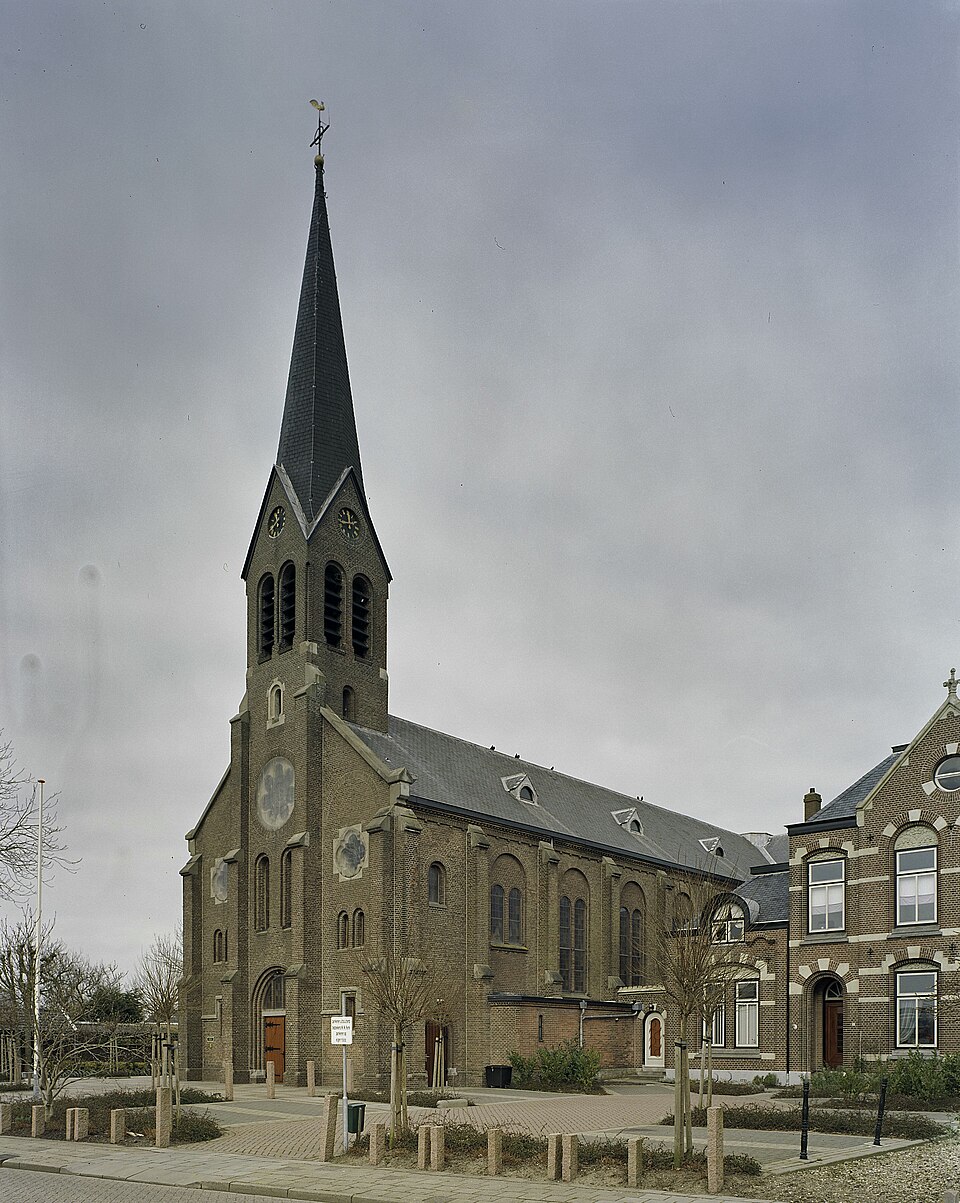
The present Maria Magdalena Church stands on Dorpsstraat in Wormer. This nineteenth-century building is not the medieval church in which devotion to Odulphus arose. Even so, it provides a visible point of reference for a vanished part of the village’s religious history.
Wormer lies in Wormerland, in the Zaanstreek region of North Holland. For centuries, the village was surrounded by lakes, ditches, waterways and dykes. Fishing, shipping and transport by water shaped everyday life. Water brought work and connections, but also uncertainty and danger.
In such surroundings, saints had a practical meaning. They were invoked for protection during journeys, fishing and trade. Odulphus belonged to that world. Before the Reformation, he was venerated in Wormer especially by sailors.
The procession of 12 June
According to historical descriptions, a procession or annual circuit passed through the village around his feast day on 12 June. An image of Odulphus was carried with it. The religious procession symbolically brought the saint into the streets where sailors and their families lived.
Such a procession temporarily turned the village into a religious route. Villagers took part in the ritual or witnessed it along the way. Prayer, protection and community came together in a form closely connected to everyday life.
Its strength did not lie in a famous miracle or a major pilgrimage site. Odulphus belonged to the everyday uncertainty of sailing, departure and homecoming. That is precisely why he gained a recognisable place in Wormer.
A parish with two patrons
Odulphus was not a local saint in the strict sense. Devotion to him existed in several parts of the Low Countries. In Wormer, however, he had a distinct role as the parish’s second patron alongside Mary Magdalene.
The church was therefore more than a building for Sunday worship. It preserved images, formed the starting point of processions and gave the village a religious identity. The choice of Odulphus shows how an existing saint could acquire local meaning: protection for those who went out on the water and reassurance for those who stayed behind.
What disappeared and what returned
After the Reformation, almost every visible trace of the Odulphus devotion disappeared from Wormer’s streets. Processions and the veneration of images vanished from public life. The image of Odulphus was no longer carried through the village, and the devotion survived mainly in church and local memory.
The present Maria Magdalena Church was built in 1868 and 1869. It is not a remnant of the medieval procession, but belongs to the renewed visibility of Catholicism in the nineteenth century. After a long period of restrictions, Catholic communities could once again build recognisable churches.
Behind the present building therefore lies a longer history of a medieval parish, the Reformation and Catholic return. The church provides a place from which the vanished devotion to Odulphus can once again be situated in the landscape.
A story still present in the landscape
The story of Odulphus does not lie in a ruin or a surviving statue, but in the relationship between church, Dorpsstraat and waterscape. Before the major land reclamations, Wormer was surrounded by far more open water. A procession for a sailors’ saint therefore suited not only the village’s faith, but also its economy and surroundings.
Imagine the image being carried outside and through the village. In this way, the saint became visible in the surroundings of the people who asked for protection and a safe return.
The procession has disappeared and its route is not marked. Yet the story of Odulphus still connects faith, work and village community. Precisely because so little remains visible, this place shows how easily local religious heritage can disappear from the landscape.