
The story of this place
Defending Amsterdam with water
Fort near Abcoude lies east of the village, in open polder country between waterways, roads and the railway to Amsterdam. As you approach the site, you see neither a towering castle nor a picturesque ruin. The fort lies low and broad in the landscape. Earth, water, brick and grass together form the defensive work. The moat forms a defensive barrier, the earthworks provide cover and the buildings sit as solid masses within the terrain.
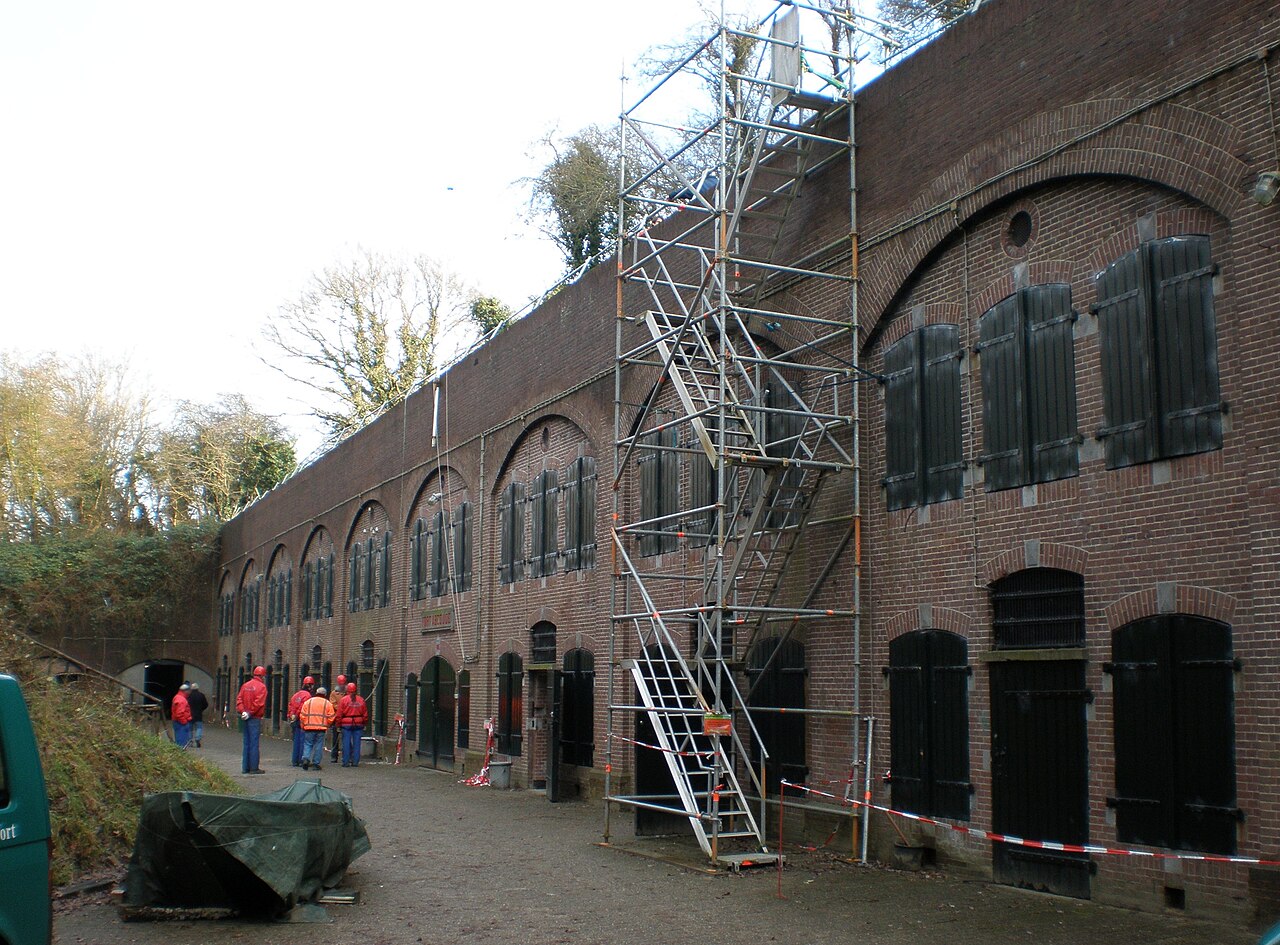
Fort near Abcoude was built between 1884 and 1887. It is the oldest fort built for the Defence Line of Amsterdam. Its two-storey brick barracks became militarily vulnerable even during construction because of the rise of the high-explosive shell.
The fort forms part of the Defence Line of Amsterdam, the great defensive ring intended to protect the capital with forts, batteries, dykes, sluices and land that could be flooded. The line was conceived as a national redoubt: a final defensible core to which the government, army and capital could retreat in wartime.
The greatest strength of this system lay not in high walls or heavy artillery, but in water. Large areas around Amsterdam could be inundated to a shallow depth. The water had to be deep enough to make roads and fields impassable, but too shallow for boats. An enemy would therefore be forced towards the few remaining dry routes.
Those routes in particular had to be guarded. Railway embankments, dykes and raised roads remained usable even during an inundation. Forts were therefore not positioned randomly around Amsterdam. They stood beside passages through which an army could still approach despite the water.
The first fort of the Defence Line
Construction of the earthworks at Abcoude began in 1883. The fort itself was built between 1884 and 1887 and is regarded as the oldest fort built for the Defence Line of Amsterdam. It therefore stands at an important technical turning point. Its function already belonged to a modern inundation-based defence system, while its architecture still clearly reflected older fortification design.
Later forts of the Defence Line were built largely in concrete. At Abcoude, brick and concrete containing crushed brick were still used. Heavy earthworks protected the buildings and a broad moat surrounded the site. The fort was not intended to rise above the landscape, but almost to disappear into it.
Within the grounds were bombproof buildings, stores, accommodation and supporting structures. The wooden shed and fort keeper’s house were also part of its daily operation. Together they formed not a collection of separate objects, but a single military landscape in which access, visibility, water and cover were precisely coordinated.
Almost immediately outdated
What makes the fort remarkable is that military technology overtook it while it was still being built. Artillery developed at great speed during the second half of the nineteenth century. New shells gained far greater destructive power. The rise of the high-explosive shell in particular changed what a modern fort had to withstand.
Brick and unreinforced concrete containing crushed brick proved vulnerable. Older projectiles mainly damaged outer surfaces, but new explosive shells could cause far greater damage to walls and vaults. Military engineers therefore had to adopt stronger materials and different forms of protection.
Fort near Abcoude had been built as an answer to a new age, only to be overtaken almost immediately by an even newer one. This does not make the fort less important. Quite the opposite. Here you can see how quickly ideas about security, technology and warfare changed.
The landscape was the real weapon
Anyone who looks only at the buildings misses much of the story. The moat, earthworks and open polder are at least as important. Without ditches, dykes and differing water levels, only a group of military buildings would remain. Within the Defence Line, the fort formed one link in a deliberately designed defensive landscape.
An attacker had to overcome not only walls and artillery, but shallow inundations, guarded passages and open fields of fire. The polder was not scenery around the fort. The polder was the defensive weapon. Water management, the clearing of fields of fire and military planning came together here.
The wider system eventually extended for about 135 kilometres around Amsterdam. Today the Defence Line of Amsterdam and the New Dutch Waterline together form the UNESCO World Heritage property Dutch Water Defence Lines. At Abcoude, that immense story becomes tangible in things you can see for yourself: a moat, heavy earthworks, brick, timber and an open horizon.
From military closure to a quiet heritage site
When its military function disappeared, the meaning of the grounds changed. A place once arranged for threat, surveillance and closure became a heritage site and nature area. The military need disappeared, but the form remained largely recognisable.
The old logic becomes clearest in today’s silence. The fort was not meant to dominate the landscape through height. It hid within it while trying to control it. Along the moat and earthworks, you can see how closely military design and Dutch water management were connected.
Fort near Abcoude is therefore not a spectacular ruin. Its power lies in what remained low, what was covered and what becomes visible only when you also look at the polder. No monument here stands apart from its surroundings. Here, the landscape itself is the monument. A visit to Fort near Abcoude reveals not only an old military structure, but above all how water, landscape and technology together formed one of the Netherlands’ largest defensive systems.