
The story of this place
Hot water as a public service
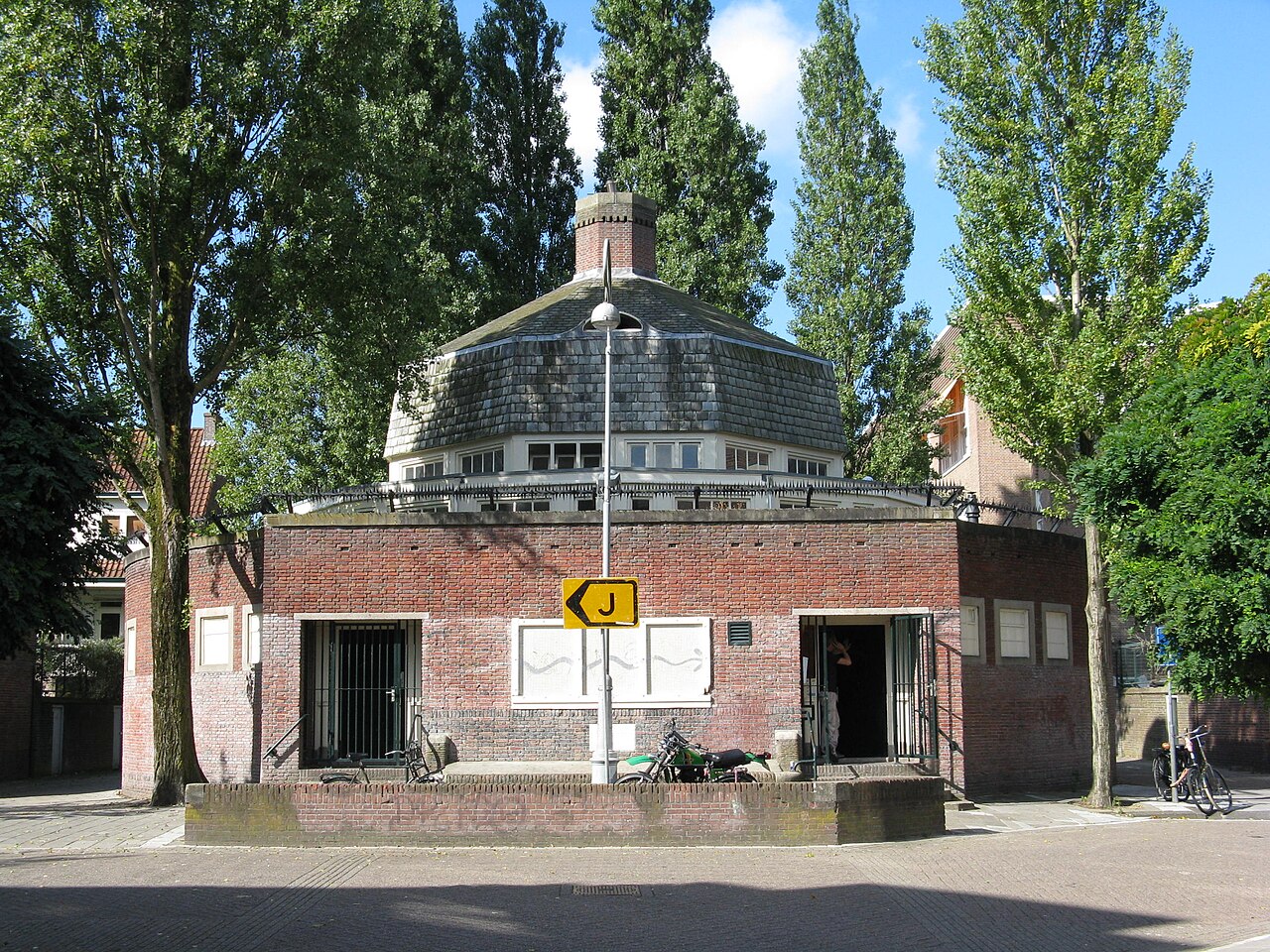
The Diamantbuurt Bathhouse stands at Diamantstraat 134 near Smaragdplein in Amsterdam-Zuid. The round building stands out because of its Amsterdam School form, but its original meaning lay in more than beauty. It was a municipal facility for something very basic: washing, hot water and personal hygiene in a city where many homes still had no private shower or bathroom.
The bathhouse was built in 1925–1926 for the municipality of Amsterdam, designed in Amsterdam School style by A.J. Westerman for the Public Works Department. It belonged to a series of municipal bathhouses erected during the first decades of the twentieth century. They formed part of a broader urban ambition: better housing, healthier neighbourhoods, public facilities and stronger municipal involvement in residents’ daily lives.
The Diamantbuurt was not a random location for such a building. The neighbourhood belonged to the expansions of Amsterdam-Zuid, with much social housing, working-class dwellings and new residential blocks. In such areas, improving hygiene was both a practical and political issue. Not every household had a bathroom. For many residents, hot water, a shower or a bath was not a private amenity but something that required a public facility.
The bathhouse made that service visible in the neighbourhood. It did not hide behind a school, church or factory, but stood freely on the street as a small public building among homes and square space. Residents could go there to shower or take a tub bath. The bathhouse was therefore both ordinary and important. It was not about leisure or spa-like relaxation, but about personal care, health, dignity and municipal provision.
A building that organised social rules
The original layout was strictly separated. The left side of the bathhouse was intended for men, the right side for women. Each section originally contained eight shower baths and two tub baths. That separation says much about the period. Hygiene was a public concern, but had to be organised according to clear rules of gender, order, supervision and decency. The building was therefore designed socially as well as technically.
The almost circular floor plan made the bathhouse unusual. The bathing cubicles were located in the low outer ring, recognisable by the small windows. The entrance section on the east side had two linked portals, matching the separate access to the two departments. The circular volume, brickwork, timber elements, windows and sculptural design give the building its Amsterdam School character. Yet this design remained in service of a highly practical function.
Beneath one of the window sections is a commemorative stone installed at the opening by residents of housing associations including De Dageraad, the Algemeene Woningbouwvereniging and Eigen Haard. The stone is revealing. The bathhouse was not connected only with the municipality, but with a wider world of housing associations, workers’ housing and neighbourhood development. It belonged to the same social infrastructure as new homes, schools, squares and public facilities.
Hygiene, technology and urban progress
During the 1920s, hygiene became increasingly linked with public health and education. A clean body was seen as part of a healthy city. Municipal bathhouses were intended to help prevent disease, improve living conditions and give residents access to facilities missing at home. Behind the simple act of washing lay a larger idea: public facilities could make the city healthier, more orderly and more humane.
This makes the bathhouse a striking reminder of the material side of social history. Poverty, housing shortages and urban density are broad concepts, but here they become tangible in bathing cubicles, waiting rooms, separate entrances, tubs and showers. The building tells not only a story of architecture, but of bodies in the city: working, sweating, washing, waiting, dressing and returning home.
The building also expressed confidence in municipal technology. Hot water had to be produced, distributed and managed. Bathers had to be received and registered, payments processed, rooms cleaned and water use managed. A bathhouse was not a simple shed with taps, but a small hygiene machine embedded in the neighbourhood’s daily routines.
Amsterdam School design gave that function additional meaning. Public facilities did not need to be bare or indifferent. Even a bathhouse could receive carefully considered architecture. The circular form, expressive brickwork and distinct entrance section turned a utility building into a recognisable neighbourhood landmark. This matched Amsterdam’s municipal building culture of the period, in which beauty, function and social purpose were not strictly separated.
From essential service to monument
During the twentieth century, the significance of bathhouses changed. Homes increasingly acquired private showers and bathrooms. Renovation, clearance programmes and new housing standards gradually made municipal bathhouses unnecessary. What had once been modern and essential slowly became a remnant of an older housing culture. Sources differ on the exact moment when the building lost its original function, but it is clear that bathing ceased during the late twentieth century.
This also changed how the building was viewed. A place once centred on hot water, waiting times and local residents came to be seen as a heritage building. Its original function faded from everyday memory. The round building remained, but the experience of a city without private bathrooms disappeared. That is exactly why the Diamantbuurt Bathhouse fits a nearly forgotten history: the building did not vanish, but its ordinary use did.
In 2004, the bathhouse was designated a national monument. This status recognises both its architectural value and its cultural-historical significance. The building matters as an example of a municipal bathhouse in Amsterdam School style, but also as a reminder of early twentieth-century public health policy. The monument therefore protects not only brick and form, but the story of public hygiene.
After the bathing function disappeared, the building was preserved and came to be valued mainly as heritage, architecture and a tangible reminder of a vanished everyday service.
A vanished routine preserved in brick
A private shower now seems self-evident, but less than a century ago many Amsterdam residents had to visit a municipal bathhouse in order to wash. That is why this building still tells a recognisable story about daily life.
The significance of this place lies in its ordinariness. The building tells no story of kings, battles or grand monuments, but of local residents and basic services. It concerns how a city cared for people who lived in small homes, worked hard and lacked modern conveniences. Behind the attractive round form lies a social history of water, warmth, hygiene and dignity.
The Diamantbuurt Bathhouse is therefore more than a striking building in Amsterdam-Zuid. It recalls a time when public health literally had an address. Diamantstraat 134 was a place where the city provided for the health and hygiene of its residents: not grandly or ceremonially, but practically, daily and necessarily. That is exactly what makes the building such powerful nearly forgotten heritage.