
The story of this place
A spring at an old burial place
The Adelbertusakker lies quietly on the edge of Egmond-Binnen. When you enter the site, you do not see a great sanctuary or a ruin rising above the landscape. There is grass, a pattern of low stone lines, a spring, an altar canopy and a small devotional chapel. At the centre of this modest place lies a spring that drew people back to the same ground for centuries.
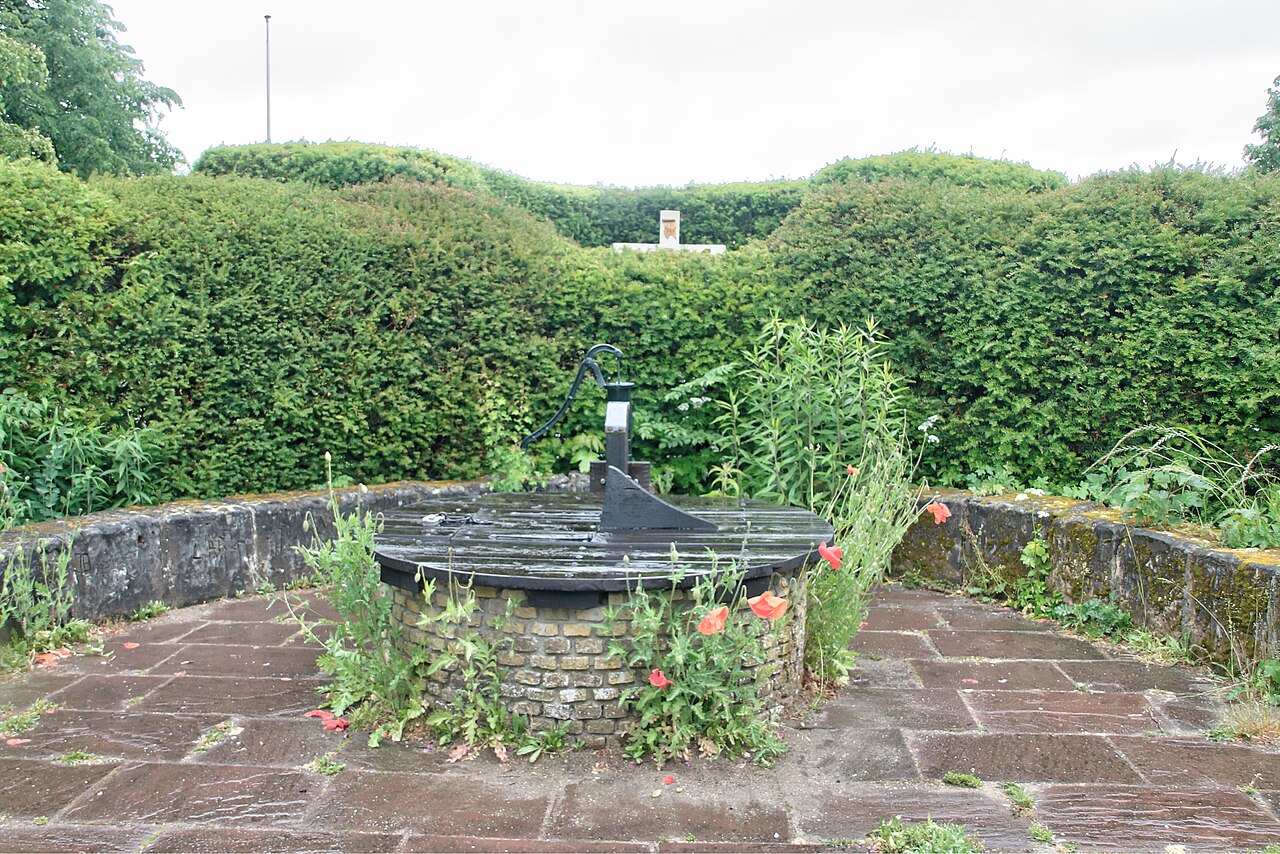
The Adelbertus spring forms the heart of the site. Around it, low stones mark the outlines of a vanished chapel. They show where the walls stood and where the choir lay. You are not looking at a reconstructed monument, but at the ground plan of a building that once enclosed the spring.
The name of the site refers to Saint Adelbert, also known as Adalbert. According to tradition, he played a part in the early Christianisation of Kennemerland and belonged to the circle of missionaries around Willibrord. After his death, he is said to have been buried near Egmond. In 922, Count Dirk I had his remains raised and transferred to a new religious centre. Water was then said to have risen at the original burial place.
Water, illness and hope
That story gave the spring its special meaning. Healing powers were attributed to the water. People sought relief from blindness, poor eyesight and other physical ailments. They did not come for a fine view or a pleasant walk past an old monument. They came in the hope of healing or because they needed somewhere to place their fear and uncertainty.
The spring still helps us understand that old need. Its water lies below ground level. You have to look down and sometimes lean forward slightly. That makes the site feel different from a tall church or a great abbey. Here, the sense of the sacred is not drawn upwards towards towers and vaults, but down towards the ground and the water.
A chapel around the spring
In the Middle Ages, a chapel stood around the spring. Archaeological research uncovered its foundations again in 1920 and 1924. The spring lay in the choir and therefore formed part of the liturgical centre. It was not an accidental pool beside the chapel. Prayer, memory and water came together within the same walls.
After the Reformation, Catholic devotion could no longer continue openly in the same way. The memory of Adelbert and his spring did not disappear. It remained present in stories, place names and local knowledge. Interest began to grow again in the nineteenth century. Scholars, believers and local residents investigated the history of the site and helped make its former significance visible again.
The visible site today
In the 1920s, the site acquired much of its present form. Large sandstone blocks marked the chapel foundations. Simple devotional features were placed near the spring. An altar canopy and a small chapel containing an image of Saint Adelbert were added later. The site was not reconstructed as a medieval chapel. It remained an open place whose visible traces need to be interpreted.
Not far away stands the Sint-Adelbertabdij, one of the most important monastic sites of medieval Holland. The abbey tells of monastic life, relics and the counts of Holland. The Adelbertusakker tells a smaller and more personal story. It centres on a spring, an old burial tradition and people who kept returning.
Annual celebrations and local stewardship keep that tradition alive. The form of the devotion changed over the centuries, but the bond with the site remained. The spring became closely associated with Adelbert. The chapel gave the water a sacred setting. His name became attached to the Adelbertusakker and its surroundings.
More than a quiet place
Standing by the Adelbertus spring today, you do not have to accept the tradition as historical certainty in order to understand the site. The spring, the chapel outlines and the small devotional chapel show how a modest piece of ground can carry meaning for centuries.
Look first at the water and then at the stone lines in the grass. Imagine the chapel that once stood here, with the spring in its choir. The Adelbertusakker then becomes more than a quiet place near Egmond-Binnen. Beneath the grass, water, the memory of the burial place and faith remain connected.